
This post was automatically translated from the German original at
NGHM-Tracker (9-10/25).
The monthly newsletter of the Research Group Modern History and Historical Migration Research at the University of Osnabrück
By Benjamin Look & Jessica Wehner
After a brief summer break, the Tracker editorial team returns on 1 September with an August-September double issue of the NGHM newsletter. Team NGHM used the lecture-free period for conference trips, for example to Denmark and Israel, and to complete publication projects.
Our August and September double issue of the newsletter reports on the team’s diverse activities.
Insights
On 24 September, Prof. Dr. Christoph Rass, Dr. Sebastian Huhn, Annika Heyen and Jessica Wehner departed for Odense to participate in an international workshop on “Agency and Forced Migration” on 25 and 26 September. This was organised by Morten Baarvig Thomsen and funded by the Carlsberg Foundation. Christoph Rass and Jessica Wehner opened the workshop with a joint keynote examining agency concepts in reflexive migration research, as developed and tested by the Osnabrück Collaborative Research Centre 1604.
Sebastian Huhn discussed in his presentation Host Countries in the Global South as Co-Creators of the Post-Second-World-War Refugee Regime the ‘Western-influenced’ historiography of the post-war refugee regime. Using Venezuela as an example, he highlighted the role of Global South actors in shaping the post-war order.
In her micro-study of Sol Bloom, one of the United States delegates at the 1943 Bermuda Conference, Annika Heyen examined the constraints on individual actors’ agency within larger processes and structures, as well as their strategies for pursuing their own goals. She argued that individuals like Bloom, through subtle interventions, nevertheless managed to help shape the post-war refugee regime despite constraints imposed by a controlled environment.
In September, Prof. Christoph Rass gave several other presentations in the context of various projects and collaborations. On 8 September, he was a guest at an event of the Association of Lower Saxony Sinti in Hanover with the contribution On the Relationship between Production and Projection. Reflexive Perspectives on ‘Antigypsyist’ Knowledge Orders. In his presentation, he discussed the concept of Z-projection through the lens of the theoretical frameworks of the Osnabrück Collaborative Research Centre 1604. On 19 September, Christoph Rass was the keynote speaker at the 55th anniversary of the city of Georgsmarienhütte. In his contribution entitled An Unexpected Celebration. Notes on the Founding of the City of Georgsmarienhütte, he reviewed the circumstances of the city’s founding, in which local actors successfully exploited the window of opportunity during Lower Saxony’s territorial reform to push through the city’s establishment in the Düte valley.
On 7 August 2025, the GOKnow project group travelled to Koblenz together with our colleagues around Prof. Dr. Gernot Fink from TU Dortmund to meet with the AI specialists of the Federal Archives. The subject was the development of a research proposal that aims to utilise the possibilities of artificial intelligence for the in-depth analysis of archival material from the context of German occupation rule in Europe and North Africa during the Second World War.
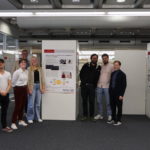
On 30 September, a poster slam on the topic “Digital Future?” organised by the University Library took place. In this context, 13 posters were presented and discussed in short pitches to further advance dialogue between disciplines. Christoph Rass participated with a pitch on developing a dedicated “Digital Humanities and Social Sciences” certificate. Annika Heyen presented the Transfer Project of SFB 1604; Ahmet Celikten and Maik Hoops presented Project A3 “‘You are Gastarbeiter children!’ Science, School and the Production of Figures of Migration”. Lukas Hennies presented the use of digital methods in the project “Deadly Forced Labour in Karya 1943“. Our student assistants Johannes Pufahl and Lea Horstmann presented the projects “Mapping the Co-presence of Violence and Memory in Belarus” and “The Emsland Camps as a Conflict Landscape in Transformation” respectively. The University Library awarded a prize for the best pitch, which Annika Heyen managed to secure!
On 29 September, Imke Selle travelled to Kiel to participate in the conference of the Working Group “History Didactics Theoretical”, which was organised by our colleague Lale Yildirim. Based on precirculated papers, various sections discussed the topic “Historical Education: Prophet or Toothless Observer?”. The central question was how and whether historical education can provide orientation in a crisis-ridden present – shaped by the COVID-19 pandemic, the climate crisis and war in Europe – or whether and to what extent history didactic theory needs to be expanded.
In August, Sebastian Musch gave a presentation entitled The Israel Mission and the Reconstruction of Jewish Communities in West Germany as part of the workshop “Beyond Wiedergutmachung: Unraveling the Legacies of the 1952 Holocaust Reparations Agreement“. The workshop was jointly organised by the Jacob Robinson Institute for the History of Individual and Collective Rights at the Hebrew University of Jerusalem, the Azrieli Center for Israel Studies (MALI) at Ben-Gurion University and the Weidenfeld Institute of Jewish Studies at the University of Sussex.
In September, he then participated in the workshop Methodological Approaches and Research Techniques in Migration and Humanitarian Studies at the Leibniz Institute for Jewish History and Culture – Simon Dubnow and gave a presentation on The transatlantic Migration from Nazi Germany and Global Intellectual History.
History@SFB1604
From 9 to 10 September 2025, the SFB 1604 retreat took place at the castle. On 9 September, the A3 project participated in a workshop with SFB colleagues to exchange further ideas for the book chapters planned for 2026. On behalf of the A3 team, Ahmet Celikten presented the draft of their chapter entitled Situating ‘Gastarbeiterkinder’: Science, School and the Production of Figures of Migration. Following the presentation, a productive discussion session took place.
On 10 September, Christoph Rass and the A3 team provided comments on the ongoing work by Peter Schneck and Laura Zander entitled “Migrancy in Law and Literature: The Figuration of the Migrant as a Subject of Rights”. Furthermore, other projects from Cluster A “Figures” presented their research work, followed by open questions and comments.
Notes
On 13 August, the team of the project “The ‘Emsland Camps’ as a Conflict Landscape in Transformation” – Imke Selle, Lina-Sofie Winkler, Marlene Schurig and Lea Horstmann – met with Jacqueline Meurisch and Sebastian Weitkamp from the Esterwegen Memorial to present to them as cooperation partners the 360° tours of the sites of the 15 former ‘Emsland camps’ – former concentration camps, prisoner camps and prisoner-of-war camps in the Emsland and Grafschaft Bentheim – that were created as part of the project.
Team NGHM was able to present several new publications in August and September:
In September, the essay Virtual Reality und digital literacy in Theorie, Lehre und Empirie. Ein Werkstattbericht [Virtual Reality and digital literacy in theory, teaching and empirical research. A workshop report] by Imke Selle and our Kiel colleague Lale Yildirim appeared in the edited volume Geschichtsdidaktisch forschen. Theorie und Empirie im Dialog [Researching history didactics. Theory and empirical research in dialogue]. The contribution shows through an empirical study that digital storytelling and the acquisition of digital competencies are central prerequisites for historical learning in a digitally shaped culture, and advocates for an expansion of history didactic theories with the concept of “digital historical-cultural agency”.
In the current issue of the journal History & Theory (64/4), the forum “Migration, Translation, Narrative” edited by Julie Weise (University of Oregon, Eugene) and Christoph Rass has appeared, in which nine scholars from Germany and the USA, including literary and cultural studies scholars, historians and representatives of ethnic studies, discuss the concept of translation of migration in interdisciplinary author teams.
Also in September 2025, a contribution on AI-supported analysis of historical sources appeared, in which the Osnabrück NGHM team together with the Pattern Recognition working group at TU Dortmund around Prof. Dr. Gernot Fink presents possibilities for making the so-called CM/1 files from the holdings of the Arolsen Archives machine-readable with the help of LLVMs.
Fabian Wolf, Oliver Tüselmann, Arthur Matei, Lukas Hennies, Christoph Rass, Gernot A. Fink: CM1 - A Dataset for Evaluating Few-Shot Information Extraction with Large Vision Language Models, in: Yin, Xu-Cheng; Karatzas, Dimosthenis; Lopresti, Daniel (eds.): Document Analysis and Recognition – ICDAR 2025, Part II , Cham 2025, pp. 23-39.
Sebastian Musch has reviewed the monograph The Nazi Study of India and Indian Anti-Colonialism: Knowledge Providers and Propagandists in the ‘Third Reich’ by Baijayanti Roy for the American Historical Review.
At the end of September, Team NGHM said farewell to Lina-Sofie Winkler. Lina-Sofie worked on the project “The ‘Emsland Camps’ as a Conflict Landscape in Transformation”. She actively supported the project from the beginning – both in the digitisation of the sites of the 15 former ‘Emsland camps’ and in the further processing of the data into 360° tours. She also actively supported the project doctoral candidate Imke Selle through the transcription and preparation of the conducted interviews.
We thank Lina-Sofie very much for her commitment and wish her all the best for the completion of her studies and her future path!
At the end of September, Julia Lohmann also said farewell from the A3 project team of SFB 1604 “Production of Migration”. Since the beginning of the project, she worked closely with the A3 colleagues and provided valuable support in building and compiling the digital corpus as well as in literature research. Recently, Julia also submitted her master’s thesis, which deals with the figure of the “second generation”, a topic closely connected to the project’s theme.
We thank Julia warmly for her commitment, support and teamwork during her time at SFB 1604 and within the A3 project and wish her all the best for the completion of her master’s degree and her future professional career.
Blog Posts in August and September
- Jessica Wehner and Benjamin Look: NGHM-Tracker (8/2025), 02 August 2025.
- Valentin Loos: Right-wing Populist Politics of History for Destabilising Democratic Systems | Summary of the Essay by Valentin Loos in Historia Prima, 2. 2025, 05 August 2025.
- Imke Selle: Making History Production ‘Playable’ | The “Osnabrück Peace Chess”. The Negotiation of Memory in Game Format, 07 August 2025.
- Manuel Büchner & Leonie Güneri: There and Back Again | Excursion to the ZeitZentrum Zivilcourage Hannover, 14 August 2025.
- Annika Heyen: History@SFB: DOMiD Workshop with Students of History and IMIB, 29 August 2025.
- Team NGHM: Inside.NGHM | Frank Wobig, 08 September 2025.
Outlook & Current Events
The Osnabrück Film Festival is turning 40 this year. On this occasion, the Osnabrück Film Festival will look back on 40 years of cinematic narratives about migration, belonging and identity on 11 October, 3-5 pm, at the Felix Nussbaum House, together with the Institute for Migration Research and Intercultural Studies (IMIS) at the University of Osnabrück and the ThinkTank Migration Policy e.V.
From the “return of guest workers” in the 1980s, through the “baseball bat years” of the 1990s, integration debates of the 2000s, flight migration of the 2010s to transnational identities of the 2020s – the film archive of the Osnabrück Film Festival shows how social discourses and cinematic perspectives have changed.
Discuss together with historian Prof. Dr. Christoph Rass, filmmaker Serpil Turhan, and cultural scholar and cultural practitioner Aurora Rodonò which narratives have been formative, which ruptures and continuities emerge – and how cinema can contribute to reflecting upon and renegotiating Germany’s self-understanding as a country of immigration. The event will be moderated by Vera Hanewinkel (IMIS).
All interested parties are cordially invited. Admission is free.