NGHM WebApp Slam | Students Present Historical WebApps

This post was automatically translated from the German original at
NGHM WebApp-Slam | Studierende präsentieren historische WebApps.
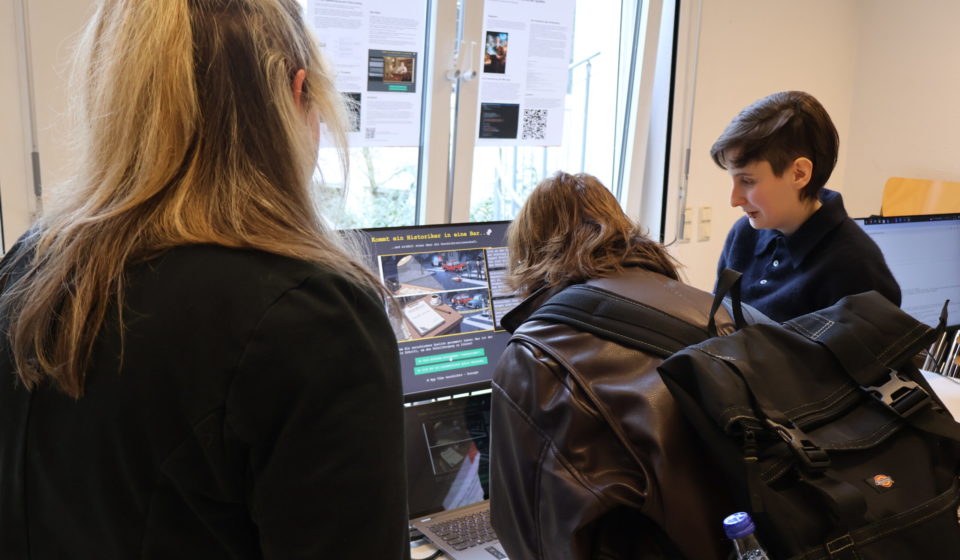
On 21 January 2026, the first NGHM WebApp Slam took place at the Department of History at the University of Osnabrück. Eleven students presented their WebApps on historical topics developed during the winter semester 2025/26 in short pitches. The event concluded the seminar “Digital History Workshop: AI & Personal Information Management for Historians” and simultaneously demonstrated the potential that lies in combining historical research, critical reflection, and digital tools.
Context: Digital History in Teaching
The Chair of Contemporary History and Historical Migration Research has pursued the goal for years of establishing digital methods not as an addition, but as an integral component of historical education. The seminar “Digital History Workshop” led by Prof. Dr. Christoph Rass, Lukas Hennies MA and Jessica-Sophie Wehner, M. Ed. tested a new approach this semester: students without prior programming knowledge were to independently develop WebApps that digitally process and communicate historical content.
At the centre was so-called ‘Vibe Coding’, a method in which generative AI models generate programme code based on natural language instructions. The students worked with various AI tools, including Google Gemini, ChatGPT and AbacusAI, and used platforms such as GitHub and Netlify to publish their projects. Cartographic visualisation was carried out in most cases via the open-source library Leaflet.
Project Overview
The eleven presented WebApps covered a broad thematic spectrum, ranging from antiquity to contemporary history and varying methodologically between simulation, visualisation and analysis tools.
Benjamin Rosenstengel developed “Das war hier einmal anders…oder?” [“That was once different here…or was it?”], an app that returns historical photographs from the archive of the Neue Osnabrücker Zeitung in the Lower Saxony State Archive to their original locations in Osnabrück’s urban space. The georeferenced images enable a visual comparison between historical photograph and current situation. The project deliberately understands itself not as a completed narrative, but as an interface between source, urban space and users.
Sebastian Waldmann presented an AI-supported negotiation simulation of the Peace of Westphalia of 1648. Users slip into the role of the imperial chief negotiator Maximilian von Trautmannsdorf and conduct diplomatic conversations with representatives of France, Sweden and the Imperial Estates. At the end of the simulation, the embedded AI compares the achieved results with the actual historical peace treaty.
Timo Diener dedicated himself to the history of East Frisia and developed an app that visualises waterways, tea culture and the economic history of the region. The map shows historical information about the context of the canals’ creation and connects this with aspects of everyday culture. The project demonstrates how regional history can be made accessible to a broader audience through digital processing.
Felix Ruholl created an industrial atlas for the Vechta district, which traces the emergence of the industrial location from 1920 to today. A movable timeline makes it possible to chronologically follow the establishment of 41 companies from various sectors. The visualisation makes the region’s industrial structural change comprehensible at a glance.
Jannik Singer’s project dealt with a (post-)colonial tour through Osnabrück. The app leads to places where colonial traces become visible in the urban space, including the continental allegories in the palace garden. The application offers both a classic guided tour on site and a digital variant with spoken text passages and planned 3D scans of the objects.
Paul Schwede developed “Analyse History”, a prototype for the digital analysis of historical artefacts. Using the example of objects from the context of the Shoah, including a diary, a yellow Star of David and a tin with marbles, the app shows how three-dimensional digitisations could make historical objects accessible for research and communication.
Alexander Pracht reconstructed the political journeys of Pliny the Younger and Marcus Aurelius in the 2nd century with “Antike Reiserouten” [“Ancient Travel Routes”]. The app links the literary sources with a cartographic representation of the travel stations and offers textual evidence for each location. The project combines source-based work with digital visualisation.
Milena Lummer transformed the Catalan World Atlas of 1375 into an interactive application. The medieval world map can be explored, individual places are provided with information, and the design is oriented towards the aesthetics of the original with jewel markers and parchment appearance. The app shows that historical maps can also be digitally accessed as sources.
Gesa Landwehr presented a simulation of the so-called ‘Calmeyer System’. The app connects to the exhibition in the Villa Schlikker in Osnabrück and makes it possible to follow the bureaucratic process through which Jews could submit amendment applications against their registration during the German occupation of the Netherlands. The project combines museum communication with digital interaction.
Maria del Mar Julian Fernandez developed a narrative dialogue game entitled “Kommt ein Historiker in eine Bar…” [“A Historian Walks into a Bar…”]. In a simulated conversation between a historian and a bartender, central concepts of historical science such as source criticism and hermeneutic understanding are conveyed. The app responds to widespread clichés about the discipline and makes methodological foundations accessible through play.
Marvin Gehricke finally presented the “KI-Historiker” [“AI Historian”], an application for systematic source analysis. The app makes it possible to upload historical sources and have them analysed according to scientific criteria. In addition to a core analysis, it offers various methodological approaches, including synoptic comparison, network analysis and discourse analysis, as well as literature research on the respective topic.
NGHM Reads: A Knowledge Graph for Study
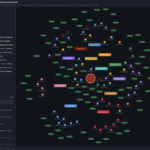
In addition to the student projects, the NGHM team also presented the new application “NGHM liest” [“NGHM Reads”] at the WebApp Slam. The knowledge graph assembles 65 works that are of particular importance for study at the Chair of Contemporary History and Historical Migration Research. The selection includes classic texts of Holocaust and Nazi research, postcolonial theory formation, migration-historical foundational texts and historical-theoretical reflections.
The WebApp, accessible at reader.nghm-uos.de, makes it possible not only to work through the literature linearly, but to explore its connections and contexts. Filter functions by subject areas, difficulty levels and languages open up various approaches. The graph visualises relationships between works, authors and between subject areas and aims to encourage the discovery of cross-connections. All titles are available through the Osnabrück University Library.
Reflection: Potential and Limitations
The presented projects made it clear that ‘Vibe Coding’ actually enables historians without programming knowledge to develop functional WebApps. However, in their poster presentations, the students also emphasised the limitations of the method: the AI-generated codes frequently required multiple revisions, the results were not always reproducible, and longer code sections sometimes led to unexpected errors.
At the same time, several reflections pointed to the necessary critical distance to the technology. AI systems are resource-intensive, their answers are not error-free, and the generated content always requires professional verification. ‘Vibe Coding’ replaces neither historical expertise nor critical thinking. However, it opens up design possibilities that were previously reserved for people with programming knowledge.
The projects showed a broad spectrum of approaches: from source-based reconstruction through playful simulation to analysis tools. What they had in common was that they did not simply digitally reproduce historical content, but created new approaches and interaction possibilities. The deliberately reduced contextualisations in several projects point to a communication concept that aims to encourage users to engage independently with the material.
Outlook
The first NGHM WebApp Slam has shown that the combination of historical research and digital tools can produce productive results when carried out with methodological reflection. The students have not only acquired technical skills, but also gained experience with the critical evaluation of AI-generated content. This competence is likely to become increasingly relevant given the growing importance of generative AI in science and society.
The Chair of Contemporary History and Historical Migration Research will further develop the format of the Digital History Workshops and deepen the methodological reflection on the use of AI in historical science. The projects presented at the Slam understand themselves as prototypes that can provide impulses for further developments. Some of the apps are already accessible online, others are still under further development.