
This post was automatically translated from the German original at
Team NGHM@”Zukünftig digital?” Posterslam am 30. September in der UB Osnabrück.
At the University of Osnabrück, Digital Humanities methods are not only applied in teaching and research in many areas, but are also being developed, tested and made ready for application. In order to further develop the bundling and networking of these approaches and to discuss the question of what infrastructures the social sciences and cultural studies in particular need in the field of Digital Humanities for their work, the University Library has organised a series of events to invite scholars active in this field, representatives of university infrastructure institutions and university management to engage in dialogue.
On 12 May, a workshop with an accompanying poster exhibition already took place.
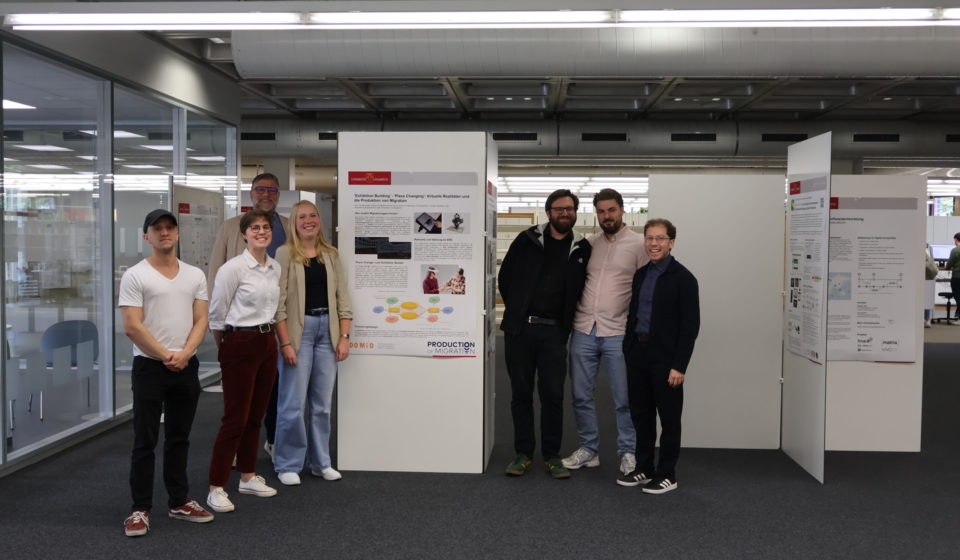
Also participating was the team from the Chair of Contemporary History and Historical Migration Research (Prof. Dr. Christoph Rass), from which a whole series of scholars have been participating for some time in an initiative group that would like to encourage the establishment of a dedicated DH centre at UOS. In the poster exhibition that accompanied the workshop programme, the NGHM working group was represented with contributions that presented the use of DH methods in research projects whilst also presenting ideas for expanding corresponding competencies in research and teaching.
On 30 September, a poster slam organised by the University Library followed. In this context, 13 posters were presented and discussed in short pitches to further advance dialogue between the disciplines.
Team NGHM contributed six presentations:
Lukas Hennies presented the project “Deadly Forced Labour in Karya 1943” and the use of digital methods in this context. He particularly highlighted the involvement of students in the project of digital documentation and prospection.
Can digital methods help to give migrantised people who are underrepresented in the existing museum and research landscape a stronger voice in telling their own stories? This question is being pursued by the transfer project “Reflexive Migration Research in Museums” of the SFB 1604 “Production of Migration”, whose poster Annika Heyen presented as part of the poster slam.
Maik Hoops and Ahmet Celikten presented a poster on SFB 1604 – Production of Migration – Project A3 “‘You are guest worker children!’ Science, School and the Production of Figures of Migration”. In their pitch, they explained among other things the various methods for corpus analysis.
Lea Horstmann, representing Imke Selle, explained the project “The Emsland Camps as a Conflict Landscape in Transformation“. Within the framework of this project, students also received the opportunity to participate directly in university research work through a project seminar and to try out and create digital methods and products.
Johannes Pufahl presented the completed transnational project Mapping the Co-presence of Violence and Memory in Belarus with a focus on the project’s results. These take the form of three digital public history formats, which use various digital methods to address sites of violence in Belarus during the German occupation in World War II as well as their processing and memory culture.
Prof. Dr. Christoph Rass advocated in his poster pitch for the introduction of a Digital Humanities certificate in order to address current technical innovations and potentials in teaching as well and to enable students to acquire competencies in this area.
After the successfully completed poster pitches, a winning pitch was also selected among the 13 contributors. Annika Heyen was able to win the best pitch for Team NGHM. Congratulations!