3D Digitization Hands-On Workshop on 10.11.2025

This post was automatically translated from the German original at
3D-Digitalisierungs Praxis-Workshop am 10.11.2025.
On 10 November 2025, the Contemporary History and Historical Migration Research working group — including Lukas Hennies, Imke Selle, Tim Ott and Johannes Pufahl — conducted a practical workshop on 3D digitisation of small objects together with Henning Wellmann, staff member in the education department of the Arolsen Archives. One of the reasons for this undertaking was the working group’s participation in the Landecker Digital Memory Lab inaugural Expo of the Landecker Foundation at the University of Sussex in July 2025.
The objects from which “digital twins” were created are the personal effects of the former Dutch police officer, Martin van Gent, who was arrested by the German occupiers in 1944 for alleged refusal to serve and deported via the police transit camp Amersfoort for forced labour to Neuengamme concentration camp. Further stations in the Nazi camp system were the subcamps Meppen and Watenstedt. Severely weakened by forced labour and detention conditions, he experienced the evacuation of the concentration camps in freight wagons on the way towards Ravensbrück concentration camp; Martin van Gent was liberated by the Red Army in a subcamp of the same at the end of the war. After several hospital stays, he finally returned to the Netherlands, where however he did not resume his profession as a police officer. He returned to Hamburg in the early 2000s with a group of Dutch young people to help build the Neuengamme memorial site.
The digitisation of objects up to entire buildings has repeatedly been part of the work of the NGHM working group in research and teaching. Already in the Karya project we conducted 3D digitisations, from medium-sized objects such as a railway switch operator or surface survey finds, to documenting the fieldwork through a 3D model of the hand-cut trench. In further projects and teaching courses, the focus was on low-threshold and cost-effective methods, ideally with open-source tools. Particularly suitable for this is Polycam, an app with free access that allows scanning with one’s own smartphone and tablet and is thus also well suited for teaching. An example of successful work with Polycam is the Lehrzeit project, in which students created 3D scans of Osnabrück monuments and memorial sites as part of a teaching course. The results were shown in collaboration with the Chair of Computer Science Education and the Chair of History Education in a digital exhibition with VR environment. The transfer project of the Collaborative Research Centre “Production of Migration” (T-Project) also uses these methods.
The digitisation of very small and small objects, such as buttons, rings or coins, however required a different approach that does justice to the fine details on small objects. While smartphone and tablet cameras are suitable for scanning larger objects, Polycam quickly reaches its limits when scanning small and very small objects, particularly those with metallic surfaces. Operation becomes increasingly unwieldy, fine details are harder to capture by the camera, and the textures do not reproduce the fine nuances of the objects.
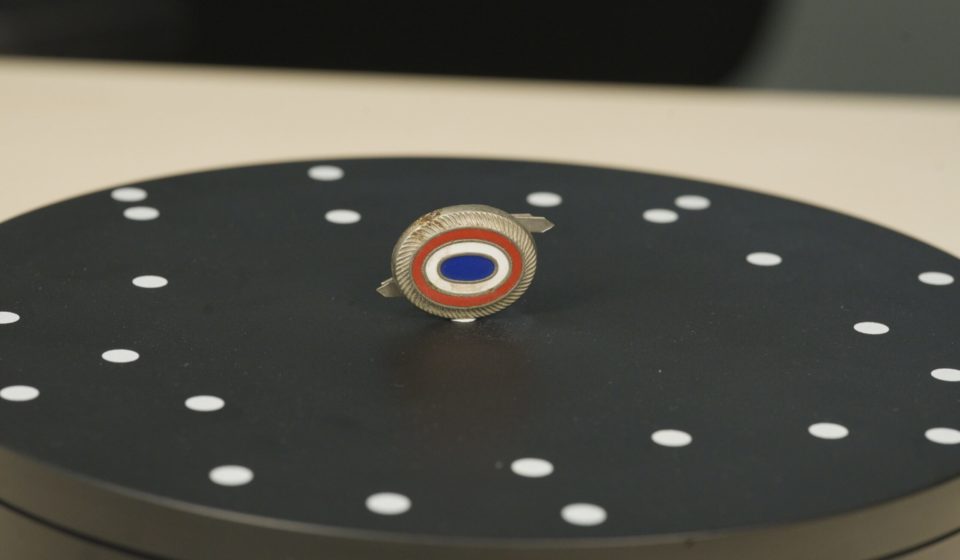
Martin van Gent’s personal effects were only handed over to his half-sister in 2024. The four objects are a cockade as part of the police uniform of the time, two small keys, and part of a ring with skull, presumably a canteen ring that was considered military fashion jewellery in the 1940s. All four objects are both small and rich in detail.
To meet these challenges in digitisation, appropriate technical equipment was first required: while Polycam uses both LiDAR and photogrammetry for digitisation and the processing of models is handled by one’s own device or the app, we relied on photogrammetry with a photo camera and polarisation lens for the “digital twinning” of such small objects. The choice fell on a mirrorless full-frame camera with detachable lens. For sharp and detailed close-ups of small objects, the use of a macro lens was suitable. To compensate for light reflection from metallic objects, we additionally used a ring light with polarisation lens, as well as a corresponding polarisation lens for the camera lens for a cross-polarisation effect. The setup was completed by a suitable turntable, a camera tripod, and LED light stands for appropriate, shadow-free lighting as far as possible.
The processing of the models furthermore requires a powerful computer with appropriate software. The software Metashape by Agisoft was used for processing, post-processing and texture generation. For post-processing and editing, the software Blender is also suitable.
For the photogrammetry work step, the use of the turntable proves extremely helpful. With the camera mounted on a tripod, the distance to the object remains constant, uniform lighting is also ensured, and it is still possible to capture the object with uniform focus through 360°. Adjusting the tripod height allowed several 360° passes around the object from different perspectives. Placing and fixing the objects on the turntable proved challenging, with modelling clay ultimately being most sensible.
The next work step was processing with Metashape, whereby the photos must first be converted into an appropriate format. The software initially processes a point cloud, also calculating the angles of individual photos. Here it can already be determined whether angles, distance and position of the photos were correctly captured. In the next processing step, a mesh model is calculated from this information, which already contains a first, rough texture of the object. The last work step involves creating a high-resolution texture, which is directly laid around the previously processed mesh. The strength of the method particularly shows here: with successful processing, the object possesses a sharp texture, even the smallest details are recognisable. Thus processing is complete and the now created scan can be exported into one of the common formats for 3D objects.
For post-processing or editing via Blender, the objects can be imported with texture and improvements made, particularly at the contact points of the objects.
The applied method allowed multiple scans or digitisation runs to be performed for each object, to select the best final result from these, and ultimately to realise successful 3D digitisations cost- and time-effectively. The four items from Martin van Gent’s possession could be successfully digitised within the framework of the workshop with the Arolsen Archives. The “digital twins” of the objects are now to be used on an emerging online platform of the Arolsen Archives in the education sector.
Special thanks go to the UOS DigiLab and the Institute for Musicology and Music Education for the kind and generous provision of technical equipment!