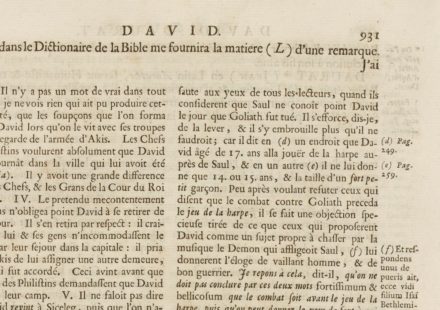
The Footnote Society | or | Following the Reference Wherever It May Lead.

Pierre Bayle's 1697 dictionary famously let footnotes devour the page itself — a radical act with real consequences. A new Osnabrück reading circle traces what that gesture unleashed. — Translated from nghm.hypotheses.org
NGHM-Tracker (9-10/26)
From Oregon archives to Vienna conferences, the NGHM team's August–September double issue spans continents and methods. At the heart: how farmworkers challenged the term "guest worker" — through picket signs, punctuation, and protest. — Translated from…
History@SFB 1604 | The transfer project with its VR experiment “Changing Places” at the Experimentiermeile 2026 at the Ledenhof
What happens to our sense of place when familiar spaces look different? The Transfer Project of SFB 1604 brought its VR experiment "Changing Places" to Osnabrück's Experimentiermeile, inviting visitors to explore the Peace Hall in virtual ... —…
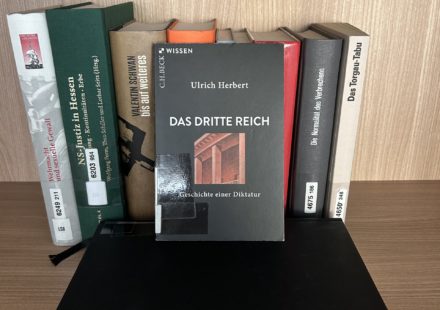
NGHM reads | 16 | Ulrich Herbert: Das Dritte Reich. Geschichte einer Diktatur (2016)
Can a dictatorship spanning twelve years be distilled into 120 pages without losing its complexity? Ulrich Herbert's 2016 survey proves it can. Our latest NGHM reads explores how a leading historian of the field achieves this analytical feat. —…
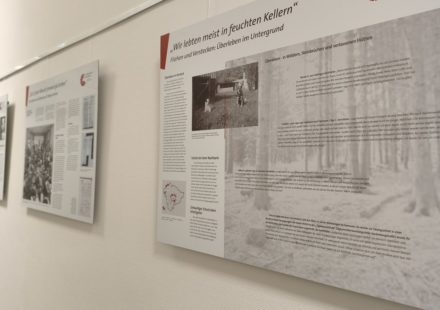
Gaps in the Culture of Remembrance | Between Commemoration and Repression. Panel Discussion on 1 October at the vhs Osnabrück.
Who decides what history remembers — and what it buries? On 1 October, a panel in Osnabrück examines gaps in remembrance culture around the Sinti and Roma genocide and post-1945 racist violence. — Translated from nghm.hypotheses.org
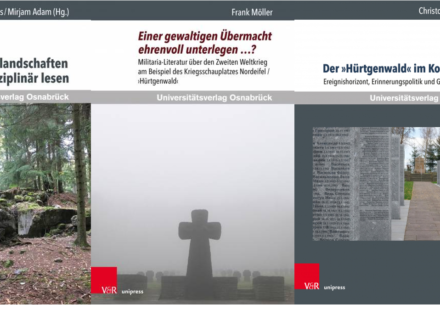
Out Now | Conflict Landscapes Volume 3: The Hürtgenwald in Context.
Volume 3 of *Konfliktlandschaften* examines how the 'Battle of Hürtgen Forest' was constructed as history rather than lived as one. How does an unnamed series of operations become a charged cultural landmark? Read the full post to find out. — Translated…
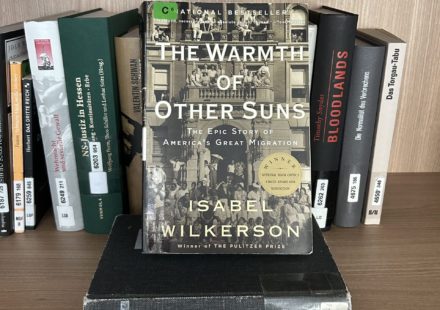
NGHM reads | 15 | Wilkerson: The Warmth of Other Suns (2010)
What moved six million people to leave the South? Isabel Wilkerson tells the story of the Great Migration in The Warmth of Other Suns (2010) through three life stories, reversing the perspective: from factors to agents. Episode 15 of #NGHMliest
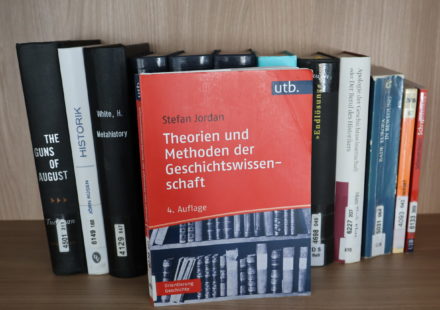
NGHM reads | 14 | Jordan: Theories and Methods of Historical Scholarship (2021)
Stefan Jordan's *Theorien und Methoden der Geschichtswissenschaft* has reached its fifth edition in 2021 — a testament to foundations sturdy enough to absorb twelve years of disciplinary change. NGHM reads it closely. — Translated from…
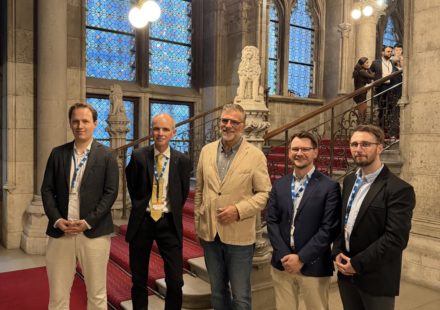
Keynote | ICDAR 2026 Vienna | History and Document Analysis in Dialogue
On 1 September 2026, I delivered the second keynote at ICDAR 2026, the central conference on machine document analysis, held at TU Wien. This report elaborates the argument of that talk: the recognition of historical handwriting is largely a solved…
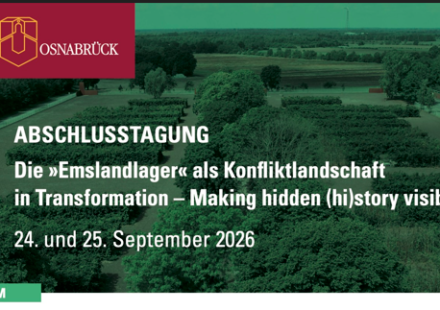
Closing Conference: “The ‘Emsland Camps’ as a Conflict Landscape in Transformation” on 24 and 25 September 2026
How do digitally dispersed histories of National Socialist camp sites become legible again? Our closing conference on 24–25 September 2026 presents new research, digital tools, and pedagogical approaches developed around the Emsland Camps ... —…
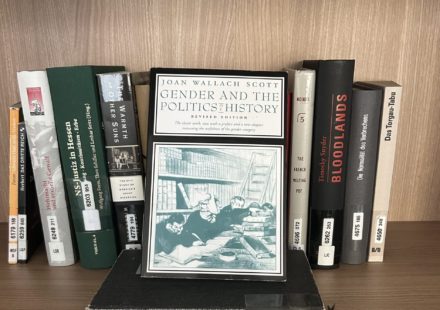
NGHM reads | 13 | Scott: Gender and the Politics of History (1988)
Joan Wallach Scott's Gender and the Politics of History (1988) asks how historical analysis makes power visible. A text that divided the discipline and received the Joan Kelly Memorial Prize a year later. Title 13 on the NGHM reading list.
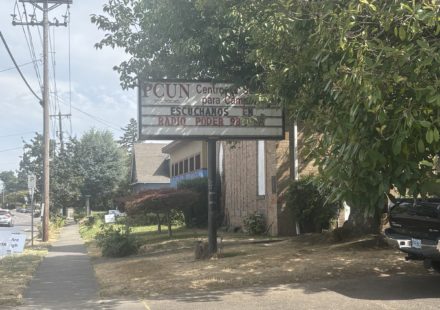
Willamette Dispatch #3 | Who Names Whom? Salem, Woodburn, and Portland.
Third week of the archive journey: Salem, Woodburn, Portland. In the Governor's records, the agricultural workers are referred to as "alien workers" — a legal category and a budget line item simultaneously. In Woodburn, it becomes clear why a separate…
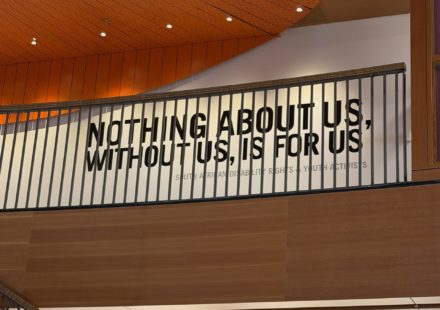
Willamette Dispatch #2 | Second Week in the Extension Service Records, Corvallis.
The second week of my journey took me to Corvallis. The Special Collections and Archives Research Center at Oregon State University holds the records of the Extension Service, the agricultural advisory agency responsible for administering the Bracero…
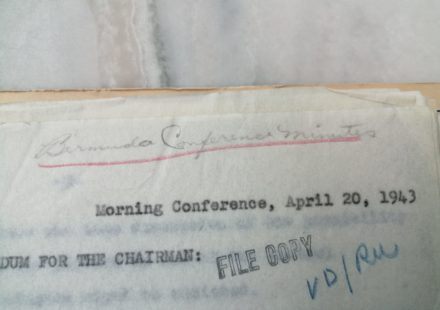
A problem of the present – a conference for the future? The 1943 Bermuda Conference on the “Refugee Problem” re-read from the perspective of a Migration Historian
What happens when a migration historian re-examines the 1943 Bermuda Conference — long studied through a Holocaust studies lens? Annika Heyen's new essay tests how fresh disciplinary perspectives can unlock overlooked dimensions of well-tr... —…
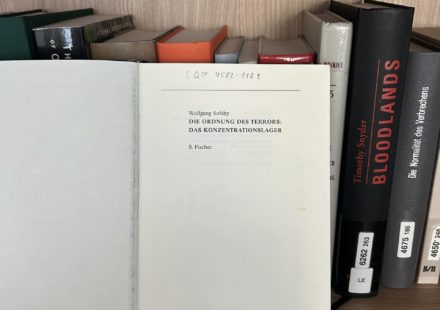
NGHM reads | 12 | Sofsky: Die Ordnung des Terrors (1993)
Sofsky's 1993 sociology of the Nazi concentration camp refuses to treat it as a civilizational rupture — reading it instead as a product of modernity itself. A structural analysis built on survivor testimony that still provokes. — Translated from…
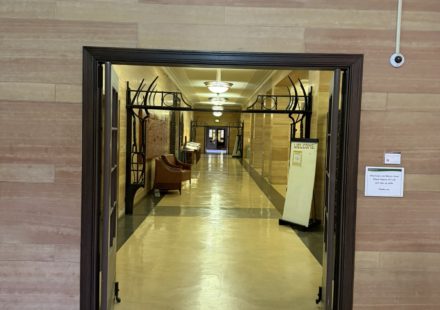
Willamette Dispatch #1 | The Arrival of a Figure. ‘Guest worker’ and ‘bracero’ in the PCUN Records, 1981 to 1997.
In 1981, Senator Alan K. Simpson justifies the choice of terminology by arguing that 'bracero' is offensive; hence the term 'guest worker'. During those same months, a coalition in Oregon maps the new word back onto the old program. First week in the…

History@SFB 1604 | »The Place Changers«: Podcast Recordings at the 180 Grad Wende in Cologne-Kalk.
On 28 July, Christoph Rass and Leonie Stoll recorded in Cologne-Kalk for the SFB podcast "Production Site," together with the association 180 Grad Wende. The episode "Die Place Changer" reverses the usual direction: it is not research that explains…
NGHM-Tracker (8/26)
How do historical categories get made — and what does it mean to read them critically? The July NGHM newsletter traces research across migration history, digital methods, and memory culture, from Paris and Tutzing to rural Georgia in 1943. — Translated…