
This post was automatically translated from the German original at
NGHM liest | Christopher R. Browning: Ordinary Men (1992).
Who were the perpetrators of the Holocaust? Christopher R. Browning’s Ordinary Men, the second title on the NGHM reading list, this time selected from the field of National Socialist history and Holocaust research, offers an answer that continues to unsettle: not demons, not fanatics, but middle-aged Hamburg reserve policemen — family men from the working and lower middle classes who became mass murderers under the pressure of conformity and obedience.
Born in 1944 in Durham, North Carolina, Browning studied history at Oberlin College and completed his doctorate in 1975 at the University of Wisconsin–Madison, where George L. Mosse became an important mentor to him. When he published Ordinary Men in 1992, he was teaching at Pacific Lutheran University in Tacoma and had already established himself as a Holocaust scholar with The Final Solution and the German Foreign Office (1978) and The Path to Genocide (1992). The material on which the book draws comes from a source first made accessible by the West German judiciary: testimonies by perpetrators in interrogation records of the Hamburg State Prosecutor’s Office from the 1960s, in which 210 former members of Reserve Police Battalion 101 spoke about their operations in occupied Poland. Browning read these records not as a jurist inquiring into criminal responsibility, but as a historian seeking to understand how the willingness to kill comes into being.
The book opens with a scene that carries the entire argument. On 13 July 1942, the battalion received orders in Józefów to shoot approximately 1,500 Jewish women, children, and elderly people. The commander, Major Wilhelm Trapp (known to his men as “Papa Trapp”), wept before the assembled troops as he read out the order. He offered to release the older men from participation in the action. Of approximately 500 men, fewer than twelve stepped forward. Trapp himself kept his distance from the massacre.
From this starting point, Browning reconstructs chronologically the battalion’s operations between July 1942 and the “Harvest Festival” massacre in November 1943: at least 38,000 Jewish men and women shot and 45,000 deported to Treblinka. In doing so, he identifies three groups among the perpetrators: a core group of eager killers, a majority who killed dutifully but without initiative, and a small minority who withdrew from participation. In the concluding analytical chapter, Browning draws on social psychological research: Milgram’s obedience experiments explain the mechanism of deference to authority, and in Zimbardo’s Stanford Prison Experiment Browning identifies an explicit parallel to the three perpetrator groups within the battalion. The closing question distills the argument: “If the men of Reserve Police Battalion 101 could become killers under such circumstances, what group of men cannot?”*
The counter-argument came swiftly and was sharply formulated. Daniel Jonah Goldhagen criticized Browning’s interpretation as early as July 1992 in The New Republic and in 1996 advanced a counter-thesis with Hitler’s Willing Executioners: it was not situational dynamics but a specifically German “eliminationist antisemitism” that had driven the perpetrators. Browning had mistakenly portrayed the killers as universally interchangeable “ordinary men.” At a public symposium at the United States Holocaust Memorial Museum in April 1996, both positions confronted each other directly; the scholarly community assessed the debate as largely favoring Browning. Historians such as Hans-Ulrich Wehler, Yehuda Bauer, and Norbert Frei subjected Goldhagen’s book to fundamental criticism. Browning himself responded in 1998 with an afterword in a new edition.
Nevertheless, the debate did not end with this reply. In his review of Richard J. Evans’s Hitler’s People (2024), Neal Ascherson had applied Evans’s findings on ideologically trained volunteers in the Ordnungspolizei to Browning’s research and spoken of a weakening of Browning’s conclusions. Browning responded with a letter to the editor in the New York Review of Books of 26 June 2025, clarifying that Reserve Police Battalion 101 did not conform to the pattern of ideologically pre-selected units but consisted of conscripts called up at a later stage — thereby confirming, rather than refuting, the generalizability of his thesis. Doris Bergen, in the Festschrift Beyond “Ordinary Men” (Thomas Pegelow Kaplan et al., eds., Schöningh 2019), criticized the neglect of gender questions in the analysis of the dynamics of violence. More broadly, it was objected that Browning’s focus on situational explanatory factors risked relativizing the individual responsibility of the perpetrators.
It is precisely these objections that attest to the productivity of the text. Ordinary Men is regarded as a foundational work of modern perpetrator research and has fundamentally shifted the historiography of the Holocaust: away from the demonization of a small National Socialist elite and toward the question of under what conditions “perfectly ordinary” people kill. An international conference marking Browning’s 75th birthday in October 2019 in Münster recognized the book as a milestone in perpetrator research; it is used as teaching material in police training. Those who take seriously Carr’s thesis from the first contribution in this series — that historians are not neutral collectors of facts but active interpreters — will find in Browning a radical case in point: the very same interrogation records that Browning read as evidence for situational perpetrator dynamics, Goldhagen read as evidence for cultural antisemitism. It is not the sources alone that make the debate, but the questions with which historians approach them.
Later in this series, Wolfgang Sofsky’s Die Ordnung des Terrors will pose the question of the mechanisms of violence from a sociological perspective, translating Browning’s historical reconstruction into a different analytical language. Browning’s text nonetheless remains a central point of departure with which perpetrator research has been engaging for more than three decades — not because his answers are uncontested, but because his question is so fundamental.
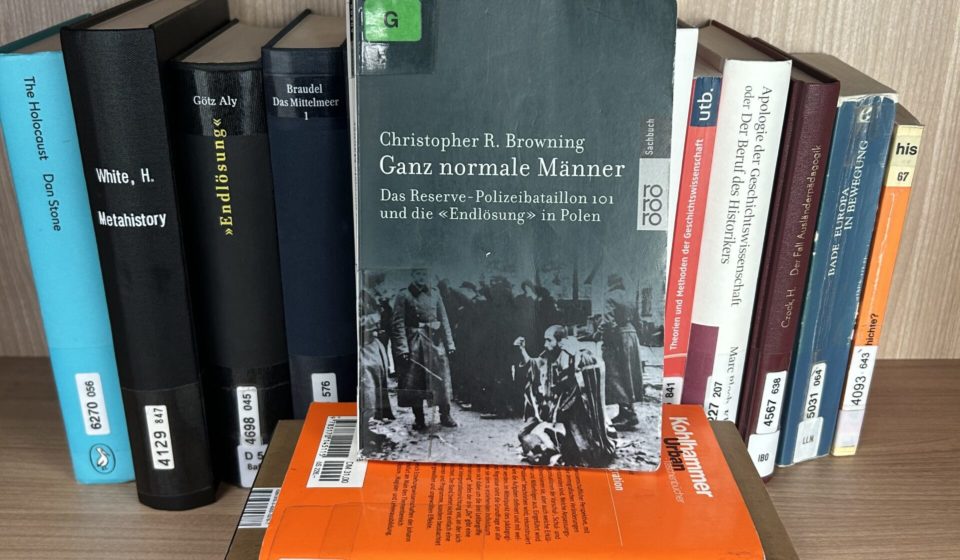
Students in Osnabrück will find Browning’s Ordinary Men in the B-Magazin under the shelf mark 4645-746 8 (OPAC).
Christopher R. Browning (1944–), Ordinary Men: Reserve Police Battalion 101 and the Final Solution in Poland, New York: HarperCollins 1992.
This post is part of the series NGHM liest [NGHM Reads], in which the 65 titles on the NGHM reading list are presented. The list can be explored as a knowledge graph.
*Thanks go to Clemens Villinger for his careful reading & his suggestion for clarifying the post.