IMIS Guests @ NGHM | Summer Semester 2026: Matti Välimäki (Helsinki) and Morten Baarvig Thomsen (Odense).

This post was automatically translated from the German original at
IMIS Guests @ NGHM | Summer Semester 2026: Matti Välimäki (Helsinki) and Morten Baarvig Thomsen (Odense)..
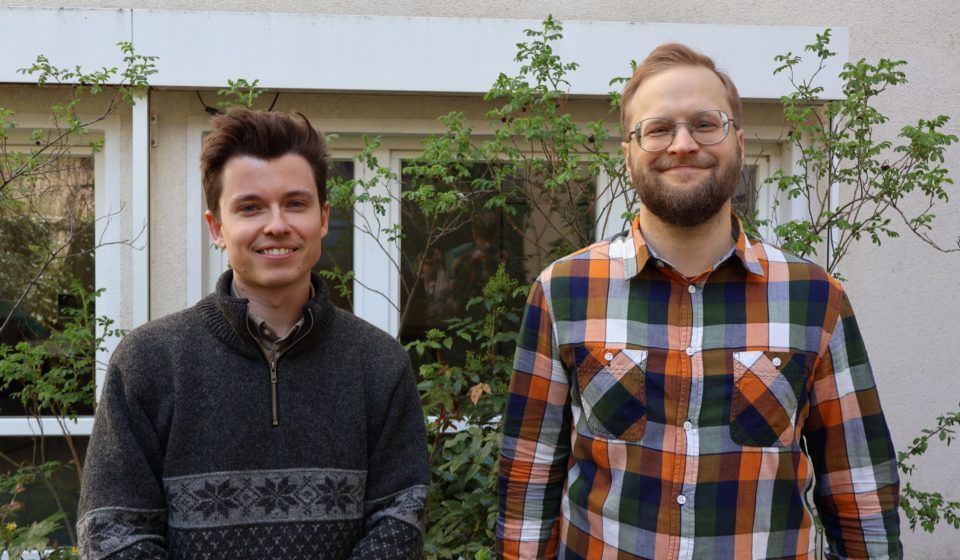
Since early April 2026, two visiting scholars have joined the Institute for Migration Research and Intercultural Studies (IMIS) at the University of Osnabrück as guests integrated into the NGHM Research Group (Prof. Dr. Christoph Rass)
Matti Tapio Välimäki (University of Helsinki) and Morten Baarvig Thomsen (University of Southern Denmark) work in different national archives and on different periods, but their projects converge on a shared analytical terrain: the nation-state’s management of movement, residence, and removal.
Välimäki will present his current work in the NGHM research colloquium on Thursday, 23 April 2026.
Matti Välimäki: The ‘Non-Entry Regime’ as Long-Term Continuity
Matti Välimäki, Associate Professor (Docent) in Contemporary History at the Centre for European Studies at the University of Helsinki, is a visiting scholar at IMIS in April and May 2026. His research sits at the intersection of contemporary history and critical migration studies, with a sustained interest in how Finnish authorities have shaped, discussed, and legislated on non-citizens across the nineteenth, twentieth, and twenty-first centuries.
Välimäki completed his PhD in Contemporary History at the University of Turku in 2019 with a study of Finnish political parties’ positions on immigration between 1973 and 2015 that traced refugee, labour migration, and integration policy across the political spectrum, from the left through the right to the radical right. His subsequent postdoctoral work, pursued at the Universities of Turku and Helsinki and in policy-oriented research at the Migration Institute of Finland and at E2 Research, ranges across the securitisation of migrants and refugees, the history of deportation and deportees, and the discourses and practices of labour migration, including recent work on regional integration policies, international students, highly skilled workers, digital nomads, and Ukrainian refugees.
This trajectory feeds into the collaborative project ‘Gatekeeping the Nation: Deportation at Finnish Borderscapes from the Cold War to Europeanisation’ (GATE, 2023-2027, Research Council of Finland / Suomen Akatemia, University of Helsinki), directed by Miika Tervonen and including Laura Sumari, Louis Clerc, and Välimäki. The project’s core question, how and why removal from a territory has become a central instrument of migration governance, sharpens an older concern of the discipline: the history of migration cannot be written without the history of those whom the state refuses, expels, or renders invisible. The team approaches this question through archives, interviews, and policy documents, tracing shifting practices, discourses, and logics of deportation since the 1950s, and treating removals of non-citizens as a form of selective nation-building that remains non-transparent and largely understudied. Foreign-policy mechanisms, often screened out of migration histories, enter the analysis as a constitutive dimension of deportation rather than as external context.
A thematic line in Välimäki’s recent work, which he will present in the colloquium on 23 April, concerns what he and Tervonen describe as the ‘non-entry regime’ at Finland’s eastern border. The argument is historical rather than presentist. The border closures of the 2020s, usually framed in public debate as an unprecedented response to ‘instrumentalisation’ by Russia, can also be read as an attempt to restore a decades-old arrangement that had structured Finnish-Soviet relations since the late 1940s. That arrangement rested on three mutually reinforcing pillars: a Cold War foreign-policy environment that subordinated asylum questions to bilateral stability; a body of aliens legislation (notably the 1958 and 1983 regulations) that left administrative discretion wide; and, most consequentially, a practice of externalisation through cooperation. Under the 1960 border agreement, Soviet authorities did not allow third-country nationals to approach the Finnish border without a visa or residence permit, so that entry was pre-filtered on the far side of the frontier. Seen through this lens, the public ‘crises’ that punctuate the record, the Cold War ‘defectors’ (loikkarit), the Somali arrivals of 1990-1991, the north-eastern border crossings of 2015-2016, the more recent episodes of ‘instrumentalisation’, appear less as ruptures than as moments at which a quiet, administrative consensus briefly became visible.
Välimäki’s broader output moves between several registers. In the European Review of History, he has recently argued together with Tervonen that modern deportation remains a historiographical blind spot in twentieth and twenty-first century Nordic history, sustained by non-transparent administrative procedures, opaque record-keeping, and the silences produced by the physical act of removing migrants from the territory. A Finnish-language article co-authored with Kivistö and Tervonen reconstructs how ‘voluntary return’ shifted from a refugee right into an instrument of removal policy, blurring the line between consent and coercion that voluntariness is supposed to draw. His work on refugee education, joint with Kaukko and Neuhaus and appearing in History of Education, compares a century of Finnish and Swedish practice and traces how the discourse on schooling refugee children shifted from Christian duty toward rationality, scarce resources, and security.
At IMIS, Välimäki intends to use the weeks in Osnabrück primarily to complete several articles currently in progress, among them two on the Finnish and Central-East European non-entry regimes between the Cold War and Europeanisation, and to advance preparatory work on an ERC Starting Grant project on silences in archives, politics, and administration, a thematic anchor that runs through much of his recent research.
Morten Baarvig Thomsen: Displaced Persons in Denmark and the Experience of Care
Morten Baarvig Thomsen, PhD fellow at the Department of Culture and Language Studies at the University of Southern Denmark (SDU, Odense), is spending 7 April to 26 June 2026 at IMIS. His stay forms part of the international research period that is part of his New Carlsberg Foundation-funded doctoral project (2024-2027) and continues an exchange that began with his guest lecture in the NGHM colloquium in 2025, ‘Danish Post-War Refugee Care’. Before starting his doctorate, Baarvig Thomsen worked as a project researcher at Sydvestjyske Museer (2023-2024) and has published, among other venues, in Fynske Årbøger.
His dissertation, ‘Experiences of the Danish Refugee Care System: Allied Displaced Persons in Denmark 1945-1953’, examines the institutional framework that Denmark established for the approximately 34,000 so-called ‘non-German’ refugees (Allied displaced persons in the Danish administrative vocabulary) who passed through a network of camps between liberation and the closure of the last facilities in the early 1950s. Rather than tracing administrative structures from above, the project asks how this system was produced in daily interaction: between refugees whose legal status oscillated between ‘allied’, ‘stateless’, and ‘to be repatriated’, and Danish employees whose mandate was less clearly defined than retrospective accounts suggest. The theoretical anchoring is explicit. Street-level bureaucracy theory, the history of experiences, and the growing body of work on refugee agency converge in the dissertation to displace the older narrative in which camps appear as uniform waiting-rooms and refugees as passive objects of aid. What emerges instead is a differentiated picture of interaction, negotiation, and quiet resistance within an institution whose documentary self-description rarely admits any of these.
Baarvig Thomsen will use his time in Osnabrück primarily for drafting central chapters of the dissertation and for consultation with colleagues at IMIS and NGHM on questions of source work, on the conceptual handling of the ‘DP’ category, and on comparative perspectives on post-war refugee administration in Northern and Central Europe.
Convergent Questions
The two research agendas meet at a problem that both scholars approach from opposite ends of the state’s machinery of movement: what does it mean, methodologically and historically, to write the history of those whose presence the state admitted only partially to the record? Välimäki traces the refusals, agreements, and silences through which a border was kept closed to asylum seekers for four decades. Baarvig Thomsen reconstructs the interior of a camp system that was itself the residue of a wartime Europe whose displaced populations no nation-state wished to claim as its own. In both cases the archives are not the same, but the challenge is: the administrative record systematically under-represents those it was designed to manage, and the analytical task begins with the recognition of that gap.
That both visits coincide at IMIS this summer term is a productive coincidence. Migration research in Osnabrück gains from Nordic perspectives that treat Finland and Denmark neither as peripheral cases nor as consensual Scandinavian models, but as sites where the contours of European migration regimes were shaped and tested. Whether the comparison that emerges from these months takes the form of a joint publication, a panel, or simply a denser set of questions in each project remains open. That openness is itself the point.