There and Back Again | Digital Excursion to the Neuengamme Concentration Camp Memorial

This post was automatically translated from the German original at
Hin und wieder zurück | Digitale Exkursion zur KZ-Gedenkstätte Neuengamme.
An Excursion Report by Jule Kumbrink
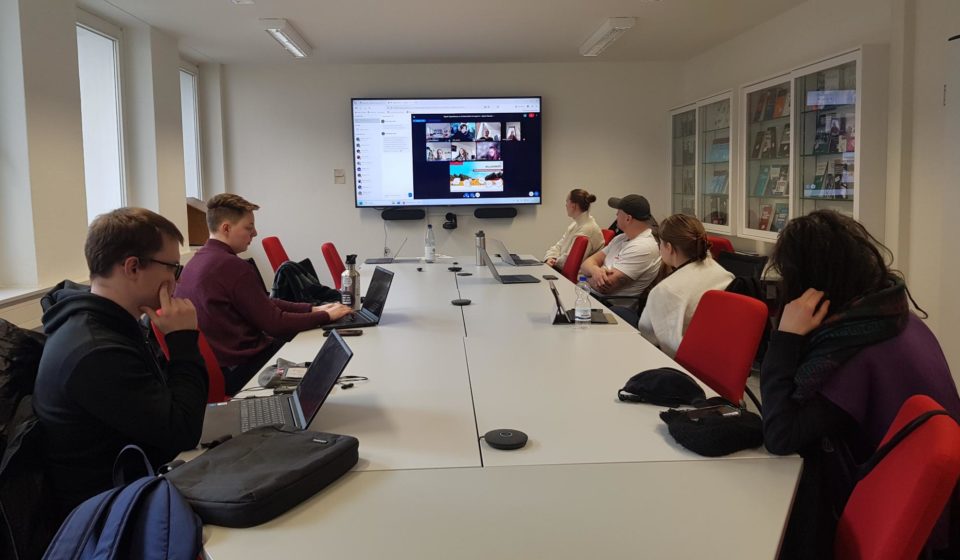
As part of a digital day excursion, a group of students from the University of Osnabrück dedicated themselves on 23 January 2026 to the history and media engagement with the Neuengamme concentration camp. The excursion led by Imke Selle took place under special circumstances: due to the onset of winter with snow and ice, the originally planned format was spontaneously implemented in a hybrid form.
The introduction to the topic was conducted through literary preparation. Working in pairs, students discussed a text by Detlef Garbe1 in which the Neuengamme concentration camp is positioned as the central concentration camp for the northwestern German region. In this context, the historical significance of the site became evident. With over 80 sub-camps and a total number of over 100,000 prisoners, of whom at least 42,900 persons did not survive imprisonment,2 Neuengamme represents a central site of Nazi crimes. The discussion particularly highlighted the close interconnection between the Hanseatic city of Hamburg and the camp regime. The city of Hamburg had been pursuing plans since 1935 for an urban redevelopment of the Altona Elbe waterfront area. Within this framework, the construction of monumental buildings such as a 250-metre-high Gau high-rise and a people’s hall was planned. For this redevelopment, clinker bricks were to be produced in Neuengamme. In 1940, the city concluded a contract with the SS company Deutsche Erd- und Steinwerke GmbH (DESt) for the construction of a large clinker works in Neuengamme. During the excursion, students particularly reflected on the various forced labour assignments to which prisoners in Neuengamme concentration camp were subjected: ranging from heavy earth and canal construction work on the Dove Elbe, to clay extraction and the construction of the clinker works, through to production in armaments factories. These most strenuous physical labours, often with inadequate nutrition, long working hours and brutal supervision, made clear the systematic exploitation and the associated principle of “extermination through work” in Neuengamme concentration camp.
Following this theoretical foundation, the digital tour of the camp took place in the form of a shared 360-degree tour with both a general focus and a focus on Soviet prisoners of war in Neuengamme. This tour makes it possible to comprehend the now extensive and structurally much-altered site in its entirety. A special offering was the tour of the site with virtual reality headsets for students present on location. The use of VR headsets was evaluated as an innovative and exciting offering, but a critical distance was also maintained in the exchange. Students reported that the representations in the headset often appeared larger than life, which rather counteracted the intended feeling of actually being “on site”. This observation illustrates that immersion in memorial site pedagogy does not per se lead to better understanding when visual scaling produces a representation that suggests an aesthetic effect rather than a historically reflected reconstruction.
Students also had the opportunity to set their own priorities within the digital exhibition during an individual tour. The digital exhibition is divided into ten categories, ranging from the history of the site through the daily life of prisoner groups to post-war use and contemporary forms of remembrance. Particularly noteworthy is the interest of many students in the post-war use of the site. The history of Neuengamme after 1945 is characterised by a long phase of repression. After the end of the war, the camp was initially used as an internment camp by British forces, before the Hamburg judicial authorities opened a prison there in 1948. The use as Vierlande correctional facility extended over several decades and considerably hindered the establishment of an appropriate memorial site. The relocation of the prison and comprehensive redesign of the area could only be achieved through pressure from survivor associations such as the Amicale Internationale de Neuengamme and societal change in the 1980s. The excursion group considered this complex post-war history to be a central element for understanding contemporary memorial culture.
The excursion culminated in a cooperative phase in which students worked in groups to examine various exhibition sections in depth and presented their most essential features. The topics ranged from forced labour in brick production through mobilisation for the war economy to detailed examination of German and foreign prisoner groups as well as the system of sub-camps. The presentations impressively demonstrated the field of tension in which Neuengamme concentration camp is to be situated.
It can be concluded that the digital excursion, despite – or precisely because of – its hybrid form, enabled intensive engagement with the site. The combination of theoretical preparation through Garbe’s texts, individual exploration of the 360-degree tour, and critical reflection on technological forms of mediation such as VR sharpened students’ awareness of the complexity of memorial site work. Digital exploration cannot replace the physical experience of the site, but it enables analysis of historical structures that on-site often succumb to the emotional impact of the terrain. A digital visit to Neuengamme camp opens up the possibility of critically analysing historical narratives and their media transmission. In this way, digital exploration can support a reflective approach to memorial work in the digital age.
- Garbe, Detlef: SS-Verbrechen in Norddeutschland. Das KZ Neuengamme, die Gedenkstätte und die Bewahrung der Erinnerung, in: Archiv-Nachrichten Niedersachsen. Mitteilungen aus niedersächsischen Archiven, 5 (2001) S. 73-94. ↩︎
- Stiftung Hamburger Gedenkstätten und Lernorte zur Erinnerung an die Opfer der NS-Verbrechen. KZ‑Gedenkstätte Neuengamme: Geschichte, unter: https://www.kz-gedenkstaette-neuengamme.de/geschichte/. Zugriff: 2. März 2026. ↩︎