
This post was automatically translated from the German original at
NGHM-Tracker (1-2/26).
The monthly newsletter of the Research Group Contemporary History and Historical Migration Research at the University of Osnabrück
By Benjamin Look & Jessica Wehner
After a brief winter break, the Tracker editorial team is back in service for public outreach. In December and January, Team NGHM, together with students and colleagues, used the time to present current projects and research.
Our December and January double issue of the newsletter reports on the diverse activities of the team.
Insights
On 3 December 2025, the first Teaching Day took place at the University of Osnabrück, where various LehrZeit projects presented their innovative approaches to the development of study and teaching. Prof. Dr. Christoph Rass and Imke Selle presented the results of the LehrZeit project “Research, communicate, exhibit. Virtual learning spaces in historical studies”, which was realised together with Prof. Dr. Lale Yildirim (now CAU Kiel) and Prof. Dr. Michael Brinkmeier and tested interdisciplinary teaching formats between history and computer science. Furthermore, Dr. Sebastian Musch, Maria Flores Rojas, Bjarne Groß and Gloria Sherif presented the LehrZeit project “Antisemitism and anti-Muslim racism: Understanding, reflecting, acting”, which also involved Helen Schwenken, Jamila Brüggemann and Mira Hazzaa and developed an integrated teaching concept for the joint analysis of both phenomena.
After the Teaching Day at UOS, there were also some highlights in Team NGHM’s teaching:
On 16 January, Prof. Dr. Christoph Rass, Dr. Sebastian Musch, Dr. Sebastian Huhn, Annika Heyen and Jessica Wehner organised the first day of the block seminar “Words as/of resistance. Thomas Mann and the German listeners”. Also participating was Dr. Anneke Thiel from the University Library, who gave a lecture on Thomas Mann’s life and work.
Between 1940 and 1945, Thomas Mann addressed the German population in Nazi Germany in monthly radio broadcasts via the BBC. These “German listeners!” broadcasts represent a significant source for the history of intellectual resistance from exile. The seminar examines Thomas Mann’s radio speeches as a historical document of the exile experience, as a medium of transnational communication in wartime, and as an attempt at political influence under the conditions of the Nazi dictatorship.
The focus is on questions about the reach and reception of these broadcasts, their function in the context of Allied propaganda, and their significance for German exile history. On 7 March, on the last day of the block seminar, a conference will take place where students will present and discuss their research results.
Another highlight was the NGHM WebApp Slam. This took place on 21 January 2026 at the Historical Seminar of the University of Osnabrück. Eleven students presented their WebApps on historical topics developed during the winter semester 2025/26 in short pitches. The event formed the conclusion of the exercise “Digital History Workshop: AI & Personal Information Management for historians” and simultaneously demonstrated the potential that lies in combining historical research, critical reflection, and digital tools. The following WebApps were presented:
- Benjamin Rosenstengel: “That was once different here… Or was it?”
- Sebastian Waldmann: “Negotiation Simulator – Peace of Westphalia”
- Timo Diener: “An App on the History of East Frisia”
- Felix Ruholl: “Industrial Atlas for Vechta District. A Small Time Journey from 1920 to Today”
- Jannik Singer: “Colonial Traces in Osnabrück”
- Paul Schwede “Analyse History”
- Alexander Pracht: “Ancient Travel Routes. Political Journeys in the 2nd Century”
- Milena Lummer: “From Parchment to Pixel. A Digital Edition of the Catalan World Atlas”
- Gesa Landwehr: “A Simulation of the ‘Calmeyer System'”
- Maria del Mar Julian Fernandez: “A Historian Walks into a Bar…”
- Marvin Gehricke: “AI Historian”
- Team NGHM: “NGHM Reads”
In the last seminar week, the NGHM teaching staff, together with the students, used the opportunity to discuss upcoming research projects. In the proseminar “‘Uprooted from their homes’ – Managing war-induced migration through the International Refugee Organization (IRO)”, led by Lukas Hennies and Jessica Wehner, 30 students presented their research proposals for their term papers. From Team NGHM, Valentin Loos, Jonathan Roters, Hannah Foth and Eduard Usov also came to engage in conversation with the students.
To conclude the seminar “Antisemitism and racial ideology in National Socialism” by Sebastian Musch, a student workshop took place on 29 January, in which the seminar participants presented in lectures the topics they had developed during the semester. The range of topics extended from Nazi educational policy to philosophical and intellectual historical approaches in Georg Mosse and Hannah Arendt. From the working groups, Imke Selle, Annika Heyen and Ahmet Celikten participated as discussants.
On 30 and 31 January 2026, the concluding conference of two courses, led by Dr. Aliaksandr Dalhouski and Dr. Dr. Valentin Schneider, took place at the University of Osnabrück, in which students analysed primary sources on the history of the Holocaust during the winter semester 2025/26. The conference brought research on crime scenes in Belarus and Greece into comparative dialogue. The students now presented their results within the framework of a joint concluding conference that brought together both courses in a comparative approach.
Exchange took place not only locally in Osnabrück, but two excursions were also scheduled for January:
In January 2026, two excursions to the Neuengamme Concentration Camp Memorial were conducted under the leadership of Imke Selle. During an in-person excursion on 16 January, participants gained insights into the history of the concentration camp as one of the largest forced labour camps in northern Germany as well as into central questions of memory culture through a guided tour. Besides the victim perspective, aspects of perpetration and post-history were also addressed, as well as the special exhibition on the camp SS, whose integration into memorial work is controversially discussed. Complementing this, a digital excursion took place on 23 January, which enabled a deeper engagement with further exhibition areas of the fully digitalised memorial through audio tours and 360° tours.
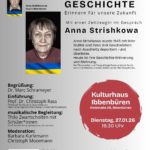
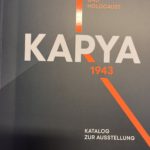
A two-part day excursion led to the Bürgerhaus Ibbenbüren on 19 January 2026, where students from the Chair of Contemporary History and Historical Migration Research participated in a film screening. The documentary “Black Sugar – Red Blood” by Luigi Toscano about the life of Auschwitz survivor Anna Strishkowa was shown. On 27 January 2026 – the 81st anniversary of the liberation of Auschwitz – the Catholic School Chaplaincy Ibbenbüren invited to the commemoration event “Voice of History – Remembering for our Future” at the Kulturhaus. The focus was on the encounter with Anna Strishkowa, a survivor of the Auschwitz-Birkenau concentration camp, who was born in 1939 and was registered at the Birkenau ramp as a nearly four-year-old child in December 1943. Prof. Dr. Christoph Rass provided the historical introduction – an occasion to reflect on the interface between historical studies and memory work.
On December 15, Christoph Rass, Lea Horstmann, Johannes Pufahl, Tim Ott and Annika Heyen visited the initiative “180 Grad Wende” in Cologne as part of the transfer project “Reflexive Migration Research in Museums” of the Collaborative Research Centre 1604 “Production of Migration”. Under the motto “Leave no one behind: Creating opportunities together”, the association works with projects on orientation, democracy promotion, prevention and empowerment for equal opportunities for young people from marginalised communities, particularly in the districts of Kalk and Mülheim. The T-Project team members spent the first part of their visit at the “180 Grad Wende” premises, speaking with managing director Mimoun Berrissoun and Numan Özer, responsible for overall project management, about the initiative’s work, their personal motivations for engaging with young people, and the goals the association pursues. Subsequently, Nouman Özer led the team through the well-known Keupstraße in Cologne Kalk, where Lea Horstmann, Johannes Pufahl and Tim Ott used a 360° camera to take recordings to develop an interactive tour. Video interviews with residents, members of the “180 Grad Wende” association as well as supplementary materials addressing life in the district, particularly for young people, will later be embedded in this tour. In the second part of the visit, the team members spoke with Alparslan Korkmaz, who supports young people at the so-called “Wendepunkt”, a counselling centre of the “180 Grad Wende” association in Mülheim, in acquiring knowledge to act effectively in their daily lives. The conversations with the association laid the foundation for further possible collaborations, for example with regard to the “Exhibition Builder” module of the SFB 1604 transfer project, for which the team members are currently seeking committed civil society groups.
On January 20, 2026, Christoph Rass spoke about the potential and challenges of artificial intelligence for historical studies as part of the lecture series “Teaching and Learning in the Digital World” at the University of Osnabrück. The central thesis of the contribution: AI does not change what history is. However, it forces us to articulate more clearly what historical competence constitutes. Based on Michel-Rolph Trouillot’s theory of the four moments in which silence enters historical production, the lecture developed the concept of a “fifth moment” – algorithmic silencing. Training data on which language models are based reproduce existing power relations. The algorithms that select and synthesise information can reinforce existing silencings by reproducing hegemonic narratives and further marginalising marginalised perspectives.
In December, the Association for History and Regional Studies of Osnabrück reported on its blog about the publication of the latest volume of the Osnabrücker Mitteilungen. In this year’s edition, the Contemporary History and Historical Migration Research working group is represented twice with Valentin Loos and Simon Hellbaum. The two contributions address central questions of social exclusion, domination and counter-action in the 20th century and are simultaneously closely connected to current methodological debates in contemporary history research. On January 15, 2026, the official presentation of the latest edition of the Osnabrücker Mitteilungen took place at the Museumsquartier Osnabrück. Three selected contributions were presented during the event, including the essay “Resistance in Osnabrück – Osnabrück in Resistance. Perception and Assessment of Regional Nazi Resistance” by Valentin Loos. The publication of what is now the 130th volume attracted great interest and stimulated lively discussions that continued in a relaxed atmosphere after the event.
To conclude the semester, our fifth Tiny Desk Colloquium traditionally took place on January 29. This semester, the TDK connected to our focus theme in teaching “The Holocaust and its Consequences – Regional and International Perspectives”.
Participants included Julia Lohmann, Gesa Landwehr and Jannik Singer, who presented student projects.
In the second block, Martina Sellmeyer, Dr. Sebastian Musch and Annika Heyen, who stepped in at short notice for the ill Dr. Michael Gander, gave presentations. A detailed report on the TDK will appear shortly on our blog.
History@SFB1604
On January 22, Max Schellbach visited our Contemporary History and Historical Migration Research colloquium. Max is employed as a research assistant and doctoral candidate at the “Historical Education Research” chair of Prof. Till Kössler at the University of Cologne and presented exciting results from his doctoral project “Leisure as a Problem. Migrant Youth and the Transformation of Urban Youth Work in German-British Comparison (1970-1990)” under the title “The Struggle for Integration. ‘Foreign’ Youth and Munich Youth Work in the 1970s and 1980s”. Given the shared research field – the nexus of education and migration from a historical perspective – the exchange with Max is particularly beneficial for the project staff of SFB project A3, who were invited to the Historical Education Research colloquium in Cologne in November in return. We look forward to further exchange with Max in the future.
At the end of January, we bid farewell to Rosalie Nele Seyde and Eduard Usov, who worked in the SFB project A3 team for almost two years and performed valuable work in building the digital source corpus, literature research and the use of the analysis software MAXQDA. While Eduard is leaving the A3 team, he remains with SFB 1604 and will support the C1 team with his work in the coming months. Rosalie, meanwhile, is close to completing her bachelor’s degree. We thank them both warmly for their commitment and good collaboration during their time in our team and wish them both all the best for their further studies and professional careers.
Notes
Several publications by team members appeared in December:
The article “Disputed (Non-)Belonging: Migrant Agency in the European Displacement Crisis 1945–56” by Christoph Rass together with Jessica Wehner appeared online first on December 1, 2025 in the Journal of Contemporary History (JCH 2025). The study examines how “Displaced Persons” marked as “Muslim” strategically navigated the categorisation practices of UNRRA, IRO and local authorities between 1945 and 1956, challenging institutional practices through their own agency.
The article analyses three dimensions of migrant agency: recognising contradictions in institutional classifications, strategically manipulating these categories to avoid forced repatriation, and the cumulative influence on institutional practices through individual and collective actions. The study thus expands the perspective on the production of migration policy categories to include analysis of the agency of those people who were made into marginalised groups through such categories, and shows how precisely processes of categorisation and exclusion could paradoxically open up spaces for agency.
On 3 December, the essay ‘An apparently indissoluble clot of unwanted humanity’. ‘Non-European’ Displaced Persons in Postwar Resettlement by Jessica Wehner was also published in a special issue of “Diasporas. Circulations, Migrations, Histoire”. In her contribution, she addresses the fate of around 800 Kalmyk Displaced Persons who were denied resettlement to Paraguay in 1951. Using sources from the International Refugee Organization and the Arolsen Archives, this article shows how their portrayal as “Asians” and descendants of Genghis Khan shaped public discourse and migration policy. These categorizations hindered their emigration, despite their efforts to present themselves as “Europeans”. The case illustrates how postwar humanitarian policy was deeply intertwined with racist and cultural prejudices and influenced who was considered ‘assimilable’ and worthy of a new homeland.
In volume 130 of the Osnabrücker Mitteilungen, Team NGHM was represented twice. Simon Hellbaum (formerly Team NGHM) examines in his contribution the Osnabrück homeless shelter ‘Papenhütte’ as a site of social marginalisation and municipal order policy in the 20th century. Based on extensive archival research, he shows how homelessness was negotiated in administration, public sphere and urban planning, and how categories such as ‘antisociality’ and ‘worthiness’ of welfare became entrenched. The spatial concentration of homeless people on the margins of the urban area appears as a deliberate strategy of social exclusion. For the period of National Socialism, Hellbaum demonstrates how existing practices of stigmatisation were radicalised and integrated into the system of racist persecution. The essay makes clear how strongly long-term continuities of municipal social policy can be traced across political caesuras. A detailed examination of the ‘Papenhütte’ in its complete history can be found in the NGHM online exhibition.
Valentin Loos addresses in his contribution the question of what can actually be understood as ‘resistance’ against National Socialism in the local context. Starting from the controversial debates about narrow and broad concepts of resistance, he analyses how resistant action is constructed in a source-dependent manner using the Osnabrück Gestapo card index. The essay shows that different definitions of resistance lead to significantly divergent findings – both regarding the quantity and the social composition of the actors identified as resistant. Particularly convincing is the connection of theoretical reflection with a data-based evaluation of a central complex of sources of National Socialist rule practice. Loos thus advocates for a self-reflexive approach to concepts of resistance and simultaneously makes an important contribution to research on NS rule and persecution at the local level.
At the end of December, Team NGHM said farewell to our student assistant Gero Leege after more than five years of collaboration. As a student assistant in the core team, Gero supported the professorship in all important tasks – teaching, publications, event organisation. In the team, he repeatedly engaged as a spokesperson for the student assistants. Since January 2026, he is now pursuing his PhD in an Ancient History project at the University of Osnabrück. We thank Gero for his years of collaboration and wish him all the best for his doctoral project!
Blog Posts in December and January
- Jessica Wehner and Benjamin Look: NGHM-Tracker (12/25), 1 December 2025.
- Team NGHM: Research Revisited: NGHM Publications on the Production of Figures of Migration 2024/25, 3 December 2025.
- Johannes Pufahl and Lukas Hennies: 3D Digitalisation Practice Workshop on 10.11.2025, 8 December 2025.
- Imke Selle: NGHM Engaged | The Day of Teaching and the Relevance of Historical Studies, 11 December 2025.
- Imke Selle: There and Back Again | Excursion to the Esterwegen Memorial, 17 December 2025.
- Team NGHM: Inside.NGHM | Eduard Usov, 6 January 2026.
- Team NGHM: Announcement: Tiny Desk Colloquium on 29 January 2026: The Holocaust and its Consequences – Regional and International Perspectives, 8 January 2026.
- Valentin Loos: Osnabrücker Mitteilungen Vol. 130 Published | Team NGHM Represented Again, 10 January 2026.
- Team NGHM: NGHM WebApp Slam on 21 January 2026, 12 January 2026.
- Christoph Rass: NGHM Reads | A Knowledge Graph with Literature Recommendations for Studies at the Professorship for Contemporary History and Historical Migration Research at UOS, 21 January 2026.
- Team NGHM: NGHM WebApp Slam | Students Present Historical WebApps, 23 January 2026.
- TEAM NGHM: Digital Teaching and Learning | Contribution to the Lecture Series of the UOS Centre for Teacher Education, 26 January 2026.
- TEAM NGHM: Ibbenbüren Excursion (I) | Film Screening “Black Sugar – Red Blood” and Meeting with Anna Strishkowa, 26 January 2026.
- Christoph Rass: NGHM Students Present Their Research | Holocaust and Occupation in Belarus and Greece., 28 January 2026.
- Team NGHM: There and Back Again | Voice of History – Commemoration and Historical Studies in Ibbenbüren, 29 January 2026.
Outlook & Current Events
From 17-19 March, the departments “Medieval History” (Prof. Dr. Christoph Mauntel) and “Contemporary History and Historical Migration Research” (Prof. Dr. Christoph Rass) are offering a joint excursion to Nuremberg.
Nuremberg was not only one of the most important trading cities of the late Middle Ages, but also one of the most important imperial cities of the Roman Empire. The National Socialists drew on this tradition, among others, when they developed Nuremberg into the “City of the Reich Party Rallies”.
The excursion aims to examine Nuremberg’s legacy between the Middle Ages and National Socialism. Programme points include a visit to the current exhibition “Nuremberg Global: 1300-1600” and the Documentation Centre Nazi Party Rally Grounds.
Interested students can register for the excursion from 9 February onwards.