
This post was automatically translated from the German original at
Hin und wieder zurück | Exkursion zur KZ-Gedenkstätte Neuengamme.
An Excursion Report by Leonie Güneri
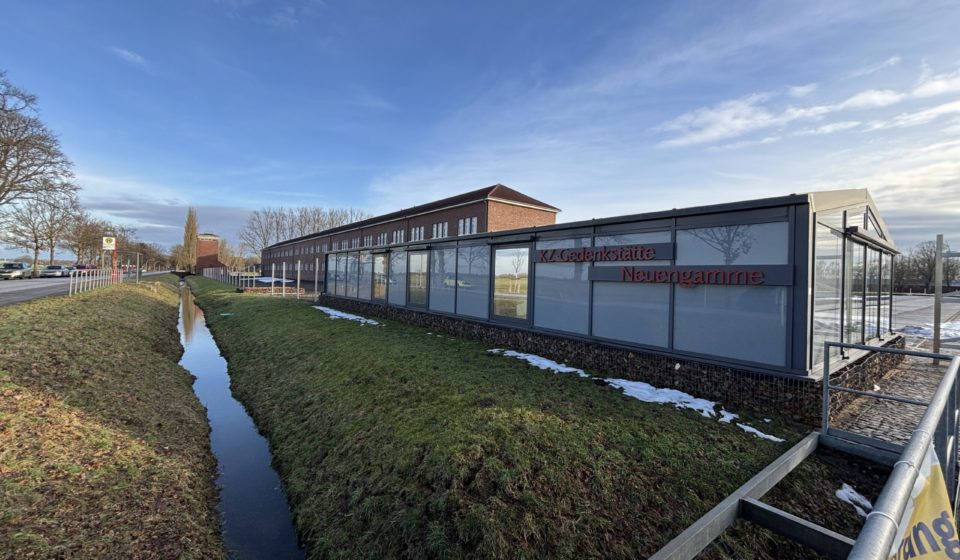
On 16 January 2026, a day excursion to the Neuengamme Concentration Camp Memorial in Hamburg took place under the leadership of Imke Selle. In preparation, the students had already received an initial thematic introduction through a preliminary discussion, which had to take place digitally due to the sudden onset of winter weather. Background information about the concentration camp memorial was provided here.
Neuengamme Concentration Camp was one of the largest forced labour camps in Northern Germany. More than 100,000 people were imprisoned there, at least 42,000 of them lost their lives. Due to various historical developments, decisions and external circumstances – as is the case with many former concentration camps – only few original structural remains are preserved today. Nevertheless, the memorial succeeds in conveying the history of the site in a vivid and comprehensible manner through comprehensive exhibitions and professional guided tours.
Our visit began with a somewhat early arrival, which allowed for an initial independent and brief overview of the site. The official guided tour then commenced. At the beginning, our guide explained fundamental information about the history of the concentration camp as well as the structure of the site. The tour was clearly structured and thematically diverse. Particularly noteworthy is that our questions were answered thoroughly and with great care, and various aspects – including perpetratorship, victim perspectives and memory culture – were related to one another. Due to limited time, however, some exhibition areas could not be covered in full depth. This is to be addressed in a second, digital excursion, which will enable a more intensive engagement with the exhibitions of the concentration camp in Neuengamme.
Neuengamme Concentration Camp existed from 1938 to 1945 and was operated by the SS as their own enterprise. The main purpose of the camp was forced labour, particularly the production of bricks. After the end of the Second World War, the British military administration initially used the site as an internment camp and later it was used by the city of Hamburg as a prison. This subsequent use is the subject of critical examination in research and memorial work. Only in 1981 was a first exhibition established on the site to commemorate the National Socialist crimes.
It is interesting to note that Neuengamme Concentration Camp has no official liberation day, as the camp had already been evacuated by the time of liberation and was found “swept clean”, as our guide described it. 3 May – on which the liberation of the camp is remembered today – is not an official liberation day of Neuengamme Concentration Camp, but is rather observed as a combined memorial day that commemorates both the capitulation of the city of Hamburg and the victims of the evacuation transports, during which the remaining concentration camp prisoners were taken to ships in Lübeck Bay and lost their lives as a result of bombardments and catastrophic conditions.
In the early years after the establishment of Neuengamme Concentration Camp, predominantly male prisoners were incarcerated in Neuengamme. More than half of them came from Eastern and Central Eastern Europe, large groups came from France, the Netherlands, Belgium and Denmark. Reasons for arrest were resistance against German occupation, punishment of forced labourers, and deportation as hostages and victims of “retaliation actions”. From 1941, Soviet prisoners of war also came to Neuengamme Concentration Camp. This illustrates the extent to which National Socialist war and economic policy was based on forced labour.
The tour also referred to the mass murder of Soviet prisoners of war: In two operations, the SS murdered hundreds of Soviet prisoners of war with Zyklon B in the camp prison (the so-called “arrest bunker”), after the arrest cells had been converted into a makeshift gas chamber for this purpose. This represents the only verifiable gassing in Neuengamme Concentration Camp. The exposed ground plan or foundation of the former arrest bunker marks this site today as a place of remembrance.
The daily life of the prisoners was characterised by hunger, disease and extremely hard physical labour. Particularly burdensome were the daily roll calls, during which the prisoners had to stand still for hours. This practice represented a considerable physical and psychological burden. Furthermore, the prisoners were employed in brick production as well as in the manufacture of war materials.
The exhibitions form a central component of the memorial; in total there are five thematically different areas. They are dedicated to the historical traces of Neuengamme Concentration Camp as well as its aftermath. One of the exhibitions addresses the role of the Walther Works (a weapons manufacturer) and their entanglement in the system of forced labour. In addition, there is an exhibition on the former brick works, which makes the working and production conditions in the camp comprehensible. Another exhibition deals with the structural remains of the correctional facility built by the city of Hamburg in 1970 and its later use of the site. The conclusion is formed by an exhibition about the former SS service office as well as the camp SS, which examines the perpetrators. The exhibitions focus predominantly on the representation of the victims of the Nazi regime. However, it should be emphasised that there is also an exhibition that deals with the perpetrators. This perspective is sometimes controversially discussed, but contributes to illuminating responsibility structures and different degrees of participation in National Socialism in a more differentiated manner. The design of the exhibition in the former SS garages is deliberately simple and restrained, in order to clearly focus on the victims while still making different perspectives visible. At the same time, possible future restructuring of the memorial was discussed. In particular, there is discussion about integrating the exhibition on the camp SS more strongly into the main exhibition. However, this consideration is evaluated differently, as many fear that the perspective of the victims could thereby be pushed into the background.
During the tour, the question repeatedly arose as to what extent the population of the village of Neuengamme was informed about the concentration camp. It became clear that the people in the village were indeed aware that a camp was located in the immediate vicinity – albeit not to the full extent and with the knowledge that exists today about its crimes. According to our guide, the residents associated the site more with the later established correctional facility than with the concentration camp.
At the same time, it became apparent that the social processing of this past remains difficult to this day, as many individuals and institutions only hesitantly engage with their historical responsibility. This problem can be seen exemplarily in the case of the Walther Works, which profited from forced labour without later comprehensively taking responsibility for it.
This underscores how important memorials continue to be in keeping memory alive and enabling continuous engagement with history.
In addition to the five exhibitions on the history of the site, the former brick works represents the best-preserved and at the same time most impressive historical location within the memorial. It conveys particularly vividly the dimensions of forced labour and suffering associated with Neuengamme. The final thematic focus of the tour was therefore the walk through the former brick works. It was precisely here that it became clear once again how differently students or pupils perceive and interpret memorials like Neuengamme. Triggered by a fellow student’s question, a joint reflection opened up about individual perspectives, expectations and different forms of engagement with such a historical site.
At this point, our guide once again impressively illustrated the inhumane conditions of forced labour as well as the extent of violence and arbitrariness to which the prisoners were subjected by the SS. It became clear again how difficult these experiences are to comprehend today, but also how necessary historical processing remains despite this distance.
The conclusion of the tour was formed by the commemoration of the victims of Neuengamme Concentration Camp. On white fabric panels in the House of Remembrance, the names of those murdered in the camp are recorded. There are also various memorial objects, presumably placed by relatives of the victims, which make their personal remembrance visible. The names were reconstructed and made visible from various surviving historical sources, in order to give the victims back their identity and rescue them from oblivion. We concluded our visit to the memorial with this impressive moment.
The numerous questions that arose from our group during the course of the tour illustrate how multifaceted and complex an appropriate culture of remembrance is. At the same time, it became clear what challenges memorials face: they must constantly weigh up how they want to convey history and what priorities they set. This raises fundamental questions such as: What should be made visible and what remains in the background? How can one do justice to the victims without simplifying historical contexts? And how can remembrance be designed so that it both touches emotionally and critically stimulates reflection? What can we do to support the culture of remembrance?
Overall, the excursion impressively demonstrated how important visiting historical memorial sites is for understanding National Socialist crimes. The site of Neuengamme, as one of the largest concentration camp memorials in Germany, illustrated not only the extent of violence and exploitation, but also the ongoing challenges of social processing. The visit contributed to understanding history not as abstract past, but as concrete and still relevant and emotional responsibility.