
This post was automatically translated from the German original at
Out Now | Zwei neue IMIS WP zur ›Produktion von Migration‹.
‘Guest Workers’ in the Nazi Press (1933–1945)
The series of IMIS Working Papers has been expanded by two contributions that address a common question from different perspectives: How do language, knowledge, and categories produce those social orders or phenomena that we negotiate as ‘migration’?
Both texts originated at the Chair for Contemporary History and Historical Migration Research at the University of Osnabrück and connect to the work in the Collaborative Research Centre 1604 ‘Production of Migration’. They take up two strands that have shaped the work of the NGHM research group for years: the conceptual history of key categories in migration politics and the critical analysis of those knowledge orders that determine how societies negotiate belonging and exclusion.
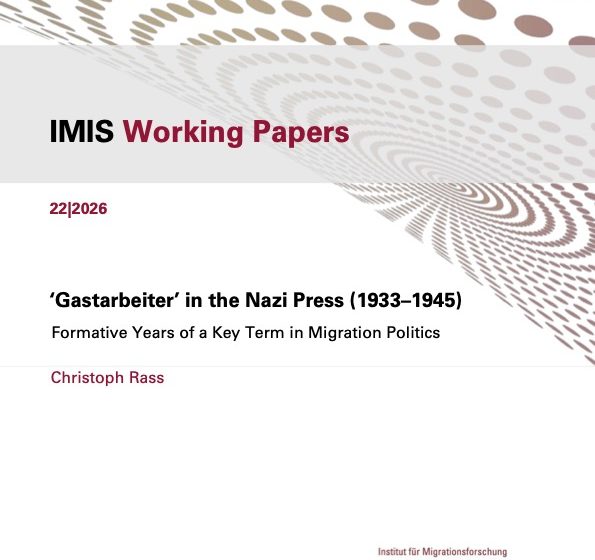
IMIS Working Paper 22, ‘Gastarbeiter’ in the Nazi Press (1933–1945). Formative Years of a Key Term in Migration Politics, turns to a hitherto insufficiently researched phase in the history of a term that the NGHM research group has been investigating for over a decade.
The conceptual history research line began in 2012 with the essay Fremdarbeiter, Ostarbeiter, Gastarbeiter (Rass/Amenda) and the study on bilateral State Treaties and ‘Guest Workers’ in the Migration Regime of the ‘Third Reich’. Building on Christoph Rass’s habilitation thesis on migration contracts in Europe published in 2010, this was followed by IMIS Working Paper 17 (2023) on the transatlantic migration of the term into English and the essay Migrating Concepts in the American Historical Review (2024, with Julie M. Weise), awarded by LASA 2025, on the European origins of the US-Mexican Bracero Program.
The new Working Paper now closes a gap in this research line: the phase between the coining of the term by Max Weber and its reuse in the Federal Republic from 1961. The study draws on two of the largest available historical newspaper databases – the Newspaper Portal of the German National Library and zeit.punktNRW – and identifies several hundred articles in the combined corpus in which the term was used between 1933 and 1945.
Before the text analyses the Nazi press, it first undertakes something unexpected: a genealogical reconstruction of the semantic prehistory of the compound. Already Kant’s distinction in Toward Perpetual Peace (1795) between the universal ‘right of visitation’ of the stranger and the conditional ‘right of hospitality’ established a conceptual architecture that separated presence from belonging. Georg Simmel’s figure of the ‘stranger’ (1908) gave this liminality sociological depth. Max Weber then condensed these layers of meaning into a single compound. While older terms like ‘seasonal worker’ or ‘migrant worker’ captured the temporal or spatial dimension of mobility, ‘guest’ operated on a different register: not movement, but position in an order of belonging – economically present, but politically absent. When the term appeared in the Nazi press, propagandists could draw on a figure that had been intellectually prepared over more than a century.
The empirical analysis shows how the term entered clearly identifiable campaign phases. After sporadic uses in 1935/36 and a remarkable absence of the term between 1937 and 1940, systematic appropriation began in 1941 – with a major event by the German Labour Front at the Berlin Sports Palace as a caesura, only weeks after the beginning of the war of extermination against the Soviet Union. From 1943, usage intensified until the quantitative peak in 1944. The contribution distinguishes three functions of the term in Nazi propaganda: a concealing one, which hid the coercive character of the ‘foreign deployment’ behind associations with legitimate exchange; a hierarchising one, which implemented differentiation between ‘guest workers’ and ‘Eastern workers’ within the forced labour system; and a legitimising one, which embedded the ‘foreign deployment’ in the regime’s pan-European propaganda. Particularly revealing is the introduction of so-called ‘ethnic badges’ at the end of 1944, with which the regime, facing collapse, linguistically included the previously explicitly excluded ‘Eastern workers’ in the category ‘guest workers’ – a desperate attempt to secure loyalty that reveals the instrumental character of the term.
Methodologically, the contribution models an iterative approach to analysing incomplete digital corpora. The comparison of two parallel databases with convergent patterns validates this approach and shows how quantifying and qualitative procedures of text analysis can work together. The concluding observation formulates a thesis that is central to the entire research line: A term’s capacity for violence derives from its previous capacity for legitimation. When ‘guest worker’ returned to West German discourse in 1961, the sedimented meanings travelled with it – Kantian limited recognition, Weberian presence without belonging, National Socialist hierarchisation.
Production and Projection: Antigypsyist Knowledge Orders
IMIS Working Paper 23, On the Relationship between Production and Projection. Reflexive Perspectives on Antigypsyist Knowledge Orders, authored by Christoph Rass and Jonathan Roters, goes back to a lecture at the scientific opening event on the Concept of Z-Projection on 8 September 2025 in Hanover. The contribution undertakes a different approach to the question of how categories establish social order.
At the centre is the concept of Z-projection, which Mario Franz developed in 2016. Franz is managing director of the Lower Saxony Advisory Centre for Sinti and Roma and president of the Lower Saxony Association of German Sinti – civil rights activist, education politician, and one of the defining actors of Sinti self-organisation in Lower Saxony. His insight is as precise as it is consequential: Racism against Sinti and Roma has less to do with the actual lived realities of those affected than with the needs of the majority society. The ‘Z’ figure – the projective construction of an ‘Other’ – fulfils functions for the self-constitution of the majority society. The concept is now a central component of the association’s community-based education programme.
What Rass and Roters now undertake is a threefold operation: the theoretical positioning, analytical operationalisation, and historical application of this concept. Theoretically, they connect postcolonial language theory (Ngũgĩ wa Thiong’o, Edward Said), Horkheimer and Adorno’s projection theory, and the approach of reflexive migration research in CRC 1604. On this basis, the contribution develops its analytical centrepiece: the explorative application of a three-vector model that Christoph Rass and Hajo Holst are conceptualising in CRC 1604. Structuration vectors (following Giddens) capture how the ‘Z’ figure is simultaneously medium and result of social practices. Subjectification vectors (following Foucault and Butler) show how people are constituted as subjects through categorisation – in both directions: Those categorised are assigned to a position, the majority society constitutes itself through demarcation as ‘normal’ and ‘settled’. Transformation vectors (following Bhabha) capture practices of resistance – from the beginning of the civil rights movement in the 1970s to the concept of Z-projection itself. To operationalise the cognitive dimension, the study draws on Dietrich Busse’s frame semantics; Jonathan Roters’ master’s thesis Of Nomadic Vagabonds and Vagabonding Nomads (2025) provides the empirical foundation.
The historical examination traces the production of the ‘Z’ figure from Heinrich Grellmann’s scientific foundation in Göttingen (1783) through the Munich ‘Z-Centre’ (1899) and Robert Ritter’s Racial Hygiene Research Unit to the personnel continuities after 1945 and the transformation processes of the present. The contribution argues that science was not merely an observer but co-producer of antigypsyist knowledge orders – while also openly naming the limits of its own analysis.
That an analytical concept from the political practice of Sinti self-organisation is taken up by historical scholarship and theoretically operationalised marks that form of reflexive research that is programmatically pursued in CRC 1604: research that takes seriously the perspectives of those about whom – and all too often: against whom – knowledge was produced.
Two Texts, One Research Programme
Both texts ask how terms and categories do not merely describe reality but actively participate in the production of social orders. What appears in WP 22 as a ‘knowledge figure’ – a process-generated category that does not map social order but co-produces it – finds its continuation in WP 23 with the three-vector model. The two contributions also point to the methodological range with which the NGHM research group approaches these questions: digital-historical corpus analysis with genealogical depth on one side, the transfer of a community-based concept into an integrated theoretical framework on the other. Thus the contributions connect to the recent conceptual history publications of the research group in the American Historical Review (2024), in Ethnic and Racial Studies (2025), in History and Theory (2025) and in the Journal of Contemporary History (2025).
IMIS Working Paper 22 is available Open Access at: doi.org/10.48693/822
IMIS Working Paper 23 is available Open Access at: doi.org/10.48693/852