Out Now | Karya 1943. Forced Labour and Holocaust – The Catalogue for the German-Greek Travelling Exhibition

This post was automatically translated from the German original at
Out Now | Karya 1943. Zwangsarbeit und Holocaust – Der Katalog zur deutsch-griechischen Wanderausstellung.
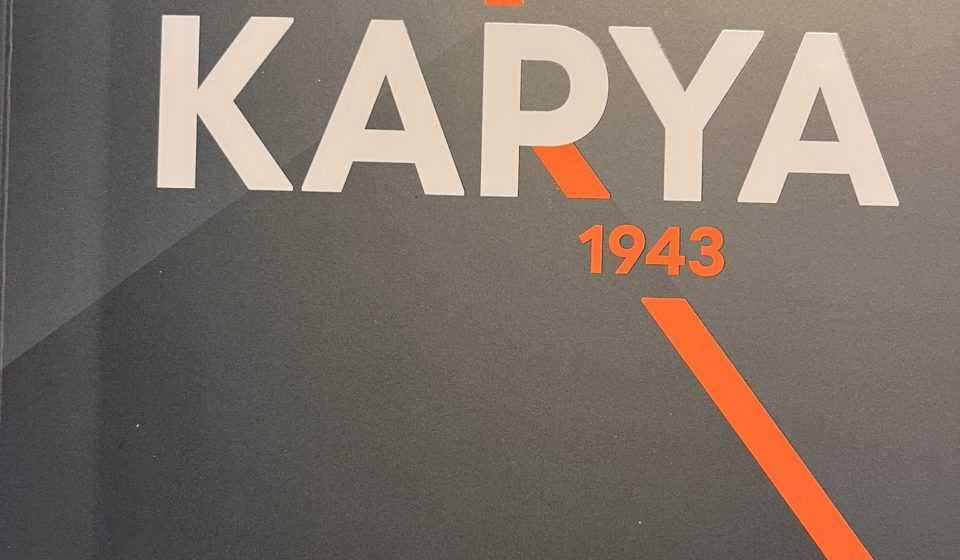
With the publication of the exhibition catalogue Karya 1943. Forced Labour and Holocaust in German and English, a publication is now available that documents a multi-year German-Greek collaborative project on the reappraisal of a long-forgotten chapter of the Holocaust and contextualises it within its historical framework. This article presents the catalogue and contextualises it through a retrospective look at the project, the travelling exhibition, and the contribution of the Interdisciplinary Working Group Conflict Landscapes (IAK) at the University of Osnabrück.
Documentation Centre NS Forced Labour, Foundation Memorial to the Murdered Jews of Europe & University of Osnabrück (eds.) (2026): Karya 1943. Forced Labour and Holocaust. Berlin
Karya – a forgotten crime scene of the Holocaust
In spring 1943, German occupiers deported between 300 and 500 Jewish men from the Thessaloniki ghetto to the railway station Karya in central Greece – a remote stop on the Athens–Thessaloniki railway line, approximately 250 kilometres north of the Greek capital. The men were forced to build a siding for Wehrmacht trains and the transportation of raw materials from Greece for the Organisation Todt (OT), which required cutting a massive slope into the rock.
The working and living conditions were catastrophic; one survivor described Karya after the war as “hell on earth”. Few managed to escape to the Greek partisans. Most survivors of the forced labour were deported to Auschwitz in August 1943 and murdered there. The Karya case clearly demonstrates the close interconnection between German occupation rule, the forced labour system, economic exploitation, and the Holocaust in Southeast Europe.
This crime would probably have remained forgotten forever had the Greek collector and researcher Andreas Assael – himself the son of a Jewish Holocaust survivor from Thessaloniki – not discovered a photo album inscribed “Organisation Todt” at a Munich flea market in 2002. The album belonging to German engineer Hanns Rössler contains around 80 photographs from the construction site in Karya – the only known photographic evidence of the forced labour deployment of Greek Jews at this location. Assael recognised the significance of the find, located the site, tracked down the last witnesses, and conducted fundamental research over many years that ultimately provided the impetus for the collaborative project and exhibition.
The collaborative project Deadly Forced Labour in Karya
The sources and findings compiled by Andreas Assael formed the starting point for the collaborative project Deadly Forced Labour in Karya. German Occupation and the Holocaust in Greece, which was funded from 2022 to 2024 within the Educational Agenda NS Injustice by the Foundation Remembrance, Responsibility and Future (EVZ) and the Federal Ministry of Finance. Under the leadership of the Documentation Centre NS Forced Labour (Dr Christine Glauning), the project brought together the Foundation Memorial to the Murdered Jews of Europe (Uwe Neumärker), the Interdisciplinary Working Group Conflict Landscapes at the University of Osnabrück, the Jewish Museum of Greece in Athens, and Aristotle University of Thessaloniki. Patronage was assumed by the Greek Ministry of Culture and the Minister of State for Culture and Media, Claudia Roth.
The project’s aim was to scientifically examine the Nazi crimes in Karya, contextualise them within the historical framework of German occupation and Jewish persecution in Greece, and make the results accessible to a broad public in Germany and Greece through a multimedia travelling exhibition. At the same time, the project combined research with historical-political educational work, including a German-Greek youth encounter with students from the universities of Osnabrück and Thessaloniki, as well as workshops with descendants of survivors.
The travelling exhibition and its venues
The multimedia and participatory travelling exhibition “Karya 1943. Forced Labour and Holocaust” was opened on 4 September 2024 at the Documentation Centre NS Forced Labour in Berlin-Schöneweide, where it was on display until 30 March 2025. In parallel, the Benaki Museum in Athens presented a twin exhibition from 16 October 2024 to 16 February 2025. From 30 October to 12 December 2025, the exhibition was hosted at the Ariowitsch House in Leipzig – a city with its own vibrant Jewish history and committed memorial work.
The trilingual exhibition (German, Greek, English) shows for the first time the historical photographs from the Assael collection in the context of German occupation and the Holocaust. It tells eight biographies of victims and survivors and makes the former crime scene accessible through 3D terrain models and a multimedia station based on the results of the research prospection by the IAK at the University of Osnabrück.
The exhibition website karya1943.eu additionally offers in-depth information and educational materials.
Conflict landscape research in Karya – the IAK Osnabrück prospection
One component of the collaborative project was the field research by the Interdisciplinary Working Group Conflict Landscapes (IAK) at the University of Osnabrück. From 30 March to 6 April 2023, a team of researchers and students under the direction of Prof. Dr Christoph Rass investigated the former railway station Karya as part of a geoarchaeological prospection. The field research was the first scientific investigation of this Holocaust crime scene.
The research prospection aimed to locate the central source for the project – Rössler’s photo album – at the concrete site of the events and to document the material traces of forced labour. The focus was on questions fundamental to conflict landscape research: How do the crimes of perpetrators, the life, suffering, and death of victims inscribe themselves into places and landscapes? How do we perceive the visible and the hidden and interpret the co-presence of the past with a gaze that always comes from the present? How do we deal with such historical sites when no memorial points to their past?
Methodologically, the team employed a broad spectrum of geoarchaeological procedures: drone flights and photogrammetry to create high-resolution 3D terrain models, laser scan surveying, magnetic gradiometry and ground-penetrating radar to investigate the subsurface, GPS surveying, soil science drilling, and systematic surface prospection. A methodologically particularly productive approach was so-called re-photography: historical photographs from the 1943 photo album were overlaid with current photographs to make visible the changes to the terrain over eight decades and to topographically locate the historical photographs.
The results of the prospection confirmed and expanded the findings from survivor reports and historical sources: the slope cut created by the forced labourers measures approximately 20 metres in depth and 100 metres in length. Within a few months, the Jewish men had to remove around 24,000 cubic metres of rock – a finding that translates the brutality of the labour deployment into stark numbers. The terracing of the narrow-gauge railway used for transport could still be recognised in the terrain. During surface prospection, 96 ground finds were recovered: nails – some bent, possibly used for hanging clothes –, a mother-of-pearl button that could have come from a forced labourer’s shirt, cartridge cases, narrow-gauge railway sleepers and screws. Each of these finds is an archival trace that connects the abstract historical finding with the concrete materiality of the crime scene.
Witnesses from the surrounding area had pointed to a possible burial site near the former construction site. However, the investigations could not provide evidence for its existence – which does not exclude that murdered and accident victims were buried or covered elsewhere. Further archaeological investigations are necessary to clarify the events in Karya beyond doubt.
The results of the prospection – 3D models of the slope cut and the spoil wagons, a 360-degree tour through the terrain, and the re-photography comparisons – form a central media station of the exhibition. They make the crime scene digitally accessible and relatable for visitors. The work is documented in IAK Working Paper 3 as well as in a series of contributions on the NGHM science blog – the so-called Karya Dispatches.
The catalogue
The now available exhibition catalogue – published in German and English editions – transfers the multimedia travelling exhibition into a permanent publication. The catalogue documents the Assael photo collection, contextualises the events in Karya within the framework of German occupation rule and the Holocaust in Greece, and presents the biographies of victims and survivors that are central to the exhibition.
The catalogue combines research results and educational objectives of the collaborative project in a format that extends beyond the temporally limited exhibition venues and thus complements the project’s digital resources – the website karya1943.eu and the research reports published on the NGHM blog – with a printed documentation.
Karya as a ‘Historical Site’
In July 2025, the Greek government recognised the former railway station Karya as a “Historical Site” – a step that also anchors the results of the collaborative project and exhibition in terms of memorial policy. This recognition underscores the significance of scientific reappraisal for society’s engagement with the crimes of German occupation rule in Greece.
Research perspectives
The field research in Karya was a first step. Further geoarchaeological-historical, but above all archaeological campaigns will hopefully follow to better understand, document, and thus rescue from oblivion the life and suffering of people deployed for forced labour. The question of the burial sites of the victims remains open. At the same time, Karya offers a case through which the interdisciplinary investigation of sites of violence from contexts of occupation rule, war of extermination, and Shoah can be developed empirically and methodologically. Numerous crime scenes of the Shoah in Greece also remain unexplored – particularly the forced labour camps and construction sites along the railway lines.
Against this background, the catalogue does not mark the end of a reappraisal but rather an interim assessment. It documents what has been achieved so far while simultaneously pointing to what remains to be done. That an abandoned stop on a disused railway line in central Greece was only recognised and scientifically investigated as a Holocaust crime scene in the 21st century shows how many traces remain to be read – and how fragile knowledge of the crimes remains when active work is not undertaken to secure it.
Further information and resources:
- Exhibition website: karya1943.eu
- NGHM blog posts on the project: nghm.hypotheses.org/26650
- Documentary film on the research prospection by Timos Zdoupas (virtUOS) on the University of Osnabrück YouTube channel: https://youtu.be/LX1htpk2Qck
- Documentation Centre NS Forced Labour: ns-zwangsarbeit.de
- Foundation Memorial to the Murdered Jews of Europe: stiftung-denkmal.de