
This post was automatically translated from the German original at
NGHM-digital | Eine App für Exkursionen: HistOS Fahrt nach Nürnberg als Test für einen DH-Prototyp..
Anyone who has navigated a city full of history with students for three days will be familiar with the challenges: meeting points, train connections, tour bookings, historical background information, and spontaneous changes of plan all compete for attention on WhatsApp, in emails, and on printed handouts. For the field trip “Nuremberg between the Middle Ages and National Socialism” in March 2026, the NGHM team therefore chose a different approach: a dedicated web app that consolidates logistics, maps, and historical context on a smartphone.
From Handout to Interactive Map
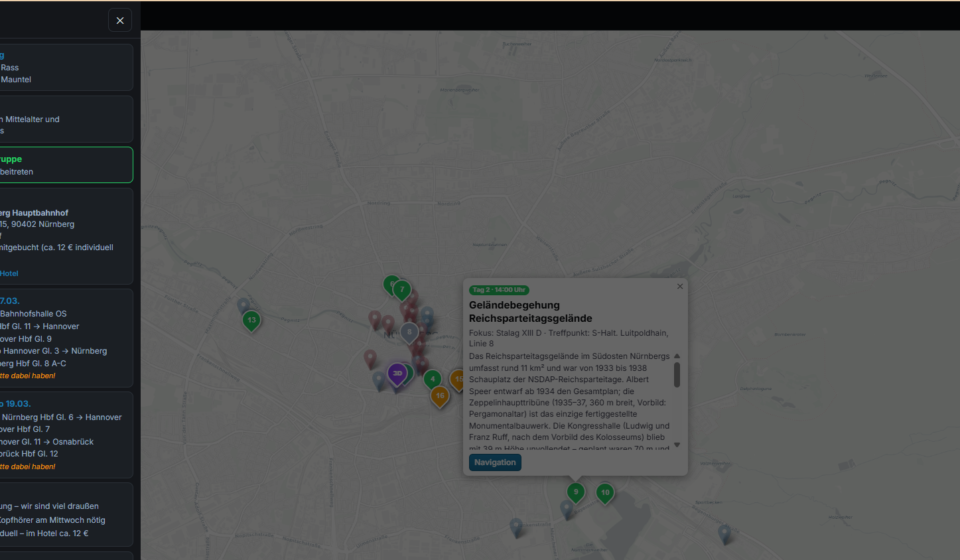
The basic idea was straightforward: everything participants need during the field trip should be accessible in one place. The result is a map-based application that displays all field trip stops as markers on an OpenStreetMap map. The stops are not merely points on a map, but linked information nodes: each marker opens a card with a description, address, web link, and references to scholarly literature. References to specialist publications and online resources appear directly alongside the coordinates. The app is thus not only a travel guide, but also an entry point into the research literature on location.
Users can switch between layers: a classic street map for orientation, and a satellite view for terrain. Color-coded markers distinguish field trip stops (red), contextual sites (blue), and infrastructure such as the hotel or railway station (green). A timeline at the top of the screen automatically highlights the current or next stop, based on the smartphone’s system time.
Programme, Bookings, Logistics
A pull-up panel at the bottom of the screen organizes the entire programme into six tabs: an overview with hotel details, train connections, and the WhatsApp group; the three days of the field trip with all scheduled activities; a booking overview with contact details, costs, and meeting points for the four booked guided tours; and finally nine historical introductory texts on the individual stops. The train connections from Osnabrück via Hanover to Nuremberg and back are stored alongside the hotel address with a map link and practical reminders: “bring smartphone and headphones on Wednesday.”
Historical Introductions: Contextual Knowledge in Three Minutes
The true centerpiece of the app is its historical introductory texts. For nine key field trip sites, expandable texts provide historical context in three to five minutes of reading time. The scope is broad: from Nuremberg’s rise as an imperial city and the Golden Bull, through the city’s global connections in long-distance trade between 1300 and 1600 (including its involvement in the transatlantic slave trade), to the instrumentalization of the Imperial Castle as a propaganda backdrop during the National Socialist period. Further texts address the Nazi Party Rally Grounds and Stalag XIII D, the Nuremberg Trials and their significance for international criminal law, Dani Karavan’s Way of Human Rights as a counter-proposal, and the history of Jewish life in Franconia: the expulsion from Nuremberg in 1499 and Fürth as the “Franconian Jerusalem.”
The aim throughout is not to provide brief tourist information, but historically grounded orientation texts that prepare visitors for each individual stop and embed it within broader research questions.
GPS, Navigation, and a 3D Experiment
Using the location button, students can display their current position on the map, including the accuracy radius. From any popup, navigation to the destination can be launched directly. This facilitates orientation, particularly on the expansive Nazi Party Rally Grounds or during transfers between Nuremberg and Fürth.
As an experimental feature, the app includes a 3D scan of an artwork located on the Way of Human Rights. The model was created on the go using photogrammetry with Polycam and integrated into the app “on the fly” — it can then be viewed directly in the browser via a dedicated marker and made available to students. This represents an innovative form of digital documentation that goes beyond photography and simultaneously demonstrates the potential of such recording methods for documenting sites of memory: we take along interesting objects of material culture as digital copies for later analysis.
In principle, the app is also suitable for subsequent digital documentation of the field trip by the students themselves.
Vibe Coding: The App as a Digital History Artifact
The app was developed using the approach of “vibe coding”: AI-assisted programming in which, rather than writing code line by line, the desired outcome is described in dialogue with an AI system. The application is deliberately lean: HTML, CSS, and Vanilla JavaScript, without a framework or build process. Map rendering is provided by Leaflet.js with OpenStreetMap and satellite layers. The historical contextual sites are stored as a GeoJSON dataset that can be maintained and expanded independently of the app. The dark color scheme and touch-optimized interface are designed for mobile use outdoors. The application is hosted on Netlify; it is password-protected and targeted specifically at field trip participants.
This approach aligns with what we have been exploring for some time at the Chair of Contemporary History and Historical Migration Research: not merely using digital tools, but building them ourselves. In the course “Digital History Workshop: AI & Personal Information Management for Historians” (Prof. Dr. Christoph Rass), students developed their own web apps on historical topics during the winter semester 2025/26 and presented them at the first NGHM WebApp Slam. “Vibe coding” enables historians to develop functional digital applications without requiring conventional programming skills. The preparation of the Nuremberg field trip was running in parallel — so what could be more natural than developing an app for it?
In practice, however, the limitations also become apparent: AI-generated code requires verification, results are not always reproducible, and longer sections of code can sometimes produce unexpected errors. At the same time, the question of maintaining a critical distance from the technology remains central.
Initial Experiences in the Field
Teaching staff and students used the app on their smartphones throughout the entire field trip. The combination of real-time orientation on the map, quick access to the daily programme, and the historical background texts proved to be a workable solution for integrating logistics and the transmission of knowledge on a field trip. Even updates on the go were possible! Overall, it can be noted that the app replaces neither a course reader nor in-depth reading. However, it does provide a low-threshold, situational access to contextual knowledge precisely where it is needed: at the historical site itself.
A Building Block in the NGHM Research Group’s Digital History Profile
The field trip app takes its place in a growing range of digital tools being developed at the Chair of Contemporary History and Historical Migration Research. The NGHM Campus Navigator, the student projects presented at the WebApp Slam, the use of GIS-based research data in ongoing third-party funded projects, and teaching in the field of Digital History together form an environment in which research, teaching, and digital methodological development interact. The field trip app demonstrates in exemplary fashion how established formats of university teaching — the field trip — can be combined with digital tools without reducing the historical subject matter to a mere use case.
The field trip “Nuremberg between the Middle Ages and National Socialism” was led by Prof. Dr. Christoph Rass (Contemporary History and Historical Migration Research) and Prof. Dr. Christoph Mauntel (Medieval History) at the University of Osnabrück.