Call for Papers | The Age of Humanitarianism. Jewish and Other Global Migrations Between Empire and Decolonisation

This post was automatically translated from the German original at
Call for Papers | The Age of Humanitarianism. Jewish and Other Global Migrations Between Empire and Decolonisation.
The 2026 annual conference of the Leibniz Institute for Jewish History and Culture – Simon Dubnow (DI) will take place with participation from the NGHM team. Dr. Sebastian Musch, Alfred Landecker Lecturer in Modern History and Historical Migration Research, is co-organising the international conference “The Age of Humanitarianism: Jewish and Other Global Migrations Between Empire and Decolonisation” together with Sebastian Willert (Dubnow Institute) and Eliana Hadjisavvas (Birkbeck, University of London).
Research at the intersection of Jewish migration history and Humanitarian Studies has been at the centre of Sebastian Musch’s work as Alfred Landecker Lecturer for some time. It was already the subject of the 2024 Jacob and Yetta Gelman International Research Workshop conducted at the United States Holocaust Memorial Museum on the theme “From the Atlantic to the Black Sea: Local Relief and Rescue Operations on the Margins of the Holocaust“, which Sebastian Musch led together with Gaëlle Fisher (Leibniz Institute for the History and Culture of Eastern Europe). While a decidedly European perspective was the focus then, this time a global historical approach is to be pursued. The conference will examine humanitarian networks in the context of imperial history and decolonisation in the period from 1910 to 1970 – from the era before the First World War to the phase of independence movements in Asia and Africa. Approaches that illuminate the history of Jewish migration in connection with other migration movements are also desired.
The deadline for abstracts is 27 March. The complete English-language Call for Papers follows.
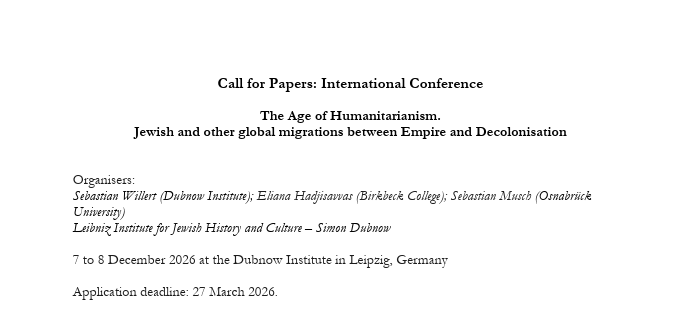
The Age of Humanitarianism. Jewish and Other Global Migrations Between Empire and Decolonisation
7 to 8 December 2026 at the Dubnow Institute in Leipzig, Germany
Application deadline: 27 March 2026
The 20th century witnessed profound waves of Jewish migration and displacement on a global scale. Empires often served as important arrival hubs for Jewish migrants, yet they were also sites of persecution and uprooting. The decades between the 1910s and the 1970s – stretching from the decline of the Ottoman Empire to struggles for independence across Africa and Asia – were marked by colonial expansion and decolonisation, extreme violence, the Holocaust, the Cold War, and fundamental shifts in the concepts of borders, citizenship, and humanitarian governance. During this long era of imperial fragmentation starting after the First World War and the onset of decolonisation, the upheavals of war, genocide, and political repression compelled many to seek new lives in unfamiliar – and often hostile – places, making migration a defining aspect of the modern Jewish and (non-Jewish) experience. At the same time, the persecution and violence of other minorities throughout the world led to large-scale domestic and international forced migrations.
Networks of support, hospitality, and solidarity proved crucial in this situation. Improving access to migration pathways enabled individuals to navigate restrictive border regimes, often determining the success of relocations, escapes, and onward journeys. In an emerging era of humanitarianism, individuals, relief actors, and various stakeholders coordinated efforts to facilitate travel, acquire necessary documentation, distribute food supplies, secure employment and/or work permits, and support the arrival of newcomers. This context prompts several questions: How did the history of empires shape and influence patterns of humanitarianism and migration throughout the 20th century? In what ways did decolonisation impact humanitarian efforts, networks, and the experiences of migrants? How can we analyse the mechanisms of connection, resilience, and adaptation that emerged among refugees and humanitarian actors across the diverse imperial landscapes?
These and other questions stand at the center of an international conference at the Leibniz Institute for Jewish History and Culture – Simon Dubnow in Leipzig, which is funded by the Alfred Landecker Foundation. It is organised by Sebastian Willert (Dubnow Institute), Eliana Hadjisavvas (Birkbeck College), and Sebastian Musch (Osnabrück University) and aims to broaden the focus on empires and migration to a more comprehensive global perspective. The conference will examine the interconnections and relationships among various humanitarian support and solidarity networks, including grassroots movements, traditional concepts of hospitality, and professional organisations that facilitate, support, and organise migration. It seeks to create a comparative approach to analyse how different cultures and regions respond to migration and the various support systems in place.
Against this backdrop, this conference will examine the dual role of empires as both havens of refuge and catalysts of forced migration.
Aiming to critically interrogate the complex interconnections between different world regions, we particularly encourage contributions that examine lesser-studied geographies, including migrations, in and across the SWANA-region, sub-Saharan Africa, South Asia, the Americas, and the former Soviet Union. Our discussions will delve into the multifaceted experiences of Jewish migrants, exiles, and refugees, examining their contributions to society, the economy, and the enduring legacies of their presence. We intend to delve into the crucial role of humanitarian aid and relief efforts, as well as the contributions of individuals in supporting migrants both during their journeys and upon their arrival. By exploring these historical trajectories in the context of eroding empires, we will reflect on the implications for contemporary debates surrounding diversity, mobility, and belonging. In doing so, the conference aspires to foster conversations that not only enrich our understanding of past movements but also discourse on migration and mobility in the present.
Submission Details
Please submit an abstract of 350 words outlining your proposed contribution and a brief academic biography (max. 200 words) in a single pdf document. Travel and accommodation will be covered by the conference’s budget. Additionally, we intend to publish a curated selection of papers in a special issue.
Submissions should be sent by 27 March 2026 to Sebastian Willert at the Dubnow Institute via email: willert(at)dubnow.de
We look forward to your proposals and to a stimulating scholarly exchange on Jewish and other global migrants between empires and decolonisation, focusing on the intersection of migration and humanitarian studies.
Organisers:
Sebastian Willert (Dubnow Institute);
Eliana Hadjisavvas (Birkbeck College);
Sebastian Musch (Osnabrück University)