German Listeners!” – Students Develop Perspectives on Thomas Mann’s Radio Addresses

This post was automatically translated from the German original at
„Deutsche Hörer!” – Studierende entwickeln Perspektiven auf Thomas Manns Rundfunkansprachen.
Student Conference of the Seminar “German Listeners! Thomas Mann’s BBC Radio Addresses as a Source for Exile and Migration History” in the Winter Semester 2025/26.
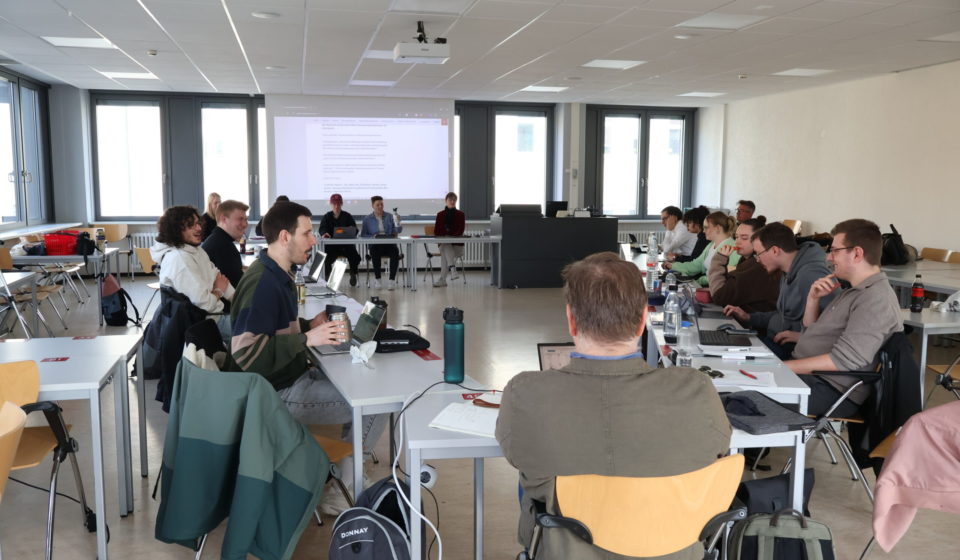
In the winter semester 2025/26, students at the University of Osnabrück examined Thomas Mann’s BBC radio addresses ‘Deutsche Hörer!’ (1940–1945) in a block seminar not as a literary work, but as a historical document: as a source for the history of forced migration and exile, as material of transnational communication under conditions of dictatorship and war, and as an object of inquiry into how intellectual resistance from exile could function. The third seminar day took the format of a student conference: fourteen presentations, organised into four thematic panels, presented independent analyses of the same source corpus and thereby opened up a spectrum of approaches ranging from media-historical contextualisation through rhetorical textual analysis and intellectual historical classification to sociological field theory. This contribution documents the results of this conference in three steps: First, it situates the seminar and its subject matter. Then it reproduces the fourteen presentations in the order of the programme and provides each contribution with a brief analytical classification. Subsequently, it summarises the overarching findings that emerge from the synopsis of the contributions.
The Seminar and Its Subject Matter
Thomas Mann left Germany in February 1933 and never returned from a lecture tour. After years in Switzerland, he emigrated to the United States in 1938; in 1936 the Nazi regime had revoked his German citizenship. The 1929 Nobel Prize winner in Literature had thus become what was then termed an ’emigrant’ – a concept that adopted the perspective of those doing the expelling and obscured the dimension of forced migration. In American exile, Mann assumed a public role that he had not previously held in this form: He became the voice of what he and others called the ‘other Germany’.
In autumn 1940, the BBC approached Mann with a request to regularly deliver addresses to the German population. The first broadcast was transmitted on 18 October 1940; around 55 more followed until May 1945. The production process documents the material conditions of this form of ‘resistance communication’: Mann recorded his five- to eight-minute addresses on gramophone records in a studio in California, the recordings were transported to New York, transmitted via telephone line to London and broadcast on long wave through the BBC’s German Service – a transatlantic production process that shows what infrastructure was necessary to bring a voice from exile into the closed communication space of the so-called ‘Third Reich’.
The seminar deliberately approached this source group from the perspective of historical migration research. The guiding question concerned not the literary quality of the addresses, but their source value for the history of exile, transnational communication and political rhetoric under wartime conditions. The tension between enablement and limitation stood at the centre: Mann could do things from American exile that would have been impossible for him in the Reich; at the same time, he had to experience that his voice could only arrive under certain conditions – if it arrived at all.
The third seminar day transformed the results of the collaborative source work into the format of a student conference. The programme organised the fourteen presentations into four thematic panels: Annika Heyen moderated the first panel on Mann’s knowledge of the Holocaust and Allied reporting, Sebastian Musch led the intellectual historical perspectives of the second panel, Sebastian Huhn guided through the third panel on democracy, realpolitik and war enthusiasm, and Jessica Wehner took over the moderation of the fourth panel on role understandings and the listener-speaker relationship. The concluding observations were provided by Christoph Rass. The contributions are documented below in the order of the programme.
The Presentations
Panel I – Knowledge of the Unimaginable: Thomas Mann, the Holocaust and Allied Reporting
Gesa Landwehr: “German Listeners!” as Part of the BBC German Service
Gesa Landwehr reconstructed the institutional framework in which Mann’s addresses were created and situated the ‘Deutsche Hörer!’ broadcasts in the context of the BBC German Service as a propaganda apparatus. The contribution worked out the dual structure that characterised Mann’s position within the BBC: On the one hand, he enjoyed remarkable freedoms as a Nobel Prize winner. The BBC gave him largely free rein in the content design of his contributions. On the other hand, he was part of an institutional structure that pursued its own propagandistic goals and occasionally attempted to moderate particularly sharp formulations. At the same time, Landwehr showed that BBC internal documents demonstrate how Mann’s ‘special status’ – a term that marks his position between instrumentalisation and autonomy – had to be repeatedly renegotiated.
The contribution thus laid the institutional foundation on which all further presentations could build, and simultaneously made visible a tension that is constitutive for the entire source corpus: the question of the extent to which Mann was an instrument of Allied propaganda and the extent to which he pursued his own agenda.
Lea Horstmann: “Between Enlightenment and Appeal: The Representation of Nazi Crimes and National Socialist Persecution Policy”
Lea Horstmann examined how Mann represented the National Socialist crimes in his addresses and reconstructed a chronological development in four phases – from an initially abstract representation of persecution through increasing concretisation to explicit documentation of extermination. The central thesis of the presentation was that Mann employed the Nazi crimes less documentarily than argumentatively: as a moral ‘exemplum’ that was meant to move listeners to insight and action. The boundary between enlightenment and appeal – as the title of the presentation suggested – proved to be fluid.
The observation that Mann did not primarily document crimes but rhetorically instrumentalised them is a finding that extends far beyond source analysis and raises questions about the relationship between historical reporting and political persuasion work.
Felix Ruholl: Thomas Mann’s Reporting on the Holocaust Throughout the Radio Addresses
Felix Ruholl traced the development of Mann’s Holocaust reporting chronologically and identified three phases: a phase of vague allusions, a phase of increasing concretisation and finally a phase of direct confrontation with the extent of extermination. The analytically most productive finding lay in the so-called ‘mirror thesis’: Ruholl argued that Mann’s reporting did not follow his individual state of knowledge, but largely mirrored the information level of the American public – the ‘Deutsche Hörer!’ broadcasts would thus be less a document of exclusive knowledge than rather a gauge for publicly available information about the genocide.
The ‘mirror thesis’ is a strong argument that raises the question of whether the addresses can be read as a source for the knowledge history of the Holocaust, and if so, for whose knowledge: that of the American public, that of the exile community, or that of the BBC?
Anna Louisa Asbrock: “‘[The] most infamous tyranny that has ever threatened the world’ – The Representation of National Socialism”
Anna Louisa Asbrock analysed Mann’s overall representation of the National Socialist system and identified three analytical approaches that Mann intertwined in his addresses: criticism of Nazi propaganda, documentation of violence, and personalisation of the system in the figure of Hitler. The presentation showed that Mann represented National Socialism not only as a political regime, but as a civilisational rupture, an interpretation that delegitimised the system as a whole, but simultaneously raised the question of the extent to which Mann’s own representational strategies – particularly personalisation – resembled the structures he criticised in the regime.
The observation of a structural similarity between Mann’s rhetorical means and those of Nazi propaganda is a finding that was to play a central role in the final discussion of the conference.
Panel II – “Evil”, “Civilisation” and “Humanism”: Intellectual Historical Perspectives
Gloria Sherif: “The Absolutely Diabolical” – Linguistic and Moral Conception of Evil
Gloria Sherif examined the linguistic means by which Mann constructed ‘evil’ as an analytical category in the addresses, and identified three rhetorical strategies: irony, the appropriation of ‘enemy language’ – that is, the deliberate adoption and recoding of National Socialist terms – and a rhetoric of condemnation that marked the Nazi regime as a manifestation of the absolutely diabolical. The presentation showed that Mann’s conception of ‘evil’ was not primarily theological, but aesthetically and morally grounded: the regime appeared as a perversion of cultural values, not as an expression of metaphysical powers.
The finding that Mann conceived ‘evil’ as an aesthetic category points to a conceptual figure that runs through his entire political thinking and raises the question of whether the intertwining of aesthetics and morality in Mann does not also have problematic implications.
Daria Ivanov: Humanity as the Touchstone of Civilisation – Humanism and the ‘Jewish Question’ in the BBC Address of 27 September 1942
Daria Ivanov presented a close-reading analysis of the address of 27 September 1942 – that speech which was independently identified as a key document by several conference contributions. The presentation showed that Mann used the term ‘Jew’ 22 times in this address – a frequency unique in the entire corpus – and framed the Holocaust as a touchstone of humanism. In doing so, Ivanov worked out a transformation of the concept of humanism: humanism appeared in the September address no longer as an educational ideal, but as an ethical stance whose validity had to prove itself in the response to the persecution of European Jews.
The empirical density of this contribution made it one of the analytically strongest of the conference; at the same time, it raised the question of the extent to which Mann’s concept of humanism addressed the victims as independent subjects or primarily claimed them as a moral argument for a European-humanistic tradition.
Timo Diener: Culture and Civilisation in Thomas Mann
Timo Diener traced the intellectual-historical development of Mann’s thinking about the opposition between ‘culture’ and ‘civilisation’, a conceptual field that is central to understanding the addresses because it refers back to the ‘Reflections of a Nonpolitical Man’ from 1918. The analytical point of the presentation lay in the thesis of ‘functional equivalence’: while in the ‘Reflections’ ‘civilisation’ appeared as a threat to German ‘culture’, in the radio addresses National Socialism took exactly the structural position that civilisation had previously occupied. The enemy of culture had changed, but the conceptual structure had remained.
The functional equivalence thesis is a remarkable finding because it shows that Mann’s intellectual biography was not simply overcome in the addresses, but transformed – a result that corresponds to the findings of Rehfeld and Schmitz.
Panel III – Luminous Figures, Democracy and War Enthusiasm: Thomas Mann and Real Politics
Luca Herrmann: Thomas Mann and his Relationship to US President Roosevelt
Luca Herrmann examined the portrayal of Franklin D. Roosevelt in the ‘German Listeners!’ broadcasts and argued that Mann did not simply honour the US President as a political ally, but systematically built him up as a democratic counterimage to Hitler. The central thesis was that Mann recoded the concept of ‘Führer’ – a central topos of Nazi propaganda – by presenting Roosevelt as the ‘true leader’: not as a charismatic demagogue, but as a democratically legitimised statesman. However, the analytically strongest finding of the presentation concerned what Mann did not say: Executive Order 9066 – Roosevelt’s order for the internment of Japanese-American citizens – was consistently silenced in the addresses, although Mann lived as an exile in the same country and must have known about the internment.
The observation of deliberate silence is analytically more productive than the reconstruction of what was said, because it shows that Mann’s portrayal of Roosevelt was strategically selective – a finding that marks the boundary between conviction and propaganda within the addresses themselves.
Pieter Rehfeld: From Conservative to Moral Democrat?
Pieter Rehfeld traced Mann’s understanding of democracy and argued that Mann developed over the course of the addresses from a conservative-cultural-critical position to a ‘moral democrat’, whose concept of democracy, however, bore a specific signature: it defined itself essentially ex negativo – through demarcation from National Socialism. Rehfeld identified three aspects of this understanding of democracy: human dignity, rule of law, and limited freedom. At the same time, the presentation showed that Mann’s concept of democracy was not developed systematically-theoretically, but narratively – in engagement with concrete historical situations.
The thesis of an ex-negativo democracy raises a question that extends beyond source analysis: what happens to a concept of democracy that feeds essentially on demarcation from an enemy when that enemy disappears?
Leon Schmitz: Flaming Enthusiasm – Thomas Mann’s Engagement with Militarism and War Enthusiasm in the Face of Two World Wars
Leon Schmitz documented the intellectual break between Mann’s war enthusiasm of 1914 – laid down in ‘Thoughts in War’ – and his position in the radio addresses. The presentation showed that Mann did not explicitly address his own militarism of 1914 in the ‘German Listeners!’ broadcasts, but implicitly – through the sharpness of his criticism of Nazi militarism – carried out a distancing that the contribution characterised as self-correction without self-criticism.
The formula of ‘self-correction without self-criticism’ is analytically apt and points to a structural feature of the addresses: in 1940 Mann spoke not only against National Socialism, but also against his own position of 1918, without ever making this explicit.
Panel IV – Thomas Mann and the German Listeners: Role Conceptions and Relationships
Alexander Pracht: Fear and Anxiety in Thomas Mann’s Rhetoric
Alexander Pracht analysed the use of ‘anxiety’ and ‘fear’ as rhetorical instruments in the addresses and reconstructed an argumentative triptych: in a first phase, Mann used anxiety rhetoric for mobilisation. The listeners were to recognise their own situation as threatening. In a second phase, the anxiety diagnosis served situational analysis. Mann identified the anxiety of the Germans as a symptom of dictatorship. In a third phase, the rhetoric transformed into confidence. The anxiety of the regime, not that of the population, now stood at the centre. In doing so, Pracht showed that Mann developed a counter-rhetoric that took up biblical phrases – such as the formula ‘Fear not’ – and turned them against National Socialist anxiety production.
The observation that Mann not only thematised anxiety but employed it as a rhetorical instrument – that is, generated anxiety in order to combat anxiety – points to the structural similarity of his means with those of the propaganda he criticised.
Emma Breulmann: Thomas Mann’s Role Conception in “German Listeners!”
Emma Breulmann systematised Mann’s changing speaker positions with the help of Pierre Bourdieu’s field theory and reconstructed four phases of role change: from the ‘cultural speaker of Germany’, who first had to justify his legitimation, through the ‘witness and enlightener’, who reported on National Socialist crimes, to the ‘advocate of the nation’, who mediated between accusation and defence of ‘another Germany’, up to the ‘historical interpreter’, who classified National Socialism as an episode and drafted a future perspective. The contribution worked out how Mann strategically converted his cultural and symbolic capital – Nobel Prize, literary work, exile status – into political capital in order to occupy a position for which he had no original legitimation – such as a political office.
The application of field theory to Mann’s exile situation makes dynamics visible that a purely text-immanent analysis would not capture; at the same time, it raises the question of whether Bourdieu’s categories – developed for fields with established rules and hierarchies – are transferable to a situation in which belonging to the relevant fields had itself become precarious.
Jennifer Funk: Thomas Mann’s Relationship to the “German Listener!”
Jennifer Funk examined the listener-speaker relationship in Mann’s addresses through a methodologically tripartite approach: a word field study of address pronouns, an analysis of argumentative strategies, and a contrast with private diary entries. The pronoun analysis revealed a significant shift: from direct, individual forms of address (‘ihr’, ‘euch’) towards collectivising connections (‘ihr Deutsche’) and finally to mere address as ‘Deutsche’ – a development that Funk interpreted as a movement from empathetic proximity to analytical distance. At the same time, the presentation reconstructed a recurring five-step argumentative pattern – cultural reference, problem statement, moral diagnosis, perspective shift, appeal – which structurally connected the addresses despite all their content variation. The analytically most productive finding, however, lay in the contrast with Thomas Mann’s diaries: Funk showed that Mann privately doubted the possibility of internal German resistance as early as 1940, which he publicly invoked – a finding that made the ‘imagined community’ of listeners – following Benedict Anderson – appear doubly imagined: imagined not only by the listeners among themselves, but also by the speaker himself.
The combination of quantitative pronoun analysis, rhetorical structural analysis and diary contrast made this contribution methodologically one of the most multi-layered of the conference; the finding that Mann privately doubted the resistance he publicly invoked belongs to those results that fundamentally complicate our image of Mann as a moral authority.
Carlotta Pioch: Thomas Mann’s Understanding of the Speaker – On the Rhetorical Construction of a Speaker Figure
Carlotta Pioch set the decidedly literary-scholarly accent of the conference and asked not about the historical person Thomas Mann, but about the rhetorically constructed ‘speaker figure’ that forms within the texts. The analytical premise was that Mann’s authority in the addresses is not presupposed, but performatively produced – a finding that Pioch traced through five stages: from analytical observer (November 1940) via moral-aesthetic critic (February 1941) and the caesura of his own voice (March 1941) – the moment when Mann first speaks his addresses himself and the metaphor of ‘voice’ gains a bodily dimension – to historical-ironic authority (1942/43) and finally to interpreter of the ‘German catastrophe’. Particularly revealing was the observation that Mann operated in a double field of address: He spoke to the Germans, but simultaneously staged himself before an American audience; a constellation that constructs the speaker figure not towards one circle of addressees, but situates it in a field of tension between at least two publics.
The consistent distinction between the historical person and the rhetorically constructed speaker figure – narratologically self-evident, but by no means always observed in political-historical research – opened an analytical space in which the performative dimension of the addresses became visible: authority is not presupposed, but produced. The contribution thus formed a productive counterpart to Breulmann’s sociological approach. Both reached the same core finding from completely different directions.
The Conference Findings Read Across
In his concluding analysis, Christoph Rass drew together the overarching lines of the conference and asked what emerges when fourteen perspectives on the same source material are placed side by side. In his contribution, he identified five findings.
First: The ‘Deutsche Hörer!’ are a process, not a text. At least seven presentations had reconstructed chronological lines of development: in Holocaust reporting, in understanding of democracy, in role development, in the rhetoric of fear, in addressing listeners, in the construction of the speaker figure. The corpus documents not a position, but its transformation.
Second: The boundary between enlightenment and propaganda is fluid. Landwehr has shown that the BBC instrumentalised Mann. Funk has shown that Mann himself managed the discrepancy between private conviction and public message. Asbrock, Sherif and Pracht have shown that his rhetorical means – personalisation, fear generation, conceptual recoding – structurally resemble the means he criticised in the regime. This is not an objection from outside, but a finding of this conference.
Third: The intellectual biography reaches back. Diener, Rehfeld and Schmitz have independently shown that one cannot understand the radio addresses without the ‘Reflections of a Nonpolitical Man’ and other earlier works. In 1940, Mann speaks not only against National Socialism, but also against his own position of 1918, without making this explicit, however.
Fourth: Authority is not presupposed, but produced. This is a finding that Pioch and Breulmann reach from completely different directions, Breulmann via capital conversion in Bourdieu’s sense, Pioch via the performative construction of the speaker figure in the text. Mann does not speak as a recognised authority, but must newly justify his legitimacy in each address. This result is analytically strong because it makes the addresses readable as sites of authority production and because it shows that the conditions of exile shaped not only the content but also the form of communication.
Fifth: Reception remains a gap. Almost no presentation could say who listened to Mann and how the addresses were received. Funk formulated this most sharply: The ‘imagined community’ of listeners is doubly imagined, also for the speaker.
Rass concluded his analysis with three questions that he posed to the conference for discussion: the question of the analytical difference between propaganda and counter-propaganda when the rhetorical procedures are structurally similar; the question of the position of victims in Mann’s speeches, who appear as moral argument but rarely as independent subjects; and the question of the viability of a concept of democracy that defines itself essentially ex negativo.