Nachlese | Essen 2026 | »Analphabeten in zwei Sprachen« [“Illiterates in Two Languages”]. The Invention of ‘Double Semi-Lingualism’ and the Production of the ‘Language Problem’ in West German Migration Research, 1960–2010

By Christoph Rass · Originally published on nghm.hypotheses.org
This long essay is an expanded and reflective version of the lecture delivered by the author on 2 October 2026 at the workshop “A Historical Perspective on Multilingual Education: Schooling Beyond Monolingualism” at the University of Duisburg-Essen. The author wishes to express his sincere gratitude to Sofia Grigoriadou, Judith Purkarthofer, and Marcel Berlinghoff for the invitation.
The essay brings together the author’s work on the production of the ‘language problem’ in West German migration research and connects it with a new reflection on how scholarship authenticates an ascription and why the refutation of a technical term left “the German of the school” intact as the benchmark for bilingual children. The findings presented here are the result of the author’s research in Sub-project A3 of the Collaborative Research Centre 1604 “Production of Migration” at the University of Osnabrück, which investigates how scholarship and schooling produce figures of migration.
Refuted and yet still effective?
In December 2010, nine scholars — among them Heike Wiese, Christoph Schroeder, Manfred Krifka, Ingrid Gogolin, Wolfgang Klein, and Michael Tomasello — declared ‘double semilingualism’ to be a “popular myth” [“populären Mythos”] in a “linguistic position statement” (Stellungnahme 2010).
The claim in question was that a child with two languages ultimately masters neither of them properly — that is, the child does not simply lack sufficient German, but rather lacks sufficient command of both languages. With this claim, pedagogy and migration research had described the children of recruited workers (children of immigrants, most of whom had already been born in Germany) for decades, later the so-called ‘second generation’, and eventually children ‘with a migration background’. In the view of the signatories, the concept described the social evaluation (“more precisely: devaluation” [“genauer: Abwertung”]) of a particular linguistic practice rather than a finding of linguistic science. The notion that a child with two languages brings primarily a language problem into school has, however, outlasted the refutation.
But how is a migrantizing ascription produced so robustly that it survives its own scholarly deconstruction and continues to operate?
The Collaborative Research Centre 1604 investigates how migration is invested with meaning, problematized, and processed. It understands this production of migration as a contested negotiation grounded in the categorization of people; according to its research program, these categorizations “condense into social figures” [“verdichten sich in sozialen Figuren”]. Scholarship, too, participates in this process. The figure of the child who is said to be illiterate in two languages can therefore be traced through the texts that scholarship and educational practice have written about these children. Sub-project A3 has constructed for this purpose a machine-readable, chronologically ordered corpus of German-language scholarly and practice-oriented literature on migration and education: 5,842 texts from the years 1960 to 2010 (A3 corpus, as of November 2026). As a broad cross-section of published material, it preserves the concepts with which scholarship and educational practice described these children, and thereby the epistemic order within which decisions about their schooling were negotiated.
The figure of migration examined in this contribution manifests in the material on three distinguishable levels. The formula is the phrase “illiterates in two languages” [“Analphabeten in zwei Sprachen”]. The concept is the technical term ‘semilingualism’ or ‘semilingualism’ [‘Halbsprachigkeit’ or ‘Semilingualismus’]. The idea is the claim underlying both: that two languages can cost a child both languages. The essay traces the figure along the three questions that Project Area A of the Collaborative Research Centre — to which Sub-project A3 belongs — poses to figures of migration: concerning their emergence, their efficacy, and their reproduction. Research has furnished the ascription with a technical term, a number, and a measurement grid, thereby lending it authority.
The ‘language problem’ is treated in what follows not as a category of analysis, but as a descriptive category produced by migration research — one that is to be explained and interrogated as to what it reveals about the production of migration through research. It thus renders the migrantization legible, not the migrantized.
1963 | ‘Language barrier’
The first question concerns emergence. The ‘language problem’ had a formula long before it became a technical term. Young female workers from southern Europe suffered, as a 1962 report on ‘Gastarbeiterinnen’ [female guest workers] noted, “under their ‘speechlessness'” [“unter ihrer ‘Sprachlosigkeit'”] (Fröhlich 1962). A year later, Wolfgang Pabst, writing in the journal “Kirche und Mann” [Church and Man], linked language to the social standing of those recruited: “Whoever comes to us from the southern countries to earn their bread here must overcome not only a language barrier, but also a social barrier: for foreign workers come predominantly from considerably poorer countries.” [“Wer aus den südlichen Ländern zu uns kommt, um hier sein Brot zu verdienen, muß nicht nur eine Sprachbarriere, sondern auch eine Sozialbarriere überwinden: Die Fremdarbeiter stammen nämlich zumeist aus erheblich ärmeren Ländern.”] (Pabst 1963) The word ‘Sprachbarriere’ [‘language barrier’] appears once per million word forms in the corpus of the 1960s, twenty-five times in the 1970s, and becomes rarer thereafter. The discourse of ‘speechlessness’ and ‘language barrier’ encoded linguistic difference as an obstacle and coupled it to social hierarchy. It did not, however, become a persistent concept.
Language became a matter for the school when the children of immigrants entered the classroom. The Federal Republic’s recruitment agreements were premised on temporary employment. The German-Turkish recruitment agreement of 30 October 1961 had restricted residence to a maximum of two years and made no provision for family reunification. In the revised version agreed upon by both governments through an exchange of notes in 1964, which came into effect with the Turkish reply note of 30 September, the Federal Republic abandoned the restriction on the length of stay (Rass 2010, pp. 415 f. and 420). The revised version no longer contained the exclusion of family reunification that the Federal Ministry of the Interior had still demanded, but neither did it include any provision explicitly permitting it (Goeke 2020, p. 37).
In May of that same year, the Standing Conference of the Ministers of Education and Cultural Affairs (Kultusministerkonferenz) had noted that the development of the European Economic Community into a common labor market was bringing “temporarily or permanently a larger number of foreigners with their families to the Federal Republic of Germany” [“vorübergehend oder ständig eine größere Zahl von Ausländern mit ihren Familien in die Bundesrepublik Deutschland”]. The educational authorities of the Länder regarded it as their obligation to enable children to enter German schools, and attached “particular importance” [“eine besondere Bedeutung”] to their promotion in the mother tongue (KMK 1964); the school thus received a dual mandate.
In March 1971, the Federal Government stated in its reply to a minor interpellation in the Bundestag that the Federal Republic understood “foreign workers as guest workers and not as immigrants” [“die ausländischen Arbeitskräfte als Gastarbeiter und nicht als Einwanderer”], and that the idea of the “return of their children to their home country’s school system” [“Rückkehr ihrer Kinder in das heimatliche Schulwesen”] had shaped educational policy “from the outset” [“von Anfang an”] (Deutscher Bundestag 1971). On 3 December 1971, the Standing Conference of the Ministers of Education and Cultural Affairs reaffirmed the dual mandate (KMK 1971), which the handbook of the German Youth Institute summarized in 1977 as “integration for the duration of the stay [in] the Federal Republic of Germany and preparation for return” [“Eingliederung für die Dauer des Aufenthalts [in] der Bundesrepublik Deutschland und Vorbereitung auf die Rückkehr”] (Akpinar et al. 1977). Henceforth, decisions about the children’s languages were negotiated within a school that was simultaneously to prepare them for integration and for return.
1972 | “Illiterates in two languages”
The earliest attestation of the formula in the corpus comes from a publication by Wilma Grossmann in the “Schwarzbuch: Ausländische Arbeiter” [Black Book: Foreign Workers], edited by Siegmar Geiselberger in December 1972 on behalf of the Federal Executive of the Young Socialists (Jungsozialisten) in the SPD. Grossmann read into the 1964 resolution of the Standing Conference of the Ministers of Education and Cultural Affairs a “dual burden imposed on the school” [“der Schule aufgebürdete Doppelaufgabe”] — “integration and, at the same time, the preservation of national distinctiveness” [“Integration und gleichzeitig Wahrung der nationalen Eigenständigkeit”] — which had led “to pedagogically so unsuccessful institutions as the preparatory classes” [“zu pädagogisch so erfolglosen Einrichtungen wie den Vorbereitungsklassen”], and concluded: “The controversy over the extent to which pupils should be integrated and the extent to which ties to the home country should be fostered has resulted in many children no longer feeling at home anywhere, in their being ‘illiterates in two languages’.” [“Die Kontroverse darüber, inwieweit Schüler integriert und inwieweit die Verbindung zum Heimatland gefördert werden soll, hat dazu geführt, daß viele Kinder sich nirgends mehr heimisch fühlen, daß sie ‘Analphabeten in zwei Sprachen’ sind.”] (Grossmann 1972, p. 145) With the formula, Grossmann named the outcome of an educational policy in which German cultural administrations and the governments of the countries of origin contested the schooling of children. What stood accused was an inconsistency in migration policy — not the child and not its languages.
In the years that followed, this formula migrated through the literature, losing the context in which Grossmann had used it. Jochen Gerstenmaier and Franz Hamburger cited it in 1974 with a footnote and page number (Gerstenmaier/Hamburger 1974), and Dieter Frey and his co-authors adopted it from them in 1978 (Frey et al. 1978). Ursula Mehrländer reproduced Grossmann’s sentence almost verbatim in the same year, referencing her own work from 1976 rather than Grossmann (Mehrländer 1978, fn. 24). From the mid-1970s, the formula also appeared as a title: Mehrangis Montazami-Dabui used it for her documentary film shot in Berlin-Kreuzberg, produced by the Deutsche Film- und Fernsehakademie Berlin and screened at the Mannheimer Filmwoche in October 1975 (Montazami-Dabui 1975). The Frankfurter Rundschau printed an article under this title in April 1976 (Wilhelmi 1976, cited in Rist 1980). Hartmut M. Griese described the formula in 1980 as a “Schlagwort” [catchword] that applied “most readily” to some of the children (Griese 1980, p. 156).
In 1972, Grossmann had attributed responsibility to educational policy. From 1976 onwards, authors sought the cause of the double language loss in different places. In an expert report submitted by Ursula Boos-Nünning, Manfred Hohmann, and Hans H. Reich in 1976 to the Institut für Kommunalwissenschaften of the Konrad-Adenauer-Stiftung, Reich, in his section on the subject areas of instruction, situated double language loss within a typology that crossed two patterns of behavior with two types of conditions (Boos-Nünning/Hohmann/Reich 1976, p. 181). A “withdrawal behavior” under “unfavorable sociolinguistic conditions” would lead “to a first language restricted to ‘hearth and home’ and a second language restricted to minimum requirements in the workplace and the immediate German-speaking environment” — that is, to “illiteracy in two languages”; a “behavior oriented towards integration” under favorable conditions would lead to “balanced” bilingualism.
Reich thus located the cause in the interplay of behavior and conditions, rather than in bilingualism itself. A year later, Holm Sundhaussen wrote, under the heading “The Problems of Bilingualism,” that the mother-tongue development of the children was “disrupted by their stay in Germany, without the German language being able to become a fully adequate substitute. The children are in danger of becoming illiterates in two languages.” For him, the cause lay in the stay in Germany. With these sentences he cited, by his own account, a contribution by Erich Renner to the volume of an “International Conference on Guest Workers,” referring “in particular” to Georgios Savvidis, who is the subject of the following section (Sundhaussen 1977, fn. 92).
In the handbook on “pedagogical work with foreign children” submitted in 1977 by Ünal Akpinar, Andrés López-Blasco, and Jan Vink to the Deutsches Jugendinstitut, the cause was identified as bilingual education itself: “Bilingual education has, however, proven to be disadvantageous for foreign children and turns them into ‘illiterates in two languages’.” (Akpinar et al. 1977) This referred to the bilingual instruction provided for under the dual mandate of 1971.
Whereas authors had until then sought the cause in educational policy, in behavior and living conditions, in the stay in Germany, and in bilingual instruction, Horst Widmann of the University of Gießen extended the formula in 1978 from language to the children’s personalities. He wrote that the children were “in danger of becoming rootless ‘illiterates in two languages,’ young people without a stable cultural and social identity” (Widmann 1978, p. 387).
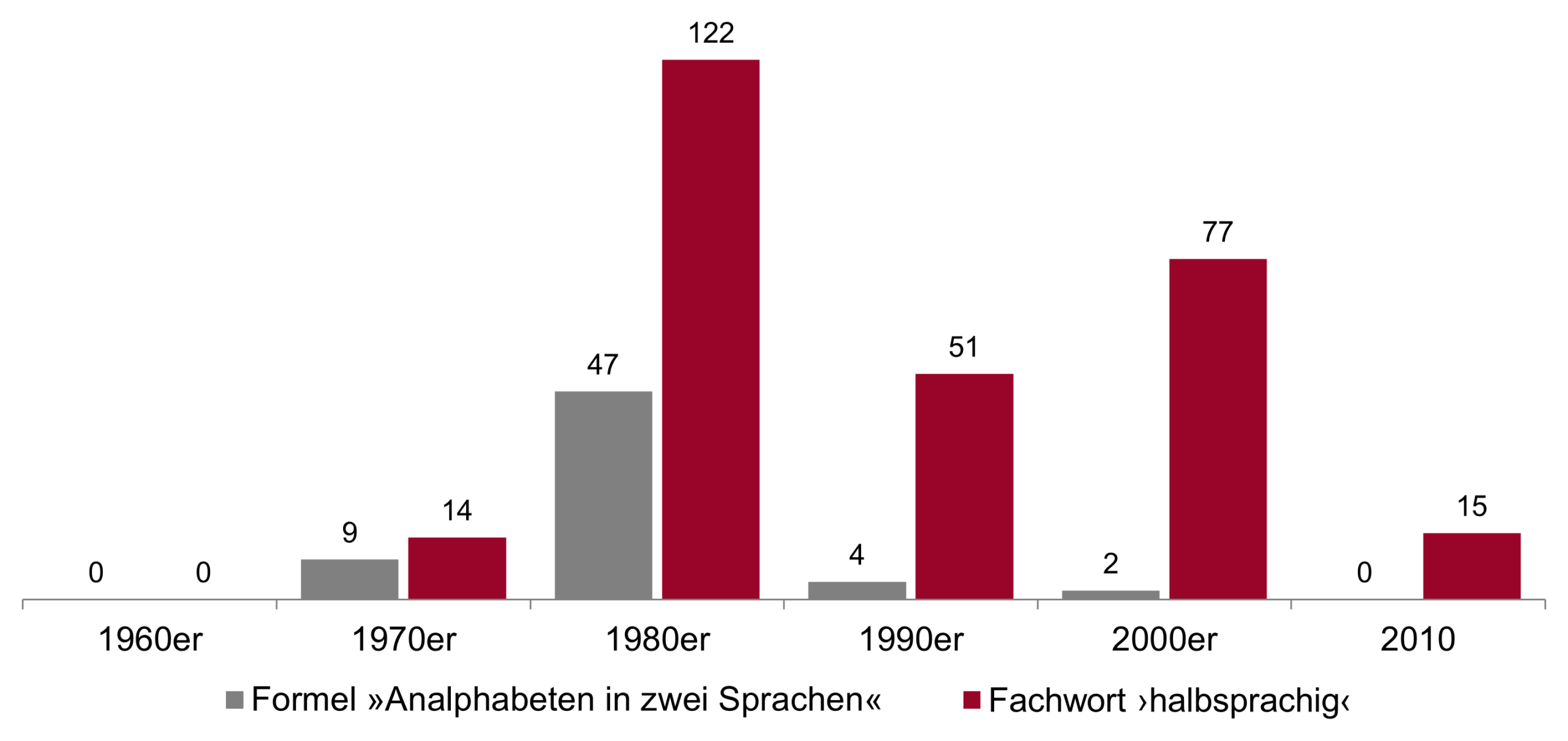
Counting reprints, tables of contents, and verbatim reproductions each only once, the formula appears a total of 62 times across 53 texts in the entire corpus (nine from the 1970s, 38 from the 1980s); after 1990 it appears only sporadically, mostly as a quotation or as a keyword in a conceptual history. How self-evident it had become by 1990 is illustrated by a late instance. In the second edition of her study, published in 1991, Valentina-Maria Stefanski wrote that the “problem of illiterates in two languages” had already been “known around the turn of the century” among Polish-speaking immigrants in the Ruhr region (Stefanski 1991). The formula of 1972 served her as a name for the experience of migration around 1900.
1975 | “Bilingualism as the Central Problem of Guest Worker Children”
But by what route did the idea of harm caused by two languages enter the West German debate before the technical term appeared? One trail leads to the primary school teacher Georgios Savvidis, who between 1963 and 1969 had founded and taught in mother-tongue schools for Greek “guest worker children” in Hamburg, Lübeck, and Munich. His dissertation was accepted by the Philosophische Fakultät of the University of Munich in winter 1973; it was published in print in 1975 under the title “Zum Problem der Gastarbeiterkinder in der Bundesrepublik Deutschland” [On the Problem of Guest Worker Children in the Federal Republic of Germany] (Savvidis 1975). The fourth chapter is entitled “Zweisprachigkeit als Hauptproblem der Gastarbeiterkinder” [“Bilingualism as the Central Problem of Guest Worker Children”] and assembles a catalogue of alleged harms, ranging from characterological “lability and superficiality” to “susceptibility to schizophrenia.”
His sources derive in large part from German literature on “Germans abroad” (Auslandsdeutschtum) produced between the wars and during National Socialism: Henß 1927, Sander 1935, Heinrich Geissler 1938, Christian Vasterling’s “Entdeutschungsgefahren im Reifealter. Zur Psychologie der Umvolkung Jugendlicher” [Dangers of De-Germanization in Adolescence: On the Psychology of the Ethnic Transformation of Young People] of 1936, and, in footnote 67, Georg Schmidt-Rohr’s “Mutter Sprache” [Mother Tongue] of 1933. Alongside these stand older titles such as Eduard Blocher 1909 and Onisifor Ghibus’s Jena dissertation on “modern utraquism” of 1910. Savvidis did not merely survey this literature — he made it his own: “We believe we can not only concur with this observation, but also agree with Ghibus that compulsory scholastic bilingualism contributes ‘to the enfeeblement of their mental faculties and to demoralization’.” (Savvidis 1975) His conclusion was the mother-tongue school, for him “the only place of healing for every psychologically afflicted guest worker child.” Two years later, Akpinar, López-Blasco, and Vink reached the opposite conclusion in their handbook for the Deutsches Jugendinstitut, rejecting national classes as “isolation in a national ghetto” (Akpinar et al. 1977). In the dispute over integration or return, over German-language or mother-tongue schooling, both sides thus invoked the same figure and presupposed a child who suffers harm from its two languages.
This establishes the bodies of knowledge from which Savvidis drew, not his convictions. He cited authors whose writings served the “Volkstumskampf” [ethnic struggle] on behalf of German minorities abroad. At the same time, Greek teachers taught in the children’s family language in his schools — a case of migrant self-organization that Stephanie Zloch places alongside the knowledge of the German school administration (Zloch 2021). That such doctrines survived into the postwar period was noted by Wilfried Stölting as early as 1974, three years before Sundhaussen referred to Savvidis. The “Weisgerber school” — the students of the linguist Leo Weisgerber — had ensured in the postwar period that the irrational elements of the doctrine of the monolinguistically constituted worldview of a nation “were not forgotten.” Responsibility for the harms attributed to bilingualism lay not in bilingualism itself, “as Weisgerber would have us believe,” but in the negative attitude of the surrounding environment (Stölting 1974). Six years later, Stölting wrote that the same doctrine recurred in Savvidis, “in direct connection with the Bavarian school model for guest worker children” (Stölting 1980, fn. 40).
1979 | ‘Semi-lingualism’
In the 473 texts in the corpus published before 1979, neither ‘Halbsprachigkeit’ [semi-lingualism] nor ‘Semilingualismus’ [semilingualism] appears. In 1979, ‘Halbsprachigkeit’ appears for the first time in three texts: in Arthur J. Cropley, in Ingeborg Willke, and in a report by Riitta Yletyinen on mother-tongue training for migrant children in Sweden. Yletyinen recorded how the term had been received in Sweden: “In public, people spoke of (double) semi-lingualism. This concept was now used almost as a catchword, having first been introduced by Hansegård in the 1960s, though at the time it had attracted little attention.”
She also cited the survey to which the German literature would later refer. According to Pertti Toukomaa, twelve percent of nine- to ten-year-old Finnish pupils in exclusively Swedish-language classes had been “unable to understand Finnish texts.” From this she concluded: “If one takes into account at the same time these children’s knowledge of Swedish, one could describe these children as semi-lingual.” (Yletyinen 1979) The figure concerned only the comprehension of Finnish texts; it became a double diagnosis only in conjunction with the children’s knowledge of Swedish, for which Yletyinen, following Toukomaa, reported deficits of partly three to four years. In a footnote she explained the term using the English technical term and the formula: “«Semilingualism», illiteracy in two languages.”
The technical term, however, had a prehistory that extends beyond Sweden back into German-language scholarship. David Karlander and Linus Salö reconstructed in 2023 that the Swedish linguist Nils-Erik Hansegård spent two months at the University of Vienna in autumn 1961, and that the language psychologist Friedrich Kainz instructed him there to read Schmidt-Rohr’s “Mutter Sprache” [“Mother Tongue”] of 1933 (Karlander/Salö 2023, pp. 512 f.). Schmidt-Rohr had headed the language policy office in the SS’s ‘Ahnenerbe’ (ebd., p. 513). From Schmidt-Rohr, Hansegård adopted the doctrine of harm caused to humans by bilingualism; at the same time, he advocated for the rights of the Finnish-speaking minority in northern Sweden. Karlander and Salö emphasize that ‘Nazi linguistics’ does not designate a uniform theory, and that Hansegård’s positions remained contradictory (ebd., pp. 508 f., 521 f.).
The book that Kainz recommended to Hansegård also appears in Savvidis’ footnote 67. Savvidis does not mention Hansegård or the Swedish debate. The Swedish line via Kainz and Hansegård and the West German line via Savvidis thus both trace back to the same book by Schmidt-Rohr, without any connection between them being demonstrable. Tove Skutnabb-Kangas, whose study with Toukomaa had disseminated the term internationally in 1976, herself cited in 1990 an essay by Schmidt-Rohr from 1932, “Von der seelischen Schädigung durch Zweisprachigkeit” [“On the psychological harm caused by bilingualism”], as an example of the reactionary, nationalist emphasis on the mother tongue in National Socialism, without establishing any connection to her own term (Skutnabb-Kangas 1990).
What did the technical term offer authors that the formula had not? Where Savvidis in 1975 had cited Ghibu and Geissler, by 1979 there stood a Scandinavian survey with a percentage figure. Through reports such as Yletyinen’s, West German literature absorbed from Sweden a notion that German-language scholarship had cultivated beyond the period of National Socialism, now presented as the result of empirical research. In place of the slogan came a term with an originator. The attribution already contained within the formula thereby acquired the authority of an international state of research. The import authenticated; it did not explain.
1980 | ‘double semilingualism’
The second question concerns efficacy. A figure is here considered efficacious insofar as it determines, within the specialist literature, which children are regarded as a problem and by what criteria they are measured. Efficacy is accordingly an indicator that the production of meaning around ‘migration’ has condensed into social fact.
By what standard were the children whom authors described as ‘semilingual’ measured? The standard was made visible by Wilfried Stölting, who in 1980 examined “Die Zweisprachigkeit jugoslawischer Schüler in der Bundesrepublik Deutschland” [“The bilingualism of Yugoslav pupils in the Federal Republic of Germany”]. He asked under what conditions these pupils “approach Äquilinguismus [equilingualism], i.e. optimal command of Serbo-Croatian and German, or ‘doppelseitige Halbsprachigkeit’ [‘double semilingualism’], i.e. poor command of both languages”, and entered both as opposing corners of a grid (Stölting 1980, chap. 6.4 and fig. 5; here fig. 1). Stölting counted “illiteracy in two languages” and ‘double semilingualism’ among the “popular designations”, yet introduced the latter as a category of his own investigation; a reviewer noted that Stölting preferred it to the “popular «illiteracy in two languages»” (Kuglin 1981). According to this framework, a bilingual child should command Serbo-Croatian as well as a child who speaks only Serbo-Croatian, and German as well as a child who speaks only German; the child was thus measured against two monolingual children simultaneously. Those who fell short of this doubled monolingualism in both languages were deemed semilingual.
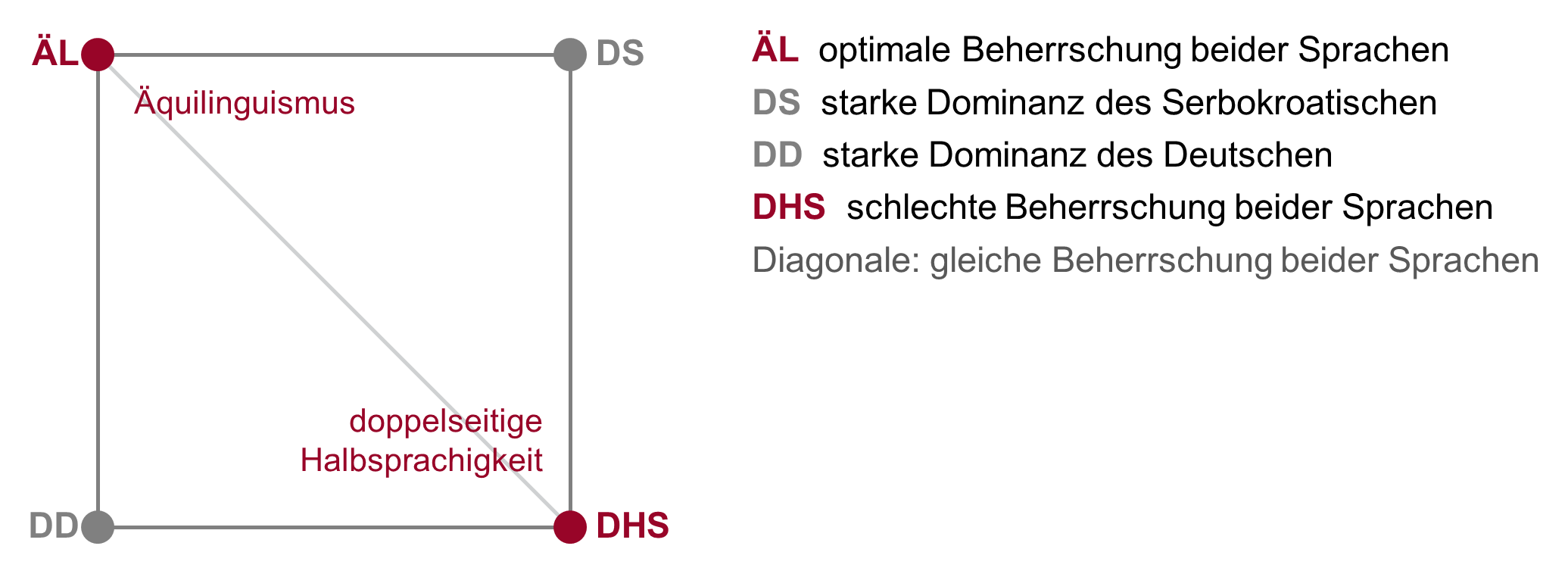
In the same work, Stölting challenged the view “that the human being is essentially monolingual” and the assumption that equal command of two languages “overtaxes the average child” (Stölting 1980). Nevertheless, his measurement employed a grid that presupposes monolingual command as the norm and demands it twice over for the bilingual child. Ingrid Gogolin, in her Habilitation thesis submitted at Hamburg and published in 1994, termed this assumption—that monolingualism is the normal case—the “monolingual habitus of the multilingual school” (Gogolin 1994). In the corpus, this assumption was already established as measurement practice before it received a name.
During the 1980s, the word family ‘semilingual’ reached its greatest density in the corpus, with 122 attestations in 67 texts, including parallel editions (nearly ten per million word forms; fig. 2). The formula disappeared from the corpus almost entirely after the 1980s, while the technical term remained in use. James Cummins, in accordance with whose threshold hypothesis a child must reach a minimum level in both languages in order for bilingualism not to be detrimental, wrote in 1984 in the German version of a 1979 essay that one must “reckon with ‘Halbsprachigkeit’ [‘semilingualism’] or ‘doppelte Halbsprachigkeit’ [‘double semilingualism’] if the lower threshold level is not exceeded” (Cummins 1984, p. 193).
Auslandsschule | The second child
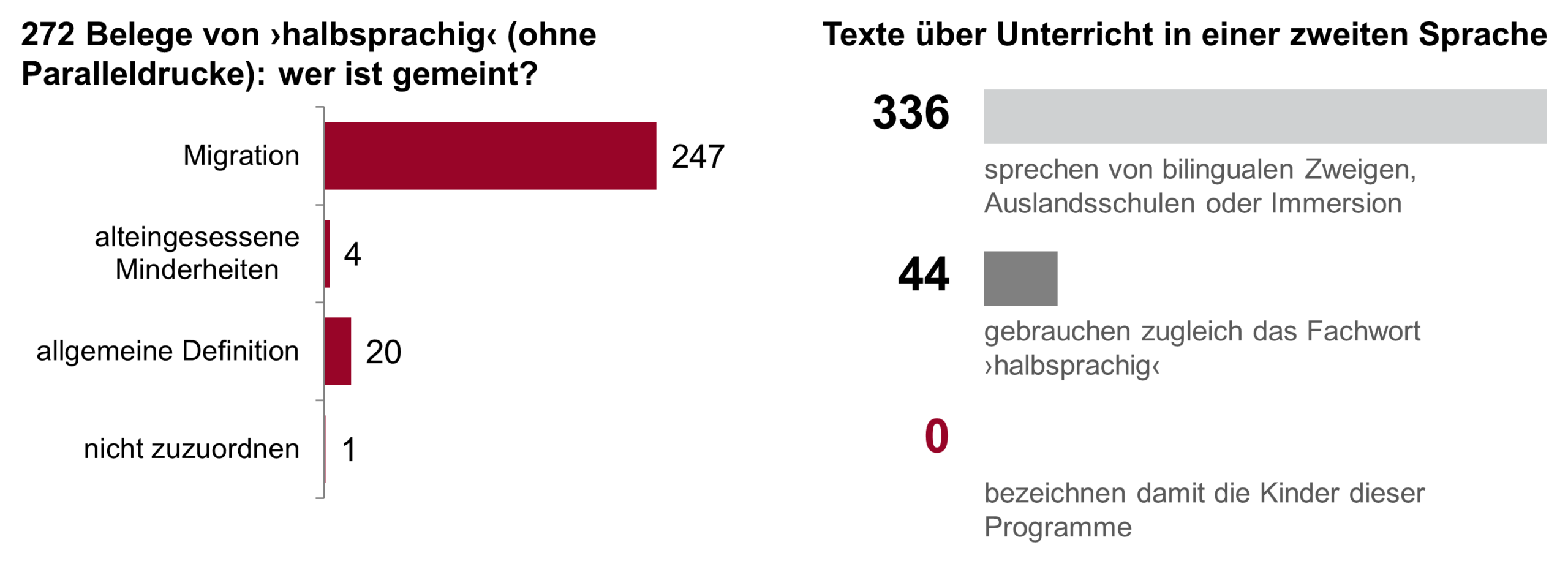
Whom did authors designate with the technical term, and whom did they not? Two hypothetical children make the question tangible. One speaks Turkish at home and learns at school in German. The other speaks Spanish at home and likewise learns in German at a German school abroad in Madrid. Both grow up with two languages; both learn through their second language. Of the 279 attestations of the word family ‘semilingual’ in the corpus, 272 remain after the exclusion of parallel editions. Of these, 247 refer explicitly to children or adults from families with experience of migration, and four to long-established minorities such as the Sorbs. A further 20 remain at a general definitional level without naming a specific group; one attestation cannot be classified. Not a single attestation refers to a child like the second.
This is not because these children are absent from the corpus. 336 texts discuss immersion, bilingual streams, schools abroad, or European Schools, and 44 of these simultaneously employ the technical term ‘semilingualism’. In none of these 44 texts does it refer to children in such programs (Fig. 3). The same authors were familiar with both forms of bilingualism, discussed them within the same text, and applied the technical term to only one of them. Guido Schmitt and Gustav Adolf Lörcher articulated the distinction in 1985: school-based bilingualism, “the acquisition of a foreign language in a school setting,” interferes less with personal development: “It commands prestige and furthers career prospects. Imperfect command of a foreign language is not perceived as a permanent stigma.” This is immediately followed by: “Foreign labor migrants and their children suffer from the linguistic stigma.” According to the same paragraph, double semilingualism occurs “increasingly” among children who have grown up in the Federal Republic in “isolated living situations” (Schmitt/Lörcher 1985, pp. 49 f.).
Heidi Rösch distinguished in 1988 between two outcomes of instruction in a language other than the home language. If children “of the dominant population group” were taught in the language of a discriminated group, as in Canada, or “children of a socially stable population group in a language with high social prestige (as in schools abroad),” the language shift promised “additive bilingualism”; for children “of an ethnolinguistic minority (such as immigrant groups),” the same principle could “become a steamroller for the mother tongue, perhaps even for both languages” (Rösch 1988). The difference was determined by the status of the languages and their speaker groups. Rösch too considered the double loss possible, but shifted its cause from the child’s two languages to the hierarchy of those languages. Hans H. Reich had already formulated a related insight in 1976 with his typology of behaviors and conditions.
Neither insight did much to alter the use of the technical term: those who employed it continued to describe difficulties as a property of the child rather than as a consequence of the conditions under which it had acquired its languages, and used the term to mark children of immigrant families as migrant and deficient through their languages — from the ‘Gastarbeiterkinder’ [children of guest workers] of the 1970s to the children ‘with a migration background’ of the 2000s. For the institutional dimension of this marking, Zloch has chosen the heading “Die Muttersprache als Fremdsprache” [“The mother tongue as a foreign language”] (Zloch 2023, pp. 525–533). The phrase is the administrative language of the period: the Minister of Education of North Rhine-Westphalia recognized in 1969 the children’s mother tongue “as a foreign language within the meaning of the guidelines for the Hauptschule [lower secondary school]” and thereby exempted the children from English instruction (cited in Koch 1970, p. 69).
The technical term accordingly did not measure a child’s competence; it marked its social belonging. It condensed categorizations based on origin, language, and social position into a single figure. This answers the question of efficacy, and with it the question of how the attribution was produced: the technical term was applied to children of immigrant families and never to children attending schools abroad or bilingual streams.
2010 | “Myth”
The third question concerns reproduction. Its history begins with a refutation. Linguistics raised two objections to the concept. François Grosjean demonstrated in 1989 that a bilingual person is not two monolingual persons in one (“The bilingual is not two monolinguals in one person”; Grosjean 1989). This disposed of the standard of doubled monolingualism that Stölting’s framework had applied. The position statement of 2010 mentioned above summarized this critique and further objected that the concept described a social devaluation rather than a linguistic finding (Stellungnahme 2010).
Ten years earlier, the technical term had found its way into a Bundestag document. In October 2000, the Federal Government presented the Sixth Family Report on “Families of Foreign Origin in Germany,” in which the Expert Commission wrote: “Semilingualism, or language difficulties, is moreover an increasing problem that also affects many German families.” (Deutscher Bundestag 2000, p. 180) Here the word had been detached from bilingualism and had become synonymous with language difficulties; it no longer stood for the figure of the child with two half-languages. A full-text search of the Bundestag’s parliamentary documentation finds it only in this passage, and the formula and ‘double semilingualism’ in none (Deutscher Bundestag 2026). The memorandum in which Heinz Kühn, as the Federal Government’s Commissioner, demanded recognition of de facto immigration in 1979 likewise dispensed with both the formula and the technical term (Kühn 1979), as did the resolutions of the Standing Conference of the Ministers of Education and Cultural Affairs (Kultusministerkonferenz) on the education of foreign children from 1964 to 1979 and on intercultural education in 1996 (Puskeppeleit/Krüger-Potratz 1999). Unlike the word ‘Gastarbeiter’ [guest worker], which the Federal Government adopted for its own policy in 1971 (Deutscher Bundestag 1971), the figure is almost entirely absent from documents of the Federal Government, the Bundestag, and the Kultusministerkonferenz. It was the specialist literature that lent it authority.
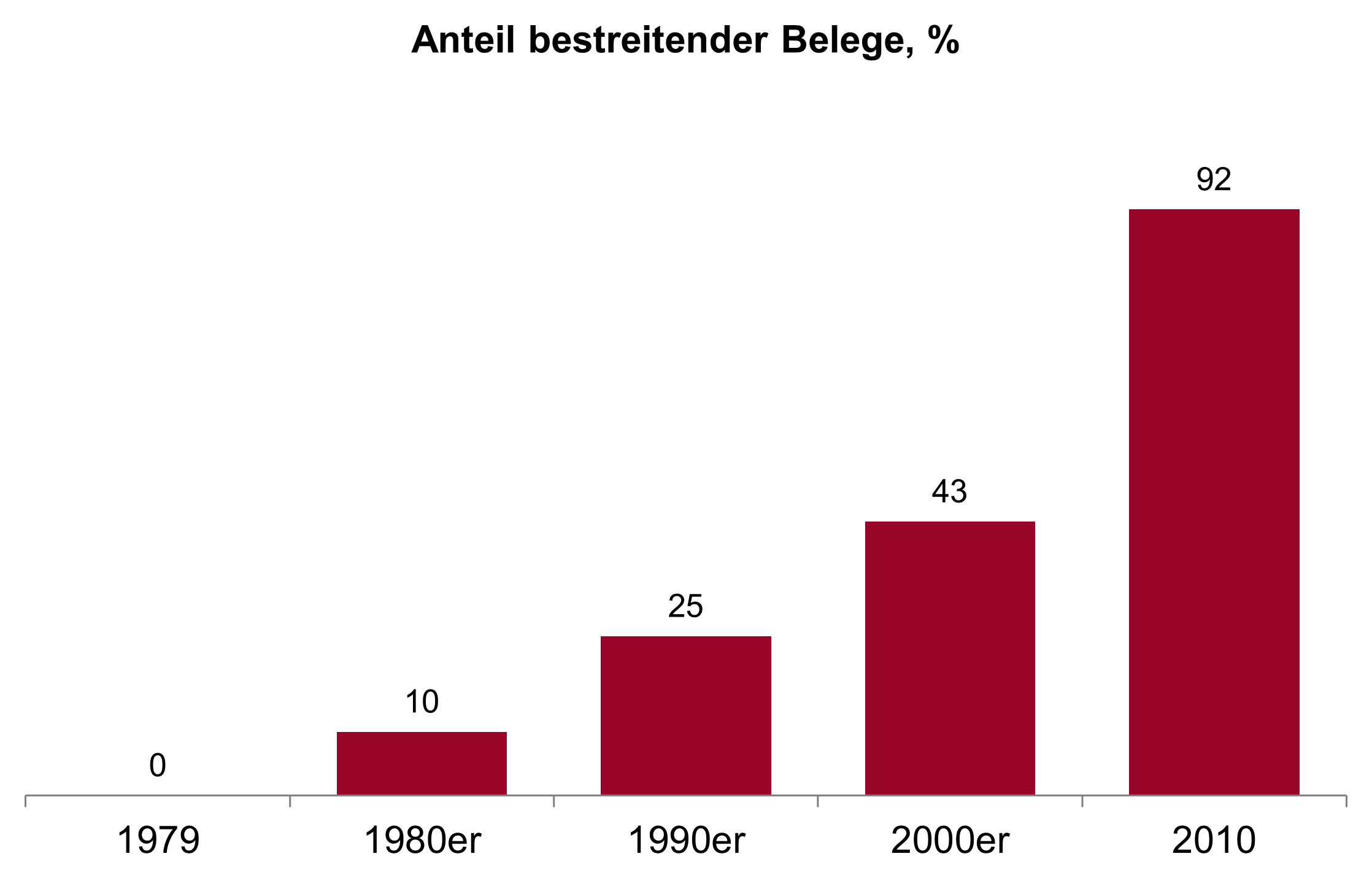
The A3 corpus allows us to trace when the specialist literature distanced itself from the concept. The use of the word family ‘semilingual’ declined from just under ten instances per million word forms in the 1980s to just over three in the 2000s. Each of these instances has been coded according to whether the text treats double semilingualism as an established fact, reports it, or contests it. Of the fourteen instances from 1979, none contests it; Willke did cite the methodological criticism of Toukomaa’s study, but did not dispute the concept itself. Excluding parallel prints, in the 1980s twelve of 117 instances contest double semilingualism (the earliest in 1983), in the 1990s thirteen of 51, and in the 2000s 33 of 77. In 2010, the final year of the corpus, twelve of thirteen instances contest it (Fig. 4). The concept lost its standing in the specialist literature only gradually; it is not until the year of the position statement, 2010, that it is contested by a majority.
Since 2010 | ‘Additional Support Needs’
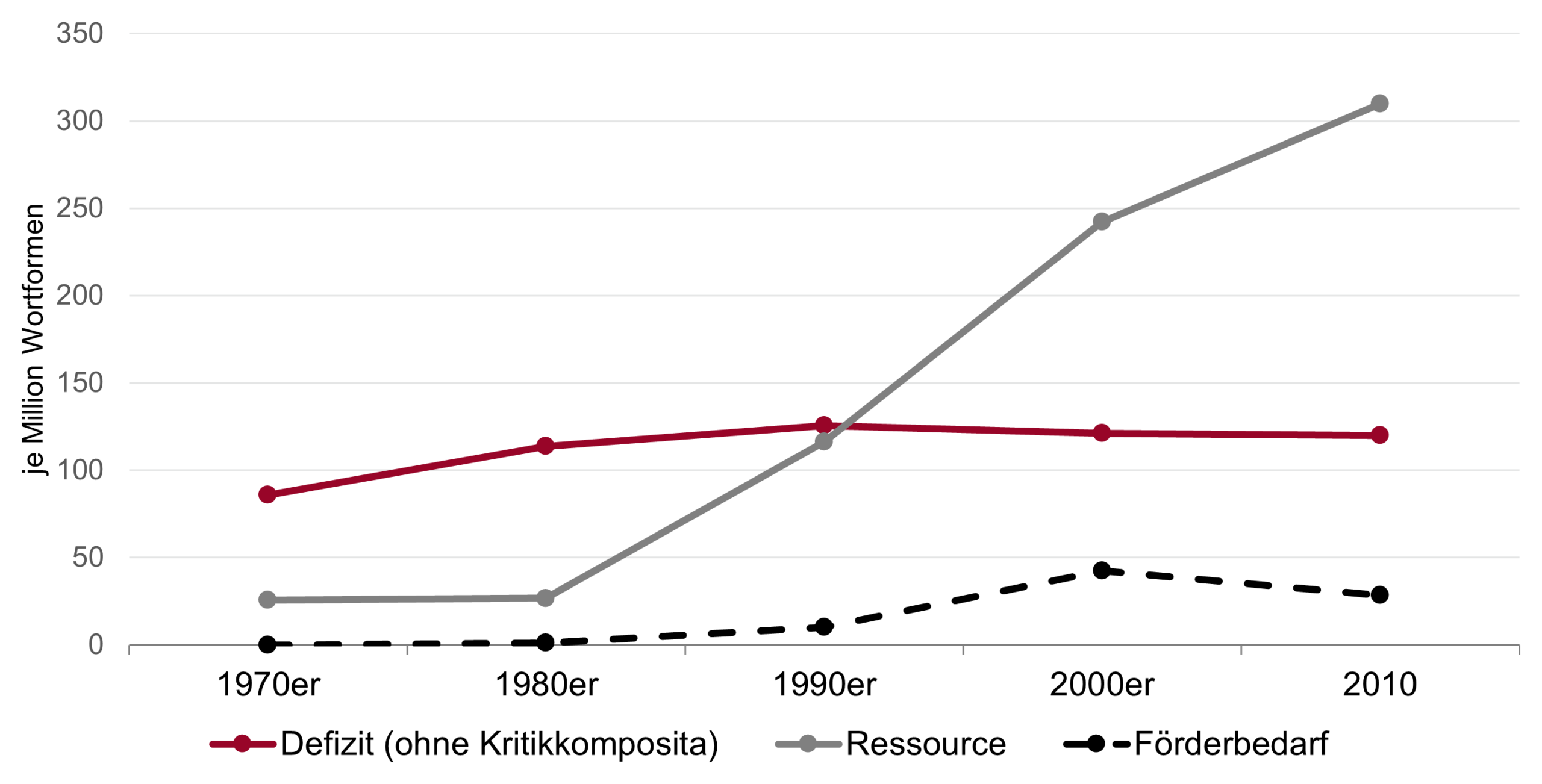
What has outlasted the refutation? The vocabulary of deficiency has remained. ‘Defizit’ [‘deficit’] and its derivatives appear in the corpus at roughly the same frequency since the 1980s, with 114 to 126 instances per million word forms through the 2000s and 120 in 2010. This holds true even after subtracting the words with which texts criticize deficit thinking itself (‘defizitorientiert’ [‘deficit-oriented’], ‘Defizithypothese’ [‘deficit hypothesis’], and similar terms). Depending on the decade, between one fifth and just over one third of these instances appear in immediate proximity to language; the density of these language-related instances reaches its highest value in the 1980s at 42 per million word forms and stands at 33 in the 2000s. ‘Ressource’ [‘resource’], by contrast, rises from 27 per million in the 1980s to 242 in the 2000s and overtakes ‘Defizit’ around the turn of the millennium, without the latter becoming less frequent. ‘Förderbedarf’ [‘additional support needs’] is entirely absent before 1980 and rises from the 1990s onward, while the density of instances of ‘Halbsprachigkeit’ [‘semilingualism’] declines. Just under one third of the instances of ‘Förderbedarf’ refer to special educational needs. The curves show a temporal coexistence (Fig. 5), not the replacement of one word by another.
That the monolingual norm is reproduced even in the word ‘Förderbedarf’ was argued by Jana Gamper, Judith Purkarthofer, and Christoph Schroeder in 2024: „Wer von der einsprachigen und ‚migrationsfreien’ Norm abweicht, wird nicht nur anders bzw. normabweichend konzeptualisiert, sondern zusätzlich mit problembehafteten Eigenschaften wie ‚unzureichenden Sprachkompetenzen’ und ‚Förderbedürftigkeit’ etikettiert.” [“Those who deviate from the monolingual and ‘migration-free’ norm are not only conceptualized as different or as deviating from the norm, but are additionally labeled with problem-laden characteristics such as ‘insufficient language competencies’ and ‘need for additional support’.”] (Gamper/Purkarthofer/Schroeder 2024, p. 206)
A year later, Gamper, Schroeder, Julia Schlauch, and Dorothée Steinbock examined 138 recent specialist articles on German as a second language and found a deficit-oriented description of learners; their contribution bears the title “Constructing a clientele in need” (Gamper et al. 2025). Schroeder had been among the signatories of the 2010 statement. The edited volume in which the contribution appeared was co-edited, among others, by Schroeder and Heike Wiese, another signatory. Fifteen years after the statement, one of its signatories measured, together with his co-authors, how deficit-oriented his discipline still was in its writing about language use in the migration society. Erkan Gürsoy, Helena Olfert, and Till Woerfel go even further: they note that designations such as heritage language or first language already reproduce inequality (Gürsoy/Olfert/Woerfel 2026).
The findings can be read as follows: around 1980, a bilingual child was measured against two monolingual children, one for each of its languages. The research that Gamper and Schroeder examine measures only its German — the German of the school — and ignores its second language. The child with two half-languages has thus become a child with insufficient German. The key is provided by the 2010 statement itself: if the term describes a social devaluation, then the linguistic refutation only addresses its claims about language; the hierarchy of languages from which the devaluation derives remains untouched by this. This is demonstrated by the final two paragraphs of the statement. Competence in the standard language should “continue to remain a goal of schooling”. The fact that monolingual and multilingual children from social backgrounds other than the middle class performed less well in German tests did not mean that they were ‘semilingual’: “It means that their competencies in the standard language of the school still need to be supported.” The signatories tied this support to recognizing the children’s linguistic competencies “objectively” (Stellungnahme 2010). The refutation of the technical term and the affirmation of the German language of schooling as the standard thus appear in the same document. This standard has been carried forward by schools and research alike: a school that assesses children’s performance exclusively in German outside of foreign-language instruction, and a research community that measures on behalf of that school.
That this standard predates the technical term is shown by the question of whether children whose German was insufficient for classroom instruction belonged in special schools. As early as 1962, the Deutscher Städtetag [German Association of Cities] noted, as the result of a survey on the schooling of children of foreign workers, that insufficient knowledge of German led to children being “placed one or two year groups too low”, and added: “Assignment to special schools for children with learning disabilities is rejected.” (after Koch 1970, p. 63) The assignment was thus under discussion. The vocabulary of special schooling and learning disability appears in the corpus of the 1970s 187 times per million word forms, in the 1980s 169 times, and reaches its greatest density in the 1990s at 242; in the 2000s it falls to 158 and in 2010 to 87. The question accompanied the specialist literature throughout the entire period in which the technical term remained current, and only receded after the 1990s.
In the American debate, Jeff MacSwan had already in 2000 placed Cummins’ threshold hypothesis alongside semilingualism among the contributions to a deficit-oriented view of linguistic minorities. ‘Limited bilingualism’, the replacement term for ‘semilingualism’, also carries the same derogatory meaning following this critique (MacSwan 2000; Lechner/Siemund 2014, p. 1). For the Federal Republic of Germany, the corpus documents, with dates and evidence, how the specialist literature detached itself from the technical term while nonetheless retaining the vocabulary of deficiency. This also explains how the attribution survived its refutation: what was refuted was the technical term, not the German of the school as the standard.
Voice and Silence
The figure of the “illiterates in two languages” thus has a datable history: the formula from 1972, the idea in the West German debate at the latest from the mid-1970s, the technical term from 1979 onward, rehearsed in research for three decades until its refutation. Research on migration and education took up the figure, furnished it with a technical term, measured it, and passed it on. In the language of Sonderforschungsbereich 1604 [Collaborative Research Centre 1604], scholarship was substantially involved in its production.
The finding also bears upon the instrument with which it was gathered. Our corpus, produced by migration-related research, is itself part of the order that is being examined through it. It assembles the voices of those who wrote about the children with scholarly authority; those of the children and their parents are absent from it. They are to be found in the parents’ associations and migrant self-organizations of the 1970s and 1980s, and in schools such as those founded by Savvidis. One such voice is the statement of the Türkischer Elternverein in Berlin (West) [Turkish Parents’ Association in Berlin (West)] on the situation of Turkish children in Berlin schools, which Juliane Karakayalı has made accessible again, together with a commentary on the history of the special classes for foreign pupils (Karakayalı 2020). These spaces, too, were not free of the figure: Savvidis justified his mother-tongue schools with the harm that two languages caused the child. The fact that the research literature is available in digitized form and machine-searchable, while the voices of parents must first be sought out, is itself a finding about this discourse — about what Michel-Rolph Trouillot has called the production of silences in the archive (Trouillot 1995).
Sources and Bibliography
Sources
- A3 Corpus (2026): Corpus of German-language academic and practice-oriented literature on migration and education, 1960–2010, as of November 2026, Sub-project A3, SFB 1604, University of Osnabrück (unpublished).
- Akpinar, Ünal/López-Blasco, Andrés/Vink, Jan (1977): Pädagogische Arbeit mit ausländischen Kindern und Jugendlichen. Bestandsaufnahme und Praxishilfen [Pedagogical work with foreign children and young people. Inventory and practical guidance], München.
- Boos-Nünning, Ursula/Hohmann, Manfred/Reich, Hans H. (1976): Schulbildung ausländischer Kinder [School education for foreign children], Bonn (Studien zur Kommunalpolitik 14).
- Cropley, Arthur J. (1979): Erziehung von Gastarbeiterkindern. Kinder zwischen zwei Welten [Education of guest worker children. Children between two worlds], Ravensburg (EGS-Texte).
- Cummins, James (1984): Zweisprachigkeit und Schulerfolg [Bilingualism and academic achievement], in: Die Deutsche Schule 76, no. 3, pp. 187–198.
- Deutscher Bundestag (1971): Antwort des Bundesministers für Bildung und Wissenschaft auf die Kleine Anfrage betr. Schul- und Berufsausbildung der Kinder ausländischer Arbeitnehmer [Reply of the Federal Minister for Education and Science to the minor interpellation concerning the school and vocational education of the children of foreign employees], Drucksache VI/2071 of 30 March 1971, https://dserver.bundestag.de/btd/06/020/0602071.pdf.
- Deutscher Bundestag (2000): Unterrichtung durch die Bundesregierung. Sechster Familienbericht. Familien ausländischer Herkunft in Deutschland. Leistungen, Belastungen, Herausforderungen und Stellungnahme der Bundesregierung [Report by the Federal Government. Sixth Family Report. Families of foreign origin in Germany. Achievements, burdens, challenges and statement of the Federal Government], Drucksache 14/4357 of 20 October 2000, https://dserver.bundestag.de/btd/14/043/1404357.pdf.
- Deutscher Bundestag (2026): Dokumentations- und Informationssystem für Parlamentsmaterialien (DIP) [Documentation and Information System for Parliamentary Materials], full-text search, https://dip.bundestag.de, accessed 31 October 2026.
- Frey, Dieter/Ochsmann, Randolph/Kumpf, Martin/Sauer, Claudius (1978): Zukünftiges Verhalten der ausländischen Arbeiter und der zweiten Generation in der Bundesrepublik Deutschland [Future behaviour of foreign workers and the second generation in the Federal Republic of Germany], in: Soziale Welt 29, pp. 108–121.
- Fröhlich, Jutta (1962): Junge Gastarbeiterinnen in Deutschland [Young female guest workers in Germany], in: deutsche jugend. Zeitschrift für Jugendfragen und Jugendarbeit 10.
- Gerstenmaier, Jochen/Hamburger, Franz (1974): Bildungswünsche ausländischer Arbeiterkinder [Educational aspirations of foreign workers’ children], in: Soziale Welt 25, pp. 278–293.
- Griese, Hartmut M. (1980): Zur Situation und Problematik ausländischer Jugend in der Bundesrepublik [On the situation and problems of foreign youth in the Federal Republic], in: Bernhard Schäfers (ed.), Jugend in der Gegenwartsgesellschaft [Youth in contemporary society], Leverkusen (Gegenwartskunde, Sonderheft 2), pp. 149–166.
- Grossmann, Wilma (1972): Die Situation der Kinder ausländischer Arbeiter [The situation of foreign workers’ children], in: Siegmar Geiselberger (ed.), Schwarzbuch: Ausländische Arbeiter [Black Book: Foreign Workers], Frankfurt am Main, pp. 133–145.
- KMK (1964): Unterricht für Kinder von Ausländern. Beschluss der Kultusministerkonferenz vom 14./15. Mai 1964 [Instruction for children of foreigners. Resolution of the Standing Conference of the Ministers of Education and Cultural Affairs of 14/15 May 1964], reprinted in: Puskeppeleit/Krüger-Potratz 1999, pp. 39 f.
- KMK (1971): Unterricht für Kinder ausländischer Arbeitnehmer. Beschluss der Kultusministerkonferenz vom 3. Dezember 1971 [Instruction for children of foreign employees. Resolution of the Standing Conference of the Ministers of Education and Cultural Affairs of 3 December 1971], reprinted in: Puskeppeleit/Krüger-Potratz 1999, pp. 41–46.
- Koch, Herbert R. (1970): Gastarbeiterkinder in deutschen Schulen [Guest worker children in German schools], Königswinter am Rhein (Verlag für Sprachmethodik).
- Kuglin, Jörg (1981): Rezension zu Wilfried Stölting, Die Zweisprachigkeit jugoslawischer Schüler [Review of Wilfried Stölting, The Bilingualism of Yugoslav Pupils], in: Deutsch lernen 6, no. 2.
- Kühn, Heinz (1979): Stand und Weiterentwicklung der Integration der ausländischen Arbeitnehmer und ihrer Familien in der Bundesrepublik Deutschland. Memorandum des Beauftragten der Bundesregierung [Current state and further development of the integration of foreign employees and their families in the Federal Republic of Germany. Memorandum of the Federal Government Commissioner], Bonn.
- Mehrländer, Ursula (1978): Einflußfaktoren auf das Bildungsverhalten ausländischer Jugendlicher. Vergleiche italienischer und deutscher Auszubildender und Jungarbeiter [Factors influencing the educational behaviour of foreign young people. A comparison of Italian and German trainees and young workers], Bonn.
- Montazami-Dabui, Mehrangis (1975): Analphabeten in zwei Sprachen [Illiterates in two languages], documentary film, Deutsche Film- und Fernsehakademie Berlin, 36 min., https://www.filmportal.de/film/analphabeten-in-zwei-sprachen_6e7838d0bb40453bb7b2a030037df783.
- Pabst, Wolfgang (1963): Gäste oder Störenfriede? [Guests or troublemakers?], in: Kirche und Mann, no. 7, July 1963, p. 4.
- Puskeppeleit, Jürgen/Krüger-Potratz, Marianne (1999): Bildungspolitik und Migration. Texte und Dokumente zur Beschulung ausländischer Kinder und Jugendlicher 1950–1999 [Education Policy and Migration. Texts and documents on the schooling of foreign children and young people 1950–1999], vol. 1, Münster (Interkulturelle Studien 31).
- Rist, Ray C. (1980): Die ungewisse Zukunft der Gastarbeiter [The uncertain future of guest workers], Stuttgart.
- Rösch, Heidi (1988): Zweisprachigkeit in der Familie [Bilingualism in the family], in: Informationsdienst zur Ausländerarbeit, no. 1, pp. 14–19.
- Savvidis, Georgios (1975): Zum Problem der Gastarbeiterkinder in der Bundesrepublik Deutschland. Eine empirische sozialpädagogische Untersuchung [On the problem of guest worker children in the Federal Republic of Germany. An empirical socio-pedagogical study], Wien/München (Pädagogik der Gegenwart 209).
- Schmitt, Guido/Lörcher, Gustav Adolf (1985): Aufnahmeunterricht für „Seiteneinsteiger” [Reception class instruction for “lateral entrants”], Tübingen (Deutsches Institut für Fernstudien, Projekt Ausländerkinder in der Schule).
- Sonderforschungsbereich 1604 „Produktion von Migration” [Collaborative Research Centre 1604 “Production of Migration”] (2026): Forschungsprogramm [Research programme], https://www.uni-osnabrueck.de/sfb1604/forschung/forschungsprogramm; Teilprojekt A3 [Sub-project A3], https://www.uni-osnabrueck.de/sfb1604/projekte/a3.
- Stefanski, Valentina-Maria (1991): Zum Prozeß der Emanzipation und Integration von Außenseitern: Polnische Arbeitsmigranten im Ruhrgebiet [On the process of emancipation and integration of outsiders: Polish labour migrants in the Ruhr region], 2nd ed., Dortmund.
- Stellungnahme (2010): Die sogenannte „Doppelte Halbsprachigkeit”: eine sprachwissenschaftliche Stellungnahme [The so-called “double semilingualism”: a linguistic position statement], December 2010 (Heike Wiese, Christoph Schroeder, Malte Zimmermann, Manfred Krifka, Christoph Gabriel, Ingrid Gogolin, Wolfgang Klein, Bernard Comrie, Michael Tomasello).
- Stölting, Wilfried (1974): Zur Zweisprachigkeit ausländischer Kinder. Probleme und Aufgaben [On the bilingualism of foreign children. Problems and tasks], in: Hermann Müller (ed.), Ausländerkinder in deutschen Schulen [Foreign children in German schools], Stuttgart.
- Stölting, Wilfried (1980): Die Zweisprachigkeit jugoslawischer Schüler in der Bundesrepublik Deutschland [The bilingualism of Yugoslav pupils in the Federal Republic of Germany], Wiesbaden (Balkanologische Veröffentlichungen 3).
- Sundhaussen, Holm (1977): Zur Statistik türkischer Migrantenkinder in der Bundesrepublik Deutschland [On the statistics of Turkish migrant children in the Federal Republic of Germany], in: Franz Ronneberger (ed.), Türkische Kinder in Deutschland [Turkish children in Germany], München/Nürnberg (Südosteuropa-Studien 26), pp. 58–93.
- Widmann, Horst (1978): Sprachprobleme der Migrantenkinder in der Bundesrepublik Deutschland [Language problems of migrant children in the Federal Republic of Germany], in: International Review of Education 24, no. 3, pp. 385–392, https://doi.org/10.1007/BF00598056.
- Wilhelmi, J. (1976): Analphabeten in zwei Sprachen [Illiterates in two languages], in: Frankfurter Rundschau, 10 April 1976, p. 10.
- Willke, Ingeborg (1979): Zweisprachiger Unterricht. Überlegungen hinsichtlich der Beschulung von Gastarbeiterkindern der zweiten Generation [Bilingual instruction. Reflections on the schooling of second-generation guest worker children], in: Bildung und Erziehung 32, pp. 492–506, https://doi.org/10.7788/bue-1979-jg48.
- Yletyinen, Riitta (1979): Muttersprachentraining für Migrantenkinder in Schweden [Mother-tongue instruction for migrant children in Sweden], in: Deutsch lernen 4, no. 2, pp. 67–70.
Research Literature
- Gamper, Jana/Purkarthofer, Judith/Schroeder, Christoph (2024): Sprachliche Bildung und Mehrsprachigkeit in der Schule: eine Begriffskritik, in: DDS – Die Deutsche Schule 116, H. 2, S. 202–211, https://doi.org/10.31244/dds.2024.02.09.
- Gamper, Jana/Schroeder, Christoph/Schlauch, Julia/Steinbock, Dorothée (2025): Constructing a clientele in need: The field of German as a Second Language, in: Artemis Alexiadou et al. (eds.), The construction of multilinguals as Others, Berlin, pp. 103–133, https://doi.org/10.5281/zenodo.17132449.
- Goeke, Simon (2020): »Wir sind alle Fremdarbeiter!« [“We are all foreign workers!”] Gewerkschaften, migrantische Kämpfe und soziale Bewegungen in der Bundesrepublik Deutschland der 1960er und 1970er Jahre [Trade unions, migrant struggles and social movements in the Federal Republic of Germany in the 1960s and 1970s], Paderborn (Studien zur Historischen Migrationsforschung 36).
- Gogolin, Ingrid (1994): Der monolinguale Habitus der multilingualen Schule [The monolingual habitus of the multilingual school], Münster/New York.
- Grosjean, François (1989): Neurolinguists, beware! The bilingual is not two monolinguals in one person, in: Brain and Language 36, pp. 3–15.
- Gürsoy, Erkan/Olfert, Helena/Woerfel, Till (2026): Machtkritische Perspektiven auf den Diskurs um „herkunftssprachlichen Unterricht” als marginalisiertes Fach [Power-critical perspectives on the discourse surrounding “heritage language instruction” as a marginalized subject], in: Ina-Maria Maahs/Marco Triulzi/Christina Winter (eds.), Sprache – Macht – Diversität [Language – Power – Diversity], Münster, pp. 205–216, https://doi.org/10.5281/zenodo.20840545.
- Karakayalı, Juliane (2020): Stellungnahme des türkischen Elternvereins in Berlin (West) e.V. über die Situation der türkischen Kinder in Berliner Schulen. Mit einem Kommentar zur Geschichte der Ausländerregelklassen [Statement by the Turkish Parents’ Association in Berlin (West) e.V. on the situation of Turkish children in Berlin schools. With a commentary on the history of regular classes for foreign pupils], in: dies. (ed.), Unterscheiden und Trennen. Die Herstellung von natio-ethno-kultureller Differenz und Segregation in der Schule [Distinguishing and Separating. The Production of Natio-Ethno-Cultural Difference and Segregation in School], Weinheim, pp. 180–187.
- Karlander, David/Salö, Linus (2023): The origin of semilingualism: Nils-Erik Hansegård and the cult of the mother tongue, in: Journal of Sociolinguistics 27, no. 5, pp. 506–525, https://doi.org/10.1111/josl.12614.
- Lechner, Simone/Siemund, Peter (2014): Double threshold in bi- and multilingual contexts: preconditions for higher academic attainment in English as an additional language, in: Frontiers in Psychology 5, Art. 546, https://doi.org/10.3389/fpsyg.2014.00546.
- MacSwan, Jeff (2000): The Threshold Hypothesis, Semilingualism, and Other Contributions to a Deficit View of Linguistic Minorities, in: Hispanic Journal of Behavioral Sciences 22, no. 1, pp. 3–45, https://doi.org/10.1177/0739986300221001.
- Rass, Christoph (2010): Institutionalisierungsprozesse auf einem internationalen Arbeitsmarkt. Bilaterale Wanderungsverträge in Europa zwischen 1919 und 1974 [Institutionalization processes in an international labor market. Bilateral migration treaties in Europe between 1919 and 1974], Paderborn (Studien zur Historischen Migrationsforschung 19).
- Skutnabb-Kangas, Tove (1990): Wer entscheidet, ob meine Sprache wichtig für mich ist? [Who decides whether my language is important to me?], in: Eckhard J. Dittrich/Frank-Olaf Radtke (eds.), Ethnizität. Wissenschaft und Minderheiten [Ethnicity. Scholarship and Minorities], Opladen.
- Trouillot, Michel-Rolph (1995): Silencing the Past. Power and the Production of History, Boston.
- Zloch, Stephanie (2021): Migrationswissen. Das Beispiel der Bundesrepublik Deutschland aus zeithistorischer Sicht [Migration knowledge. The example of the Federal Republic of Germany from a contemporary historical perspective], in: Aus Politik und Zeitgeschichte 71, no. 3–4, pp. 33–38.
- Zloch, Stephanie (2023): Das Wissen der Einwanderungsgesellschaft. Migration und Bildung in Deutschland 1945 bis 2000 [The Knowledge of the Immigration Society. Migration and Education in Germany 1945 to 2000], Göttingen, https://doi.org/10.46500/83535491.
Find the original post at Nachlese | Essen 2026 | »Analphabeten in zwei Sprachen«. Die Erfindung der ‚doppelten Halbsprachigkeit‘ und die Produktion des ‚Sprachproblems‘ in der westdeutschen Migrationsforschung, 1960–2010 on nghm.hypotheses.org.
This post was automatically translated from the German original.