
This post was automatically translated from the German original at
NGHM Website 2.0 | Negotiating Migration & Konfliktlandschaften sind online..
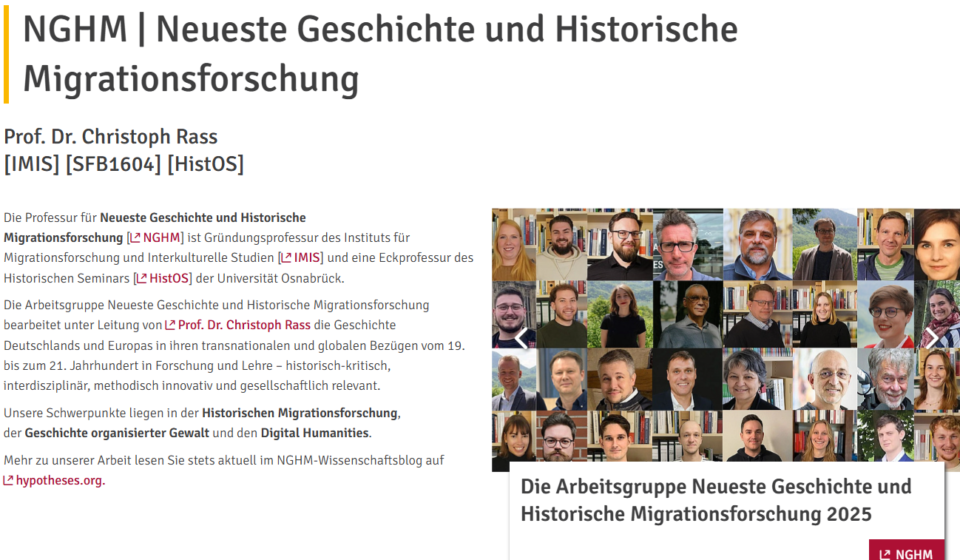
In April and May 2025, the University of Osnabrück, along with all its facilities, departments, and institutes, will switch to a new version of its website. This includes the Research Group for Contemporary History and Historical Migration Research (NGHM).
After our new online presence went live at the beginning of the month, the NGHM team has now modernised two additional sections of the website.
The menu items “Conflict Landscapes” and “Negotiating Migration” have just gone online as extensions of our research profile.
In the research field “Negotiating Migration”, we examine the emergence and development of modern migration regimes in the 20th century. The focus is on the question of how migration was not only administered but actively negotiated – between international organisations, states, civil society actors, and the migrants themselves.
The focus of our research lies on the period after the Second World War, when millions of people lived as so-called “Displaced Persons” (DPs) in Europe. International organisations such as UNRRA and IRO developed procedures for registering, caring for, and resettling these people. Categories such as “refugee” or “DP” were used not only for description but also for political control. The research group shows that these terms are historically developed and politically charged.
A central concern of the project is to make visible the agency of people under conditions of violence-induced migration or mobility. In interviews with authorities, when applying for support, or in self-organisation in camps, migrants actively negotiated their rights and perspectives. We link this micro-level of negotiation with a view of macro-political developments to draw a more complete picture of social, cultural, and institutional relations in migration regimes.
In the research field “Conflict Landscapes”, we have been dedicated since 2014 to the history of violence-shaped places and their transformations. The Interdisciplinary Research Group Conflict Landscapes has since then captured numerous historical sites of violence – from “battlefields” to Nazi camp sites to crime scenes of the Shoah – in their material and discursive transformation. Central to this is the interdisciplinary collaboration between history, archaeology, geography, geoinformatics, and didactics.
One of the research group’s most recent major projects was “Deadly Forced Labour in Karya”, which was conducted in Greece in 2023 with a network of international partners. The Osnabrück team investigated the railway station Karya, where in 1943 approximately 300 Jewish men from Thessaloniki were deployed for forced labour. An ongoing project deals with the former sites of the “Emsland camps” and develops a didactically considered concept for their digital development.
For us, conflict landscapes are dynamic spaces in which history, memory, and the present overlap. Examining these places in their continuous transformation and multi-layered nature helps to understand them not only as historical sites but also as constantly active elements of memory culture.
The new homepage also features the Working Papers & Short Reports of the Interdisciplinary Research Group Conflict Landscapes.