
This post was automatically translated from the German original at
Sussex Depesche #2.
The second day of the Landecker Digital Memory Lab inaugural Expo – Exploring the Future of Digital Holocaust Memory at the University of Sussex in Brighton began for the Osnabrück team with the two-hour workshop Mapping the Past and the Production of History: Low-Tech, Participatory Approaches to Documenting Holocaust Sites, and Conflict Landscapes.
Following an introductory lecture on the methods and projects of the research group for Contemporary History and Historical Migration Research at the University of Osnabrück and a discussion round on experiences and approaches in Digital Humanities within Holocaust Studies, a “hands-on” session formed the focus of the event.
Participants were able to try out the processes from collecting 3D models of material culture through editing, contextualisation and hosting to integrating the materials into a digital exhibition themselves, providing extensive opportunity to become familiar with the NGHM workflow in participatory projects with students and representatives of civil society groups, and to network, exchange ideas and test selected tools while working with them.
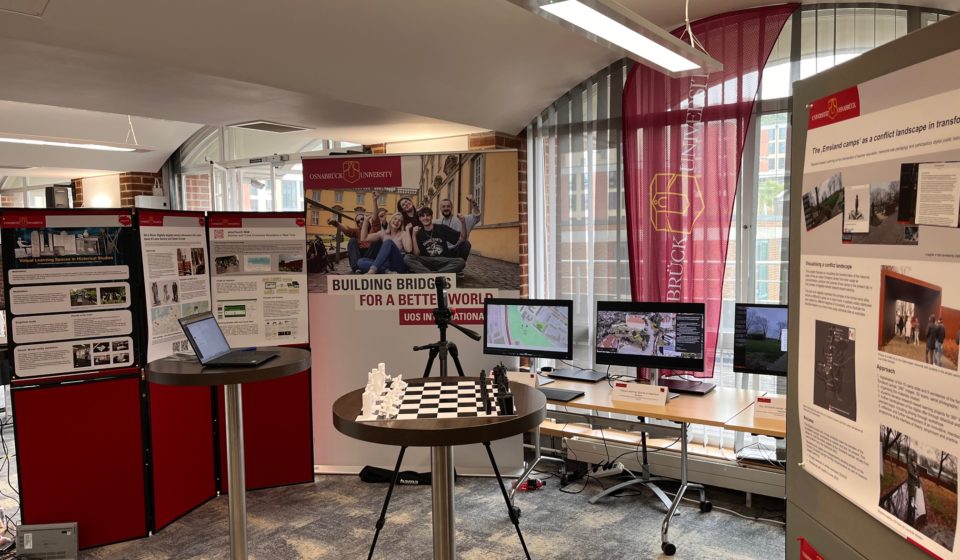
While part of the team had the opportunity to attend lectures and workshops during the rest of the day, the Exhibition Space also opened today, where the Osnabrück stand is present and invites visitors to engage more closely with our projects and methods.
The first conference day ended with a keynote by Eva Pfanzelter, who presented a four-stage model for the development of digital Holocaust discourse and research in her lecture, which she developed in her monograph “#URL Holocaust digital. Verhandlungen des Genozids zwischen Public History, Geschichtspolitik und Kommerz” [Negotiations of Genocide between Public History, Politics of History and Commerce] (2023). The model shows how memory of the genocide has changed in parallel with technological developments.
The first phase of “digitalisation” began, according to the author’s analysis, in the mid-1990s with the transfer of Holocaust content to the early internet. Websites had a strongly text-oriented character due to technical limitations, while projects like Nizkor and the Cybrary established themselves as instruments for combating Holocaust denial. This period marked the fundamental reconceptualisation of Holocaust education for digital media.
From 2007 onwards, social media fundamentally changed the forms of communication in Holocaust memory. The mechanisms of liking, sharing and commenting opened up new possibilities for participation, but simultaneously enabled the increased spread of antisemitic content. Linear narratives of institutional actors were challenged by the fluid structures of social media. Parallel to this, the systematic integration of digital technologies into Holocaust education developed from the 2000s onwards. Digital interview archives became central instruments for preserving survivor testimonies. Projects by the USC Shoah Foundation and other institutions aimed to extend the “aura of witness testimony” through the use of digital technology.
The speaker characterised the current phase as the era of digital storytelling, marked by a convergence of archival technologies and social practices of sharing. New narrative forms are emerging that indeed challenge traditional boundaries of appropriateness in the context of Holocaust research. Examples such as “Eva.stories” on Instagram or Holocaust-related computer games demonstrate the expansion of memory culture into popular cultural spheres. Pfanzelter’s analysis illustrated to conference participants how digital media not only expand the practices of Holocaust memory but structurally transform them, highlighting the necessity of a differentiated consideration of the opportunities and challenges of digital memory culture.