
Out Now | Ramirez & Rass: Producing Integration. The Translation of Non/Belonging in Germany and the United States @ History and Theory Early View.

This post was automatically translated from the German original at
Out Now | Ramirez & Rass: Producing Integration. The Translation of Non/Belonging in Germany and the United States @ History and Theory Early View..
On July 11, 2025, texts by the interdisciplinary working group Translations of Migration were published as Early View in a forum of the journal History & Theory; the print edition of the forum Translation, Migration, Narrative will follow in September.
Since 2020, the working group Translations of Migration has formed a format for exchange among literary and cultural scholars, historians, and representatives of Ethnic Studies from the USA and Germany regarding the production of the meaning of migration in academia and society.
The nine scholars have now compiled their observations, experiences, and findings in the forum edited by Julie Weise (University of Oregon, Eugene) and Christoph Rass (University of Osnabrück).
All contributions are available open access. Access to the essay by Rass and Ramirez is enabled through Project Deal by the University of Osnabrück.
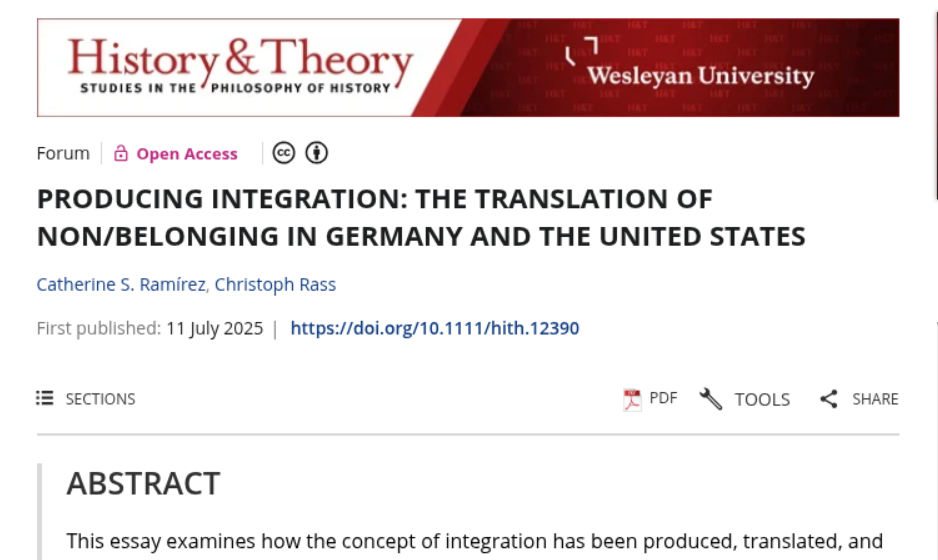
In their contribution Producing Integration. The Translation of Non/Belonging in Germany and the United States Catherine Ramirez and Christoph Rass examine from a contemporary historical perspective the translation of the concept of integration as a mechanism for producing social order. They combine conceptual history and translation theory to show how different concepts of “integration” translate people into “migrantized” subjects while reproducing hierarchies of belonging.
The authors trace the German conceptual history from racist concepts of “Umvolkung” [population replacement] from the Nazi era through the integration paradigms of the postwar era to today’s idea of “integration” as a central field of migration policy action. In parallel, they analyze the US-American practice of market-based differential inclusion, which formally dispenses with explicit integration definitions but achieves similar effects through programs like DACA and historical exclusion mechanisms.
Particularly revealing is the analysis of how older forms of exclusion translate into contemporary governance structures. Germany, for instance, transformed the temporality logic of the “Gastarbeiter” [guest worker] model into the toleration system, while the USA manages a subset of its undocumented population with DACA without breaking through the fundamental illegality framework.
Both case studies illustrate how concepts that are today expressed with the term “integration” provide mechanisms for managing social change on the one hand, while simultaneously enabling the reproduction of existing power relations.
So far, five texts from the forum are available online; the introduction by Christoph Rass and Julie Weise as well as an essay by Anand Yang will follow shortly.
History and Theory – Forum: Translation, Migration, Narrative
Journal: History and Theory (ISSN: 1468-2303)
Publisher: Wiley Online Library
URL: https://onlinelibrary.wiley.com/toc/14682303/0/0
1. From Secrecy to the Public Sphere: Translating Chinese Sworn Brotherhood Practices for Western Audiences
Authors: Albert Manke, Fredy González
DOI: https://doi.org/10.1111/hith.12393
Status: Open Access
2. Producing Integration: The Translation of Non/Belonging in Germany and the United States
Authors: Catherine S. Ramírez, Christoph Rass
DOI: https://doi.org/10.1111/hith.12390
Status: Open Access
3. Travelers in Translation: Of “Liminal Spaces” and “Literary Contact Zones”
Author: Laura A. Zander
DOI: https://doi.org/10.1111/hith.12388
Status: Open Access
3. Migration, Mobility, and Being in Translation
Authors: Peter Schneck, Julie M. Weise
DOI: https://doi.org/10.1111/hith.12389
Status: Open Access
5. List, Assemblage, Interruption: Migrant Literature Against Story
Author: Kirsten Silva Gruesz
DOI: https://doi.org/10.1111/hith.12391
Status: Open Access