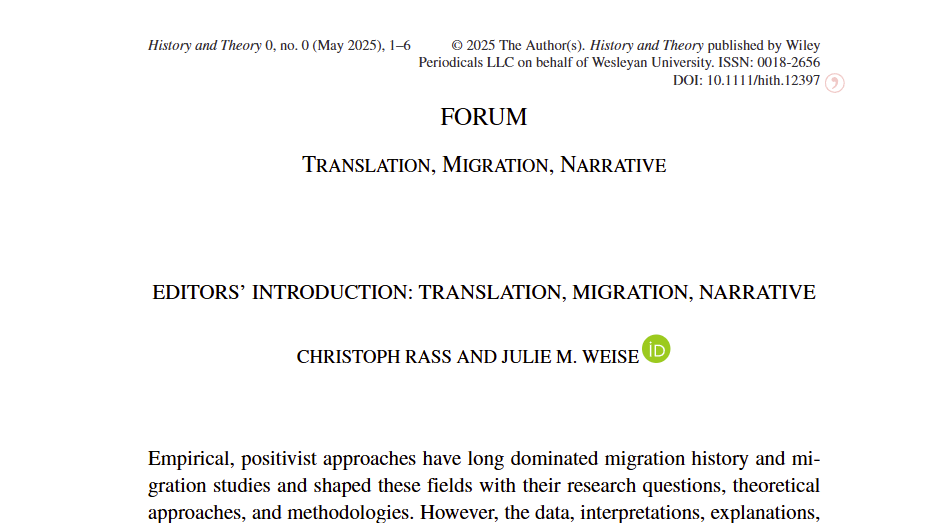
Out Now | TRANSLATION, MIGRATION, NARRATIVE – Editor’s Introduction by Julie Weise and Christoph Rass in History & Theory.

This post was automatically translated from the German original at
Out Now | TRANSLATION, MIGRATION, NARRATIVE – Editor’s Introduction von Julie Weise und Christoph Rass in History & Theory..
The Forum on the Translation of Migration, recently published in the journal History & Theory, is now fully accessible online as Early View.
In the introduction to the Forum, co-edited by Julie M. Weise from the University of Oregon, Eugene, and Christoph Rass from the Institute for Migration Research and Intercultural Studies at the University of Osnabrück, the two historians argue for a shift in perspective in migration research. As a reflexive corrective to often dominant empirical-positivist approaches, they propose “translation” as an analytical framework.
Their argument: migration researchers do not observe neutrally, but through their scholarly work themselves contribute to the production of migration figures and narratives. Translation here means more than linguistic transfer – it encompasses cultural meaning-making that can both inscribe power structures and create spaces for migrant self-determination. This perspective is also pursued by the Osnabrück Collaborative Research Centre 1604 from the viewpoint of a “production of migration”.
The interdisciplinary Forum now available, in which literary and cultural scholars as well as historians from Germany and the United States have collaborated, connects postcolonial translation theories with migration history and shows how translation processes shape social realities: from political concepts like “integration” to migrant testimonies. The reflexive turn in migration research demands that when analytically engaging with such phenomena, one questions one’s own role in knowledge production and develops new narrative forms that neither force migrant experiences into prefabricated categories nor uncritically reproduce politically or academically dominant perspectives. The approach through translation can help to perceive cultural and linguistic encodings of the meaning of migration more differentially and to benefit from this sharpened perspective both when reading process-generated data and when producing scholarly narratives about “migration”.