History@SFB: DOMiD Workshop with Students of History and IMIB

This post was automatically translated from the German original at
History@SFB: DOMiD-Workshop mit Studierenden der Geschichtswissenschaft und des IMIB.
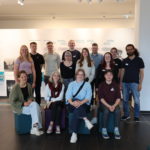
On 27 June, the first test workshop of the SFB 1604 transfer project “Reflexive Migration Research in the Museum” took place. For this event, the project team members Aladin El-Mafaalani, Lale Yildirim, Annika Heyen, Johannes Pufahl and Tim Ott, together with students from the History programme and the Master’s programme “International Migration and Intercultural Relations” (IMIB), were guests at the project’s external application partner, the Documentation Centre and Museum of Migration in Germany (DOMiD), represented by Bebero Lehmann and Sandra Vacca.
The aim of the workshop was to test various technical tools, which are primarily intended for use with the so-called Exhibition Builder, as well as time schedules under practical conditions, before beginning work with civil society, extra-university groups. The Exhibition Builder is designed to give civil society actors the opportunity to design their own exhibitions in virtual environments or to revise existing ones so that they feel more strongly represented along with their own history. Both the Exhibition Builder and the second tool, the so-called Place Changer, serve in the transfer project “Reflexive Migration Research in the Museum: Potentials and Perspectives of Virtual Realities” to investigate the extent to which digital methods and virtual realities enable a shift of agency in the narration of migration history towards migrantised actors who are underrepresented in the traditional museum landscape.
The group of participants for this first test workshop consisted of students from History as well as the Master’s programme “International Migration and Intercultural Relations” (IMIB). After examining the Virtual Reality application “Fragments of Migration History”, which had been compiled in advance and shown at the international opening conference of SFB 1604 “Production of Migration: Figures, Infrastructures and Spaces“, the group received a tour of the DOMiD facilities. Sandra Vacca and Bebero Lehmann provided insights into the genesis of Germany’s largest collection of objects and testimonies documenting the diverse history of migration in Germany.
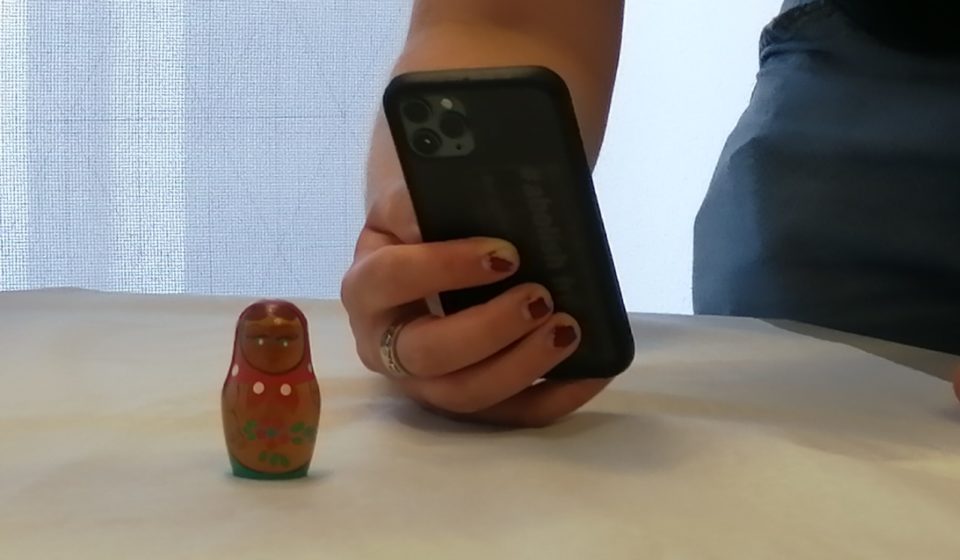
An introduction to the DOMiD database enabled the students to research such objects. Divided into two groups, they searched for items that, in their view, represented aspects of the history of German migration history – and especially social groups – that had not yet been narrated in the permanent exhibition. The first group dealt with objects on the theme of “arrival” on the one hand, but also with developing voice and agency of migrantised persons on the other. They selected a matryoshka doll and a rocking horse from the Landesstelle Unna-Massen, the first arrival point for many resettlers from the Soviet Union between 1975 and the early 1990s, as well as a rubbish bin that was used as a prop for the first Turkish cabaret in Germany, Knobi-Bonbon, but also as a speaker’s podium at demonstrations. The second group showed interest in long-term perspectives for migrants in the Federal Republic as well as in the topic of civilian sea rescue. They chose the headlamp of a Korean miner, a sewing box belonging to a Turkish immigrant, and a life ring from the Cap Anamur I, whose crew rescued Vietnamese boat refugees in the South China Sea from 1979 to 1982.
Using their own digital devices, the students transformed the selected objects into digital 3D models through photogrammetric scanning. These models are currently being integrated into the existing application “Fragments of Migration History” by Michael Brinkmeier and other colleagues from the Chair of Computer Science Education, and the design wishes of the workshop participants are being implemented. Once this work is completed, the students will be able to revisit the digital exhibition modified according to their wishes.
Insights from this first test workshop on 27 June are now being incorporated into the refined planning of events with extra-university civil society groups.