
This post was automatically translated from the German original at
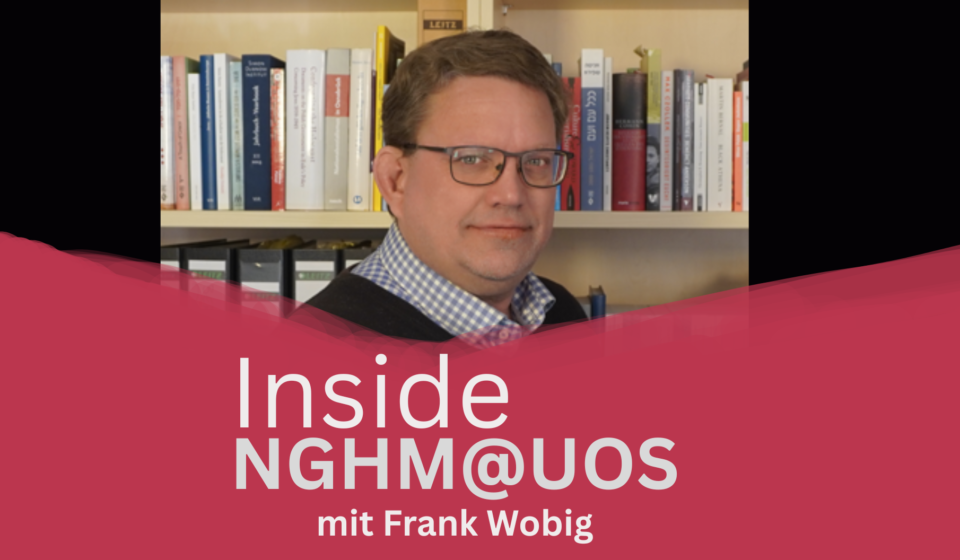
Inside.NGHM | Frank Wobig.
With the Inside.NGHM series, we regularly provide insights into research and teaching at the Chair of Contemporary History and Historical Migration Research at the University of Osnabrück, but above all we introduce the scholars who work behind the scenes.
In the second issue, Frank Wobig reports on his studies at UOS, his activities as a student assistant and his daily work in the NGHM secretariat.
Frank Wobig studied History and Sociology in the two-subject Bachelor’s programme and has been enrolled in the Master’s programme in Contemporary History at the University of Osnabrück since 2020. Since 2020, he has been a student assistant at the Chair of Contemporary History and Historical Migration Research and has been managing the secretariat there since October 2023 as part of a temporary position.
How did you find your way to the University of Osnabrück?
My path to the University of Osnabrück and ultimately to my current role in the NGHM secretariat led me as a student via the second educational pathway: After having been professionally active for several years, building on training as a technical draughtsman and as a clerk for office communication, I realised that my activities neither fulfilled me nor corresponded to my interests. A few years ago, it happened that an adult education lecturer advised me, with regard to professional prospects, to consider taking up university studies via the second educational pathway. I didn’t have to think long about it, because in principle the lecturer merely confirmed what I had already been thinking about for some time. However, since I didn’t have the Abitur qualification that would have given me access to studies in my desired subject “History”, I subsequently enrolled at the Osnabrück Adult Education Centre for the preparatory course for the “Immaturenprüfung” [university entrance examination for non-traditional students].
After a period of intensive studying and successfully completed examinations – including with Professor Dr. Oltmer – I had made it and was able to matriculate at the University of Osnabrück in History and Sociology in the two-subject Bachelor’s programme. I then successfully completed my undergraduate studies with a thesis on forcibly recruited Luxembourgers who were interned as military prisoners of the Wehrmacht in the Emsland camps, in the field of Contemporary History.
What is your role in Team NGHM?
I had and have the interest to make “more” of my studies in History and the opportunities offered to students at the university, and to always go one step further. For this reason, following my Bachelor’s thesis and at the beginning of the Master’s programme in Contemporary History, I sought a conversation with Professor Raß and enquired whether there would be the possibility of starting as a student assistant for Team NGHM. After working for several years in various projects, I have been managing the NGHM secretariat since October 2023 as part of a temporary position. My professional experience as a clerk for office communication serves me well in this role. Furthermore, I am simultaneously preparing for my Master’s thesis, which will build on the experiences of my work as a student assistant.
What does your working day look like? What do you like about your work?
I would say that communication and organisation are the essential attributes of my daily work in the secretariat: I am the contact person for organisational questions for students, lecturers as well as colleagues from the Historical Seminar and the administration. In close collaboration, I support Professor Raß as well as the team assistants of the chair – Lukas Hennies and Jessica Wehner – among other things with teaching and appointment organisation, provide organisational and administrative support with personnel matters, procurement, budget administration and invoice processing, the organisation of events with internal and external guests and much more.
The NGHM secretariat is open to the public from Monday to Thursday between 8:30 and 12:30, and beyond that I work additional hours per week from home office. In addition to my work in the secretariat, I currently give an “OMEKA” tutorial for students as part of my employment as a student assistant, for those who are dealing with the topics of forced migration, refugee policy and society in Lower Saxony after the Second World War in the context of a seminar with Sebastian Huhn.
With regard to my work in the secretariat, I like that, aside from work routines, varied, responsible and complex tasks challenge me. Furthermore, through my work I gain fascinating insights into the university cosmos: How does a university function? What is organisationally necessary for teaching, research and administration to merge into the institution where we study, teach, work and which, as the University of Osnabrück, enjoys a high reputation externally? As a “simple” student, these insights and the resulting understanding of internal processes would have remained largely hidden from me. Thus I have got to know the University of Osnabrück from a completely new perspective and continue to learn a little more about it every day. Last but not least, I also appreciate the good cooperation with colleagues in Team NGHM and the individual organisational units in Faculty 1 Cultural and Social Sciences: Beyond the necessary hierarchies, we can rely on each other and support each other as a team with problems and questions.
As a student assistant at NGHM, I deal with topics and methods on a project basis that go beyond the content of History studies. My work initially included collaboration in the evaluation of the Osnabrück foreigners’ registration card index. Subsequently, I moved to various projects with work focuses in Conflict Landscapes Studies, Military History and Holocaust Studies. My task in these projects includes, among other things, creating virtual exhibitions on the internet with OMEKA, an open-source web publishing system. This platform was specifically developed for presenting and managing digital collections, especially in the fields of humanities, museum work, archives and libraries. OMEKA is also used at NGHM in teaching to introduce students to “digital storytelling” projects.
Furthermore, I participate in field research, analyse historical aerial photographs and digital terrain models using Geographic Information Systems (GIS). In addition to research in archives, I am also involved with academic literature management, critical source analysis and editorial work.
What I particularly like about working as a student assistant at NGHM is that I gain fascinating insights into various historical research projects and into the practice of academic work. As a “Hiwi” [student assistant], I am right in the middle of the action, so to speak, and am encouraged in my work, but also challenged to develop my abilities and contribute. For me, the direct insights into the multi-perspective and interdisciplinary approaches in research and teaching that I receive as part of my work are particularly valuable, as they give me the opportunity to develop holistically as a person. I also really enjoy working as a tutor, where I can pass on my knowledge to fellow students within a limited framework.
What sparked your interest in Contemporary History?
One of the initial sparks for my interest in Contemporary History and in historical topics in general was a cinema visit many years ago. At that time, I attended a screening of Steven Spielberg’s “Schindler’s List” with my class as part of a school project week on the topic of “Holocaust”. I can remember that the film was my first conscious visual confrontation with the fate of European Jews during the Nazi period and that this experience moved me deeply and lastingly. From then on, my interest in engaging with this historical thematic complex grew. For example, I dealt with the topic of the “Wannsee Conference” on 20 January 1942 as part of the examination to obtain my secondary school certificate. Furthermore, in retrospect, the presence of war-related “flight” and “loss” narratives in my family history certainly also played a role, so that my initial interest in Contemporary History was essentially shaped by perspectives on National Socialist tyranny and the Second World War.
I find social history questions and analyses particularly fascinating, such as those concerning the social and geographical mobility of Displaced Persons as well as labour migrants in the Federal Republic of Germany: What individual negotiation processes condition(ed) this mobility, can patterns be identified, and what conclusions can be drawn for present and future migration processes? These are just some of the questions I engage with in this context and for which my interest was sparked through various project work during my history studies.
What topic would you absolutely like to attend a university course on?
Building on the publications by Katrin Himmler, a great-niece of Heinrich Himmler, as well as Monika Hartwig, the daughter of the commandant of Płaszów concentration camp, Amon Göth, I would like to attend an interdisciplinary workshop examining historical and action-theoretical questions about possible processing and repression processes within families of former Nazi perpetrators. I am interested in the multi-perspective examination of individual and intergenerational strategies of action by actors within a family unit. What scope for action exists within an affected family in the ambivalence between justification and coming to terms with the past, and what effects do these have on the identity of individual actors and the family? Is their own history discussed and what narratives exist? How is the behaviour of their relative reflected upon? Are there indications of secondary traumatisation and what specific symptoms can be identified? How were and are affected families perceived by society? I would like to explore these and other questions and publish the results using possible case studies.
Where would you like to organise an excursion?
I would like to lead students on a visit to the Porta Westfalica Concentration Camp Memorial and Documentation Centre to trace the history of war economy and forced labour in the final phase of the Second World War: At Porta Westfalica, the Weser breakthrough between the Wiehen and Weser mountains south of Minden, several underground sandstone quarries were requisitioned for armaments production from March 1944. The aim was to secure goods and operating materials needed for the continuation of the war in underground armaments relocations, protected from air raids through the use of forced labour. The deployment of thousands of forced labourers, transferred to Porta Westfalica from concentration camps including Neuengamme and Auschwitz, who had to expand the underground facilities and work in production under precarious living and working conditions, was a repressed history in post-war society for a long time.
The memorial site currently in the process of development is suitable for critical reflection on memory and commemoration of violence against forced labourers in the regional area as well as a site of the armaments industry in the Second World War. During a guided tour through the former underground relocation “Dachs I” in the Weser mountains, there is also the opportunity to visualise the enormous expenditure of resources that was used to maintain armaments production until shortly before the end of the Second World War and what living conditions the forced labourers faced when expanding the facilities. Students would thus have the opportunity to engage with the fascinating transformation process from repression to active engagement with a “conflict landscape” shaped by National Socialist tyranny. Questions about the discrepancy between the idyllic landscape and tourist marketing of the present on one side and historical violence on the other, as well as the search for the seemingly vanished traces of this “conflict landscape”, can be critically reflected upon by students here.
Which museum did you last visit?
My last museum visit was in 2023 and took place as part of an excursion by Maik Hoops and Jessica Wehner to the “Hospital Museum” at Bremen-Ost Hospital. The reason for the visit was the permanent exhibition “Insane?! Psychiatry – Society – Art”, which addressed the history of the “Bremen-Ost Hospital” psychiatry up to the most recent past. In the exhibition, historical treatment devices illustrate to visitors the respective contemporary therapy and treatment methods. Interactive learning stations and audio points offer the opportunity to listen to the experiences of patients, doctors, nursing staff and relatives. The museum pursues questions such as “What is ‘crazy’?” or “How do we deal with illness?” and dedicates a focus to the history of Bremen psychiatry under National Socialism. For me, the visit was a first more intensive engagement with the complex topic of psychiatric history and I was able to take away many new approaches to thinking and can recommend a visit to this small but very informative museum.
What interests do you have outside your work at the university?
As a historian, I cannot change my nature – and therefore it is actually no surprise that alongside my work at the university and as a student, I predominantly engage with historical topics in my free time: for me, there is always something exciting to discover and explore. In this respect, there is no clear dividing line between professional and student interest on one side and private curiosity about historical topics on the other. Since I also like to be “on the move”, I often combine extended hikes and excursions with visits to historically interesting places such as war cemeteries or seek out ancient ring wall installations and “lost places” in the broadest sense.
Of course, I also have a life beyond the stories from history: From my perspective, a society can only function if we contribute as actors and engage – within the framework of our individual possibilities: Thus, I have been a member of the Bad Essen-Eielstädt-Wittlage Volunteer Fire Brigade since my youth and have been active in the operational department there for many years. I have thus learned the firefighting craft “from the ground up” and can now look back on many years of exciting but sometimes (challenging) operations. Entry and exit are voluntary – the rest is duty as a member of a volunteer fire brigade. This means that I am on call 24/7 and when an alarm sounds, I immediately go to the fire station, equip myself and proceed with our emergency vehicles to the scene. This may not only be in my home district of Wittlage, but has also led me to places throughout Lower Saxony as part of disaster relief, such as during the moor fire near Meppen in 2018. But regular participation in training exercises and courses is also part of the duties one undertakes in this voluntary service. This effort is rewarded by the fact that I can contribute to helping other people when they find themselves in an emergency situation – an experience that is always valuable and meaningful for me anew. I am particularly fascinated by the fact that no operation is like another and one is constantly faced with new challenges. In the fire brigade, we must be team players, we must be able to rely on each other and catch each other when there is a need for conversation after stressful operations.
In addition to my involvement in the volunteer fire brigade, I am a member of the local council of Bad Essen as well as an advisory member of the municipal council faction of my party, for which I have also been working as press spokesperson since 2014. What I find exciting about local political work is that I have the opportunity to actively participate in shaping and developing my home community.