
This post was automatically translated from the German original at
NGHM-Tracker (3/26).
The monthly newsletter of the Research Group Contemporary History and Historical Migration Research at the University of Osnabrück
By Benjamin Look & Jessica Wehner
In February, the lecture-free period began for Team NGHM, and with it the concentrated work on texts, projects and presentations. In addition, several trips were scheduled – for example to Hamburg or Bremen.
Our February newsletter reports on the diverse activities of the team.
Insights
In teaching, the staff of the Chair of Contemporary History and Historical Migration Research repeatedly try out new (digital) methods and tools together with students. A concept that has proven successful by now are the digital exhibition projects designed by our students, two of which went online in February. Both emerged from courses by Prof. Dr. Christoph Rass and combine source-based analysis with digital presentation formats.
After the academic editing of the contributions by Valentin Loos, M.Ed. – in close coordination with the University Archive – could be completed, the two exhibitions implemented with the Omeka-S system have now gone online. They make results from research and teaching publicly accessible – and invite readers not only to read about Osnabrück university and city history, but also to explore it analytically:
The University of Osnabrück – Foundation and Early Years
Lohstraße – Urban History Reflected in a Street
We have already reported extensively on the publication on our blog:
The following exhibitions are already accessible online, some emerging from courses, others from research projects:
- War Cemetery Hürtgen
- War Cemetery Vossenack
- Prisoner of War Camp Hollerath
- ‘Camp II Aschendorfermoor’
- ‘War Cemetery’ Dalum
- The Camp System in Emsland
- Maly Trascjanec: The Perpetrators
- Maly Trascjanec: The Culture of Memory
- Maly Trascjanec: Transformations of an Extermination Site
- Path of Memory I. The Disenfranchisement in Vienna and Deportation to the East
- Path of Memory II. The Persecution and Extermination in Maly Trascjanec
- Path of Memory III. The Commemoration in Maly Trascjanec
- Osnabrück in the First World War
- Osnabrück “Papenhütte”
- „Arrival Quarter Weidenstraße? A Contribution to Osnabrück Migration History”
Not only has our exhibition portfolio grown:
The series of IMIS Working Papers has been expanded by two contributions that address a common question from different perspectives: How do language, knowledge and categories produce those social orders or phenomena that we negotiate as ‘migration’?
Both texts originated at the Chair of Contemporary History and Historical Migration Research at the University of Osnabrück and connect to the work in the Collaborative Research Centre 1604 ‘Production of Migration’ . In doing so, they take up two strands that have shaped the work of the NGHM research group for years: the conceptual history of key categories in migration politics and the critical analysis of those knowledge orders that determine how societies negotiate belonging and exclusion.
IMIS Working Paper 22, ‘Gastarbeiter’ in the Nazi Press (1933–1945). Formative Years of a Key Term in Migration Politics, turns to a hitherto insufficiently researched phase in the history of a term that the NGHM research group has been investigating for over a decade.
IMIS Working Paper 23, On the Relationship between Production and Projection. Reflexive Perspectives on Antigypsyist Knowledge Orders, authored by Christoph Rass and Jonathan Roters, goes back to a lecture at the academic opening event on the Concept of Z-Projection on 8 September 2025 in Hanover. The contribution undertakes a different approach to the question of how categories establish social order.
History@SFB1604
From 23 to 25 February 2026, the SFB 1604 retreat 2026 took place in Bremen, where the subprojects and the participating project members came together for intensive exchange. The A3 project team – Christoph Rass, Lale Yildirim, Ahmet Celikten and Maik Hoops – was fully represented at the retreat. For the team, Christoph Rass presented on Monday afternoon on initial results of the corpus linguistic analyses and gave an outlook on the work and publication programme for 2026.
Tuesday began with an intensive programme, including discussions on “Production Approaches” and a PhD session. Subsequently, the first SFB podcasts were presented. The first two episodes come from subproject A3: Christoph Rass and Catherine Ramirez speak with migration researcher Czarina Wilpert in episode 1, in episode 2 Christoph Rass and Lale Yildirim engage with the work of journalist Gerhard Kromschröder and his book “Als ich Türke war” [When I Was a Turk].
Furthermore, the members of the Transfer Project “Reflexive Migration Research in the Museum” met for a strategy meeting with the SFB leadership as well as colleagues from public relations. The aim was to take stock of project progress since the start of funding as well as to discuss further steps for the near future and for the remainder of the project duration.
Additionally, A3 met with SFB 1604 subprojects A5 and C1 for an exchange on corpus-based research approaches.
On the last day of the retreat, the A3 project participated in the “Media Linkages” session with a group of projects from all three clusters (Figure, Infrastructure, Space). In the closing session of the retreat, Christoph Rass presented the empirical work of the A3 project within the framework of a discussion among A-cluster projects on methods, data, and result perspectives.
The SFB 1604 A3 team recently welcomed Elif Çelik as a new student assistant. She is a first-semester master’s student in the Conflict Studies and Peacebuilding programme. She will support the project particularly in text collection, corpus expansion, and data management for Turkish-language materials being compiled for the dissertation projects. We are pleased to have her on our team!
Notes
Last week, the excursion report on the visit to the Neuengamme Concentration Camp Memorial was published.
Neuengamme concentration camp was one of the largest forced labour camps in northern Germany. More than 100,000 people were imprisoned there, at least 42,000 of them perished. Due to various historical developments, decisions, and external circumstances – as with many former concentration camps – only few original structural remains are preserved today. Nevertheless, the memorial succeeds in conveying the history of the site in a vivid and comprehensible manner through comprehensive exhibitions and professional guided tours.
The exhibition catalogue “Karya 1943. Forced Labour and Holocaust” was recently published. This documents a multi-year German-Greek collaborative project on the reappraisal of a long-forgotten chapter of the Holocaust and places it in its historical context.
On our research blog, we have already reported extensively on the prospection conducted in Karya in March/April 2023 as well as the resulting research findings.
Further information and resources:
- Exhibition website: karya1943.eu
- NGHM blog posts on the project: nghm.hypotheses.org/26650
- Documentation film on the research prospection by Timos Zdoupas (virtUOS) on the University of Osnabrück’s YouTube channel: https://youtu.be/LX1htpk2Qck
- Documentation Centre NS Forced Labour: ns-zwangsarbeit.de
- Foundation Memorial to the Murdered Jews of Europe: stiftung-denkmal.de
From 25 to 27 February, Imke Selle travelled to the University of Hamburg to participate in the FUER colloquium together with Lale Yildirim. Various dissertation projects were presented here and a further development of the FUER model (Förderung und Entwicklung eines reflektierten und selbst-reflexiven) [Promotion and Development of Reflective and Self-Reflexive] Historical Consciousness was discussed.
Blog Posts in February
- Jessica Wehner and Benjamin Look: NGHM-Tracker (1-2/26), 2 February 2026.
- Team NGHM: Out Now | Karya 1943. Forced Labour and Holocaust – The Catalogue for the German-Greek Travelling Exhibition, 5 February 2026.
- Team NGHM: Online Now | Two New NGHM Exhibitions, 6 February 2026.
- Team NGHM: Out Now | Two New IMIS WP on the ‘Production of Migration’, 20 February 2026.
- Imke Selle: There and Back Again | Excursion to Neuengamme Concentration Camp Memorial a report by Leonie Güneri, 23 February 2026.
Outlook & Current Events
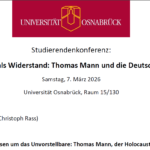
On 7 March, 9 am to 5 pm, a student conference will take place as part of the course “Words and/as Resistance. Thomas Mann and the German Listeners” offered by Christoph Rass, Sebastian Musch, Sebastian Huhn, Annika Heyen and Jessica Wehner. Interested parties are cordially invited. The conference programme will appear shortly on our blog.