There and Back Again | Nuremberg between the Middle Ages and National Socialism – An Excursion into the Historical Layers of a City

This post was automatically translated from the German original at
Hin und wieder zurück | Nürnberg zwischen Mittelalter und Nationalsozialismus – Eine Exkursion in die historischen Schichten einer Stadt.
From 17 to 19 March 2026, a joint excursion by the Chair of Medieval History (Christoph Mauntel) and the Chair of Contemporary History and Historical Migration Research (Christoph Rass) at the University of Osnabrück took the group to Nuremberg: a city that, like few others in Germany, not only preserves layers of the past and history but also permanently renegotiates them.
Medieval imperial city, stage for the performance of National Socialist rule, birthplace of international criminal law, and site of ongoing debates about how to deal with historically tainted architecture: Nuremberg condenses these phenomena within a confined space. Under the direction of Christoph Rass (Contemporary History) and Christoph Mauntel (Medieval History), students from the Historical Seminary explored nine stations in Nuremberg and Fürth over the course of three days.
The program was deliberately interdisciplinary in design, placing the medievalist and the contemporary historical perspectives on the city in a productive tension with one another. It was guided at the same time by a fundamental consideration that served as a common thread throughout all three days: what we perceive in Nuremberg as historic building fabric is, for the most part, reconstructed. The question of what is “authentic,” what is staged, and what is reconstructed proved to be far less straightforward than the picturesque surface of the city might suggest.
Day 1: Critical Perspectives on Global Interconnectedness
The starting point on the afternoon of 17 March was a guided tour of the special exhibition “Nuremberg GLOBAL 1300–1600” at the Germanisches Nationalmuseum, the largest cultural history museum in the German-speaking world with over 1.3 million objects. Across approximately 1,000 square meters, some 200 exhibits from 25 lenders made visible the global networks of the early modern commercial metropolis.
At the center of the visit at the outset was the Behaim Globe of 1492/93: the oldest surviving depiction of the Earth in spherical form (designated a UNESCO Memory of the World in 2023), and at the same time a world map without the Americas, since Columbus landed on the Bahamas at precisely the same time, while the Earth’s circumference was dramatically underestimated at only 29,000 kilometers. The exhibition itself demonstrated how Nuremberg goldsmiths worked with coconuts and ostrich eggs from the Indian Ocean, and how motifs by Albrecht Dürer were received in Indian manuscript painting. However, it also directed attention to the darker sides of this interconnectedness: Nuremberg trading houses were not only involved in the transatlantic slave trade, but also waged bloody economic wars along the East African coast in concert with the Portuguese. The fact that the acquisition history of the Behaim Globe is itself historically tainted — it was acquired for the Germanisches Nationalmuseum in 1937 with the support of the then Lord Mayor Willy Liebel and Adolf Hitler — illustrated, already on the first day, the entanglement of culture and political instrumentalization so characteristic of Nuremberg.
From there, the route led to the Straße der Menschenrechte (Way of Human Rights), the walkable artwork by the Israeli artist Dani Karavan inaugurated in 1993: 27 white concrete columns, each eight meters tall, bear abbreviated articles of the Universal Declaration of Human Rights in two languages each. Karavan, who had lost family members in the Shoah, experienced the decision to create art in the former “city of the Reich Party Rallies” and of the Nuremberg Race Laws as a profoundly personal challenge. Nevertheless, he understood the work as a “moral counterpoint to Nuremberg’s history in the first half of the twentieth century.” The inauguration of the Way is indeed regarded as the birth of the city’s international human rights profile, which subsequently crystallized in the Nuremberg Human Rights Award (established 1995) and the International Human Rights Film Festival. In October 2018, Nuremberg conferred honorary citizenship upon Karavan. He died on 29 May 2021 in Tel Aviv.
The first day ended at the Fränkische Weinstube in the Handwerkerhof at the Königstor: a staged recreation of a “medieval” artisans’ quarter erected in 1971 to mark the 500th anniversary of Albrecht Dürer’s birth, originally conceived as a temporary attraction, which was never demolished and for over 50 years has been the first thing many tourists see of Nuremberg. The site thus raised, already on the first evening, the fundamental question that ran through the entire excursion and proved essential to understanding the city: Nuremberg’s old town is 90 percent postwar reconstruction, the Imperial Castle was rebuilt according to National Socialist-era renovation plans, and the Handwerkerhof is a fantasy medieval quarter from the 1970s. What is genuine, what is construction, and who decides?
Day 2: Reception of the Middle Ages, Nazi Propaganda, and Camp History
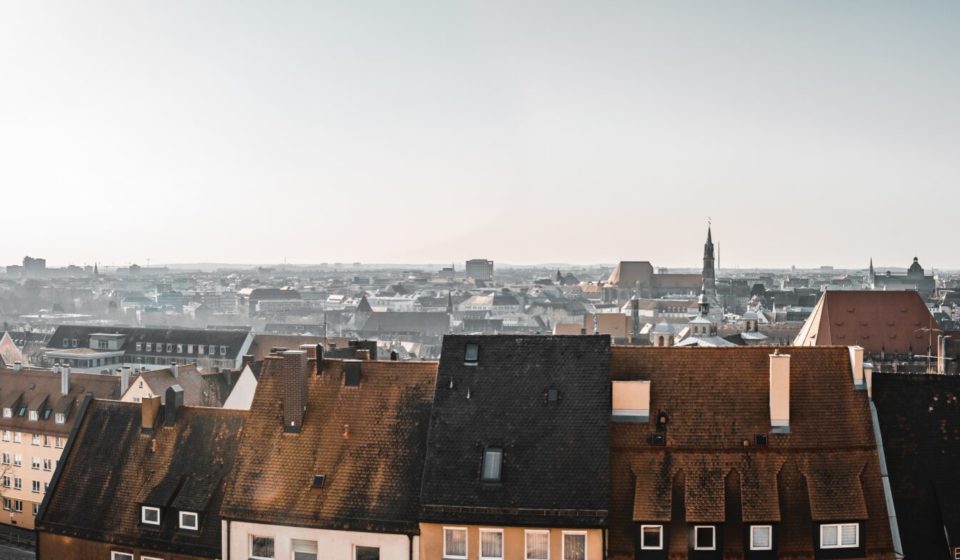
The second day was thematically the most dense of the entire excursion. It began with a tour of the old town that made tangible the tension between Nuremberg’s medieval history and its near-total destruction on 2 January 1945. The scale of this destruction can be expressed in figures: 521 RAF Lancaster bombers dropped 6,000 high-explosive bombs and over one million incendiary bombs within the space of an hour; 90 percent of the medieval old town was destroyed, 1,800 people were killed, and 100,000 were left homeless. The subsequent decision in favor of a middle path between modern reconstruction and historical restoration — iconic buildings such as the Albrecht-Dürer-Haus were restored, while new structures were adapted in scale and character without being copies — continues to shape the cityscape to this day, while simultaneously complicating any simple distinction between “original” and “reconstructed.” Most recently, archaeological discoveries have attracted considerable attention: in 2024, one of the largest mass graves ever excavated in Europe was uncovered in the city center (approximately 1,000 skeletons of plague victims from the epidemic of 1632/33, with an unusual green coloration caused by copper oxide), and excavations at the Hauptmarkt yielded turquoise-glazed ceramic fragments from Raqqa in northern Syria within a twelfth-century stratum, attesting to Nuremberg’s early role in long-distance trade.
At the Imperial Castle, the guided tour “Kaiserburg und Hakenkreuz” [“Imperial Castle and Swastika”] by Geschichte für Alle e.V. concentrated the central theme of the day: the National Socialist instrumentalization of medieval symbolism to legitimize the regime. From 1933 onwards, the National Socialists declared Nuremberg the “city of the Reich Party Rallies” and deliberately used the medieval castle as a propaganda backdrop. Albert Speer aligned the Große Straße of the Reich Party Rally Grounds directly toward the Imperial Castle: the symbolic linking of medieval imperial diets and National Socialist mass spectacles was thus architecturally materialized. The city model of 1939, which the group examined on site, documents not only 2,580 buildings in linden wood at a scale of 1:500, but also the traces of the National Socialist “old town renovation”: the main synagogue on Hans-Sachs-Platz, demolished on 10 August 1938, is absent, and the model thus becomes an unwitting witness to the destruction of Jewish life in the city.
The afternoon was devoted to a walkthrough of the Reich Party Rally Grounds, which extend across 11 square kilometers in the southeast of the city. The focus was on an aspect that has long remained marginal in the public perception of the site: the prisoner-of-war camp Stalag XIII D. Established in September 1939 in the SA camp buildings, this camp grew into a vast complex in which, at its peak, 150,000 prisoners from all occupied countries were interned. Following the launch of Operation Barbarossa in June 1941, Soviet prisoners of war flooded in en masse. More than 5,000 prisoners of war and forced laborers lie buried in individual and mass graves at Nuremberg’s Südfriedhof; only since 2017 has this history been systematically researched through an international research project. The walkthrough made clear that the Reich Party Rally Grounds were not only a site of National Socialist spectacle, but simultaneously a site of imprisonment, forced labor, and mass death. Its layers of memory overlap and comment upon one another in turn.
After a lengthy tour of the grounds of the “Reichsparteitage” [“Reich Party Rallies”], unfortunately no time remained for an exploration of the interim exhibition “Nürnberg – Ort der Reichsparteitage. Inszenierung, Erlebnis und Gewalt” [“Nuremberg – Venue of the Reich Party Rallies. Staging, Experience and Violence”] at the Documentation Center. This is housed in the north wing of the unfinished Congress Hall, the third-largest surviving National Socialist monumental building in Germany. The glazed ‘stake’ designed by Austrian architect Günther Domenig, opened in 2001, pierces the Nazi structure diagonally: a deliberate architectural rupture with the building’s monumental aesthetics. The exhibition is the first to consistently adopt the local perspective as its narrative principle, structured around four ‘time periods’ (1918–1933, 1933–1939, 1939–1945, 1945–2020). At the same time, however, the future of the building itself has become the subject of intense debate: on 28 January 2026, the city council voted by a large majority to convert the circular structure of the Congress Hall from 2028 onwards into studios, studio stages, and a performance venue for the Staatstheater. The question of whether such a cultural repurposing of a National Socialist building revitalizes or trivializes remembrance accompanied the evening’s follow-up discussion at the hotel.
Day 3: International Criminal Law and Jewish History
On the third day, the programme led first to the Palace of Justice and Courtroom 600. It was here, on 20 November 1945, that the most significant criminal trial in history began: for the first time, individuals (politicians, military officers, industrialists) were held personally accountable before an international court for crimes against international law. The ‘Nuremberg Principles’ formulated here — individual criminal responsibility, no protection under national law, no protection by virtue of official position or rank, and ‘superior orders’ as no grounds for exemption — form a direct line to the International Criminal Tribunals for the former Yugoslavia (1993) and Rwanda (1995), as well as to the International Criminal Court in The Hague, which commenced its work on 1 July 2002. 123 states have ratified the Rome Statute. Notably, Courtroom 600 was used as an active courtroom for over 100 years; the last regular hearing took place as recently as 1 March 2020. The Memorium, opened in 2010, now faces its most significant expansion to date: Phase 2 (planned for 2027–2029) will double the exhibition space by approximately 635 square metres and, for the first time, make the historic deliberation room of the Allied judges accessible to visitors. This positions it as the only museum site in Germany dedicated to informing the public about the history of modern international criminal law. In parallel, a renewed UNESCO World Heritage nomination for the entire Palace of Justice has been underway since February 2024.
The excursion concluded with a visit to the Jewish Museum Franconia in Fürth, with the guided tour “Ein fränkisches Jerusalem” [“A Franconian Jerusalem”]. This drew the arc back to the first day, unfolding the question of the expulsion, coexistence, and destruction of Jewish life in Franconia across a long period of more than five centuries. In 1499, Emperor Maximilian I expelled all Jews from Nuremberg. Many settled in the nearby town of Fürth, whose unique political structure of ‘triple lordship’ (the Bishopric of Bamberg, the Margraviate of Ansbach, and the Imperial City of Nuremberg) permitted settlement without a ghetto. In the early nineteenth century, almost 2,500 Jewish men and women lived in Fürth, comprising approximately 20 percent of the population. The town possessed several synagogues, a renowned Talmudic school with students from across Europe, and a centre of Hebrew printing. Hence the epithet ‘Franconian Jerusalem’. During the Night of Pogroms on 9–10 November 1938, the entire Schulhof — the religious centre of the community, comprising a complex of synagogues, a Talmudic school, library, rabbi’s house, mikveh, and kosher butcher’s shop — was destroyed. Three hundred years of Jewish history were obliterated in a single night. The museum, opened in 1999 (exactly 500 years after the expulsion from Nuremberg), houses in its cellar a mikveh dating from around 1600, and in its rear building a rare permanently installed sukkah with an original coffered ceiling; a virtual reality application reconstructs for the first time the Schulhof destroyed in 1938. The guided tour connected both the long history of Jewish life in Franconia and its violent destruction with the question of the possibilities and limits of museum reconstruction. It is a question that arises at almost every site in Nuremberg.
What Remains
Overall, the interdisciplinary design of the excursion proved analytically productive. The interweaving of medievalist and contemporary historical approaches revealed a foundational structure of Nuremberg’s urban history that would have remained invisible under a purely period-bound perspective: Nuremberg’s ‘medieval’ heritage is not simply a historical given, but a resource renegotiated anew in every era — from the Golden Bull of Charles IV (1356) through the National Socialist instrumentalization of the Imperial Castle to the postwar reconstruction and the fantasy medievalism of the Handwerkerhof. The city is permanently engaged in constructing its own image.
In Nuremberg, sites of spectacle and sites of suffering were intertwined within a confined space. This entanglement proved to be the key to understanding the current debates over memorial politics. The Nazi Party Rally Grounds were not merely a backdrop for mass parades, but simultaneously the location of a prisoner-of-war camp in which tens of thousands were interned under inhumane conditions. The Congress Hall, planned as a National Socialist monumental building and never completed, serves today both as a documentation centre and, in the future, as a cultural performance venue. The debate over whether such repurposing revitalizes or trivializes remembrance remains unresolved. The 88-million-euro restoration of the Zeppelin Tribune, the UNESCO nomination for Courtroom 600, the cultural development of the Congress Hall, and the archaeological discoveries in the city centre are all negotiating the question of how to deal with historically burdened sites — not in the past, but in the present.