
This post was automatically translated from the German original at
NGHM liest | Edward Hallett Carr: What is History? (1961).
Our series “NGHM Reads” opens with Edward Hallett Carr’s What is History?, in which the 65 titles of the NGHM reading list from the field of historical theory and historiography are presented. Carr’s six lectures, delivered in Cambridge in 1961 and broadcast on BBC Radio, formulated a question that every generation of historians has since had to answer anew: What exactly are we doing when we write history?
Who was the man who posed this question? Edward Hallett Carr (1892–1982) did not come to historical scholarship by the conventional route. He studied Classics at Trinity College, Cambridge, entered the diplomatic service in 1916, and participated in the Paris Peace Conference of 1919. From 1936 he taught as Woodrow Wilson Professor of International Politics at University College of Wales, Aberystwyth; this was followed by years as Assistant Editor at The Times, a tutorship at Balliol College, Oxford, and finally a return to Cambridge as a Fellow of Trinity College. His major work is the fourteen-volume series A History of Soviet Russia, published between 1950 and 1978. Politically, Carr had moved to the left over the decades; intellectually, he positioned himself as an opponent of naive empiricism. When he delivered the George Macaulay Trevelyan Lectures in January 1961, it was not a theorist in an ivory tower who spoke, but a diplomat, journalist, and large-scale historian who knew the practice of his discipline from multiple perspectives.
The central thesis can be stated quickly, yet is difficult to refute. History, Carr argued, is not a mere collection of objective facts, but an ongoing process of interaction between historians and their sources: an endless dialogue between the present and the past. Carr draws a sharp distinction between ‘facts of the past’ and ‘historical facts’: the latter become such only through the selection and interpretation of researchers. The now-famous injunction in the first chapter captures this succinctly: “Study the historian before you begin to study the facts.”
Across six chapters, Carr develops this argument systematically: from the relationship of historians to their facts, through the interplay of individual and society, the question of whether history is a science and what role moral judgments play, the problem of historical causation, to the idea of progress as the foundation of historical thinking. The concluding chapter synthesizes these arguments and advocates for a forward-looking historiography that takes seriously the interaction between subject and object. In doing so, Carr charts a middle course: neither the naive empiricism that believes in the objectivity of ‘facts’, nor the absolute relativism that declares every statement about the past to be arbitrary.
The counterarguments were not long in coming. Geoffrey Elton, in The Practice of History (1967), attacked Carr’s distinction between ‘historical facts’ and ‘facts of the past’ as an expression of an arrogant attitude toward the past; he saw in Carr’s idea of progress a secular version of medieval salvation history, in which ‘Progress’ assumes the role of God. Hugh Trevor-Roper, writing in Encounter (1962), attacked Carr’s disinterest in counterfactual scenarios and described historians who studied only the victors of history as “bad historians.” Isaiah Berlin, writing in the New Statesman in 1962 under the title “Mr Carr’s Big Battalions,” criticized Carr’s treatment of individual motivation and moral judgment. Later generations have identified a further lacuna: the exclusively masculine language of the book and Carr’s largely complete disinterest in questions of gender.
What endures? Carr’s insight that historians are not neutral collectors of objective facts but active interpreters whose selections are shaped by their own present has today become part of the foundational stock of historiographical thinking. The book has sold over a quarter of a million copies worldwide. Richard J. Evans situated it, in his introduction to the 2001 reissue, within the context of the epistemological debates of the late twentieth century; David Cannadine edited the 2002 successor volume What is History Now?, in which ten historians answered Carr’s question for a new generation (among them Alice Kessler-Harris with the chapter “What is Gender History Now?”, which addresses precisely Carr’s blind spot).
Nevertheless, Carr’s formula of the ‘endless dialogue’ contains a tension that the book itself does not resolve: if the present determines which facts become ‘historical facts’, who then decides which presents count, and which pasts remain silent? Those who take Carr’s argument seriously will find themselves asking, later in this series, what happens when Michel-Rolph Trouillot’s Silencing the Past intervenes at precisely this point and examines the power-laden nature of that selection which Carr still described as dialogue.
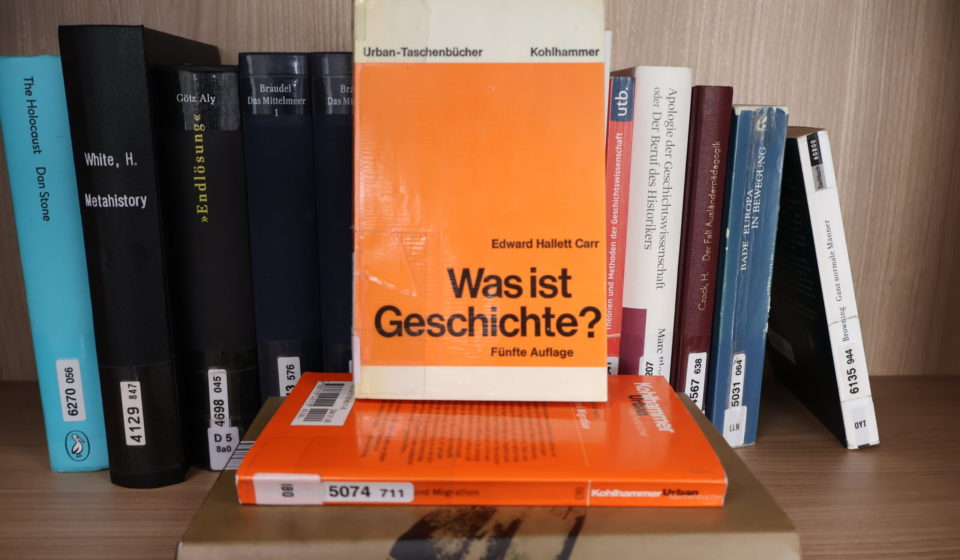
Students at Osnabrück will find Carr’s What is History? in German translation in the Bereichsbibliothek Alte Münze (open stacks) under the call number 4372-189 6 (OPAC).
Edward Hallett Carr (1892–1982), What is History? The George Macaulay Trevelyan Lectures Delivered in the University of Cambridge January–March 1961, London: Macmillan 1961 (new edition with introduction by Richard J. Evans: Basingstoke: Palgrave Macmillan 2001).
This post is part of the NGHM Reads series of the Chair in Contemporary History and Historical Migration Studies at the University of Osnabrück (Prof. Dr. Christoph Rass), in which the 65 titles of the NGHM reading list are presented. The list can also be explored online as a knowledge graph.