
This post was automatically translated from the German original at
Hidden Legacies, Untidy Endings. Notes from the InechO Conference in Florence..
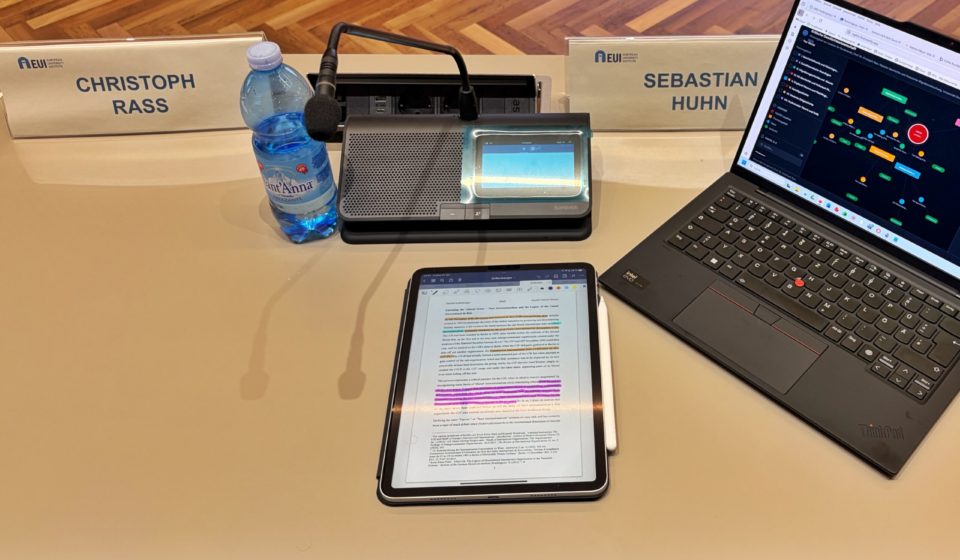
What happens to an international organization after it has ceased to exist? On 23 and 24 April 2026, the Alcide De Gasperi Research Centre at the European University Institute in Florence convened a conference of the InechO project (International Organizations and their European Consequences and Hidden Outcomes) on precisely this question.
The framework, developed by Kiran Klaus Patel and his research team at LMU Munich, traces the afterlives of discontinued international organizations along three vectors: people, ideas and practices, resources and objects.
Our work at NGHM on the figure of the ‘displaced person’ and the management of violence-induced mobility in the aftermath of the Second World War, situated within the SFB 1604 ‘Production of Migration’ at Osnabrück University, examines how the political and administrative categories of forced migration are produced and carried forward through the bureaucratic infrastructures, normative frameworks, and practices of international organizations. The IRO sits at the heart of that question. Our paper, which will appear as a chapter in the planned edited volume of the InechO project and was discussed in Florence, reconstructs how the IRO came to an end as an institution.
When we set out, we considered framing the work around the entire interwar network of refugee organizations, from the League’s High Commissioner for Refugees and the Nansen Office through the Intergovernmental Committee on Refugees and UNRRA. For the paper we finally narrowed the scope to the IRO to gain analytical depth in a paper limited in length. After Florence, that earlier framing returns as a necessity rather than an option.
Our Argument in Brief
The International Refugee Organization (IRO, 1946–1952) was singular in form, combining legal protection and non-refoulement, material care, and the logistical mass resettlement of those classified as ‘displaced persons’ and ‘refugees’ under one institutional roof. Its end fits neither the model of orderly succession nor that of plain dissolution. We propose ‘functional disaggregation’ as a fourth termination type: the deliberate decomposition of an integrated mandate across several successor organizations, each inheriting a specific set of functional components while actively denying institutional continuity. The UNHCR took on legal protection on a minimal budget. The well-resourced ICEM, today’s IOM, received the operational transport apparatus and twelve IRO vessels. The split was not a byproduct of organizational decline. Rather, it was political design, driven above all by the United States. A ‘double amnesia’ accompanied the process: both successors disavowed their IRO origins in carefully curated archives and shifted founding narratives.
Comments by Jessica Reinisch: The Argument Travels Backward
Jessica Reinisch’s (Director of Birkbeck’s Centre for the Study of Internationalism) discussion of our paper on Friday morning gave us an incisive analysis of our chapter and made, among a number of valuable comments, one decisive point. The pattern we describe for the IRO’s end already characterizes its beginning. UNRRA also had been an integrated organization whose dissolution distributed functions unequally across successors. The IRO is hence not only predecessor but successor as well. Indeed, the historiographical invisibility of the UNRRA–IRO continuity becomes legible through our own model, as an effect of the same curated amnesia we trace on the successor side. The intervention proves productive because the longer chain (High Commissioner for Refugees in 1921, Nansen Office, IGCR, UNRRA, IRO) was the framing we had originally pursued before narrowing it. Florence brought it back. Functional disaggregation does not describe a single termination event. It names a recurrent mode in which the international community has organized and reorganized its response to violence-induced mobility for the better part of a century.
Resonances Across the Programme
Five contributions to the conference resonated particularly closely with our argument. Jane Mumby’s analysis of buildings supplied the sharpest counter-image, and Geneva’s architectural geography turns out to map the geometry of disaggregation almost exactly. The IRO took up its headquarters at the Palais Wilson on the Rue des Pâquis, the lakeside hotel that had served as the League of Nations’ first home from 1920 until the League moved into the purpose-built Palais des Nations in Ariana Park in 1937. When the IRO arrived in 1947, it occupied offices in a building that had become a site representing an older order. The UNHCR, by contrast, was placed in 1951 in three rooms of the Palais des Nations itself, the active UN seat, and only moved into its own purpose-built headquarters on the Rue de Montbrillant in 1995. ICEM, and the IOM, the other partial successor of the IRO, never enjoyed that kind of placement: for more than three decades the organization rotated through low-profile rented addresses around Geneva, almost invisible in the city’s diplomatic landscape, until it acquired its own building on the Route des Morillons in 1984. Legal protection – even if modestly funded – was elevated to the symbolic core. Transport of labor migrants – otherwise well-funded – was kept at the urban periphery. The predecessor’s headquarters faded in a former hotel by the lake that became a Swiss administration building.
Alessandro Venieri’s paper on data and statistics in international organizations opened an adjacent axis. What outlasts an organization that was set up to solve an imminent crisis is often less a structure than a knowledge infrastructure: the categories, surveys, and statistical conventions that travel into successors regardless of formal succession. The IRO’s eligibility manuals, which migrated into UNHCR practice and from there into national asylum systems, sit on precisely this axis. So do the IRO case files, which continued to be used by successor and tracing organizations for decades after the IRO itself had ceased to exist. Nicole Albrecht described an ‘institutional dispersion’ of the League’s rural welfare programmes across WHO and UNICEF. The contrast with our case lies in agency: where the IRO was disaggregated from above, Albrecht’s Eastern European health experts deployed dispersion strategically, as a mode of survival for their professional networks. Miguel Bandeira Jerónimo introduced ‘institutional refraction’ for the transition from the late-colonial CCTA to the Organization of African Unity, a process in which legal arrangements, technical office routines, and European expert networks ran asynchronously into the successor, and pragmatic appropriation paradoxically carried colonial hierarchies into post-colonial projects. Marine Pierre traced a kindred politics of forgetting in the OEEC-to-OECD transition, where colonial baggage was rhetorically dissolved into the language of a global think tank.
What We Take Away
The two days in Florence confirmed that the architecture of contemporary ‘global governance’ is shaped, often invisibly, by such hidden legacies. The line between ‘refugees’ and ‘migrants’ that gives today’s international regime its basic geometry is not a natural fact but the direct outcome of a very specific production of migration, shaped by infrastructural, normative, praxeological, and spatial transformations, among those the formation of the modern ‘refugee regime’ by a lineup of international organizations that were set up and terminated from the 1920s to the 1950s. The disaggregation of the IRO was one event in that complex chain. Reinisch’s intervention, and the resonances across the programme, push the argument back into the longer history we had set aside for the paper we wrote: the interwar refugee organizations, their predecessors, and the recurrent logic by which integrated mandates are repeatedly decomposed and selectively forgotten. Functional disaggregation is hence not the description of an endpoint. It names a mode in which international institutions have ended and begun for the better part of a century, and it opens new avenues for understanding the production of migration in greater granularity.