Research Revisited | Twelve Years of the Interdisciplinary Working Group Conflict Landscapes at the University of Osnabrück

This post was automatically translated from the German original at
Research Revisited | Zwölf Jahre Interdisziplinäre Arbeitsgruppe Konfliktlandschaften an der Universität Osnabrück.
Conflict Landscapes in Osnabrück:
An Interim Assessment after Twelve Years
In spring 2026, the project “The ‘Emsland Camps’ as a Conflict Landscape in Transformation. Research-Based Learning at the Intersection of University Teacher Education, Memorial Pedagogy, and Participatory Digital Public History” is racing towards its conclusion. The endeavor builds on preliminary work carried out between 2020 and 2022 within the BKM program “Jugend erinnert” [“Youth Remembers”], which included geoarchaeological investigations at Emsland camp sites, and it simultaneously marks a milestone: that of work which has been systematically pursued at the University of Osnabrück since 2014/15. It is precisely this interlinking of ongoing research, university teaching, and public outreach that provides the occasion to undertake a retrospective on twelve years of conflict landscape research.
The present contribution reconstructs the work of the Interdisciplinary Working Group on Conflict Landscapes (IAK) in six steps. In what follows, current formats of research-based learning are first outlined, followed by a detailed presentation of the ongoing Emsland Camps project. A third section returns to the genesis of the IAK since 2014/15 and traces its conceptual foundations and cooperative structure. This is followed by an account of the methodological approach that marks the Osnabrück position within the field of conflict landscape studies. A chronological overview of projects, conferences, and publications between 2014 and 2025 follows. An assessment closes the contribution and asks about the institutional conditions under which the Osnabrück approach in research, teaching, and public engagement can be sustained.
I. Research-Based Learning 2025/26
Conflict landscape research at the University of Osnabrück is consistently embedded in courses that convey how acts of violence reshape their sites and how, in the longue durée, this gives rise to the production of interpretation and meaning, of visibility and invisibility. A number of formats from the years 2025 and 2026 illustrate this exemplarily.
In March 2025, a day excursion led to the ZeitZentrum Zivilcourage in Hannover. In June 2025, Imke Selle and her team, as part of a Digital Public History workshop at the Esterwegen Memorial with pupils from the Georgianum Lingen, piloted a 360° offering covering the fifteen former camp sites and the nine camp cemeteries. On 28 November 2025, a further day excursion to Esterwegen followed, likewise under the direction of Imke Selle.
In the winter semester 2025/26, Christoph Rass addressed the perspectives of conflict landscape research at the NGHM professorship in the lecture course “Introduction to the History of the Holocaust.” Arising from the lecture course, a two-part day excursion to Ibbenbüren followed. On 19 January 2026, the documentary film “Schwarzer Zucker – rotes Blut” [“Black Sugar – Red Blood”] by Luigi Toscano was screened at the Bürgerhaus Ibbenbüren, reconstructing the fate of Anna Strishkowa, who was registered at the ramp of Auschwitz-Birkenau in December 1943 at just under four years of age. On 27 January 2026, the 81st anniversary of the liberation of Auschwitz, the Catholic School Chaplaincy Ibbenbüren invited guests to the Kulturhaus Ibbenbüren for the commemorative event “Stimme der Geschichte – Erinnern für unsere Zukunft” [“Voice of History – Remembering for Our Future”]. A contemporary witness conversation with Dr. Boris Zabarko, historian and Holocaust survivor from Kyiv, had been planned; after he was unable to travel for health reasons, Anna Strishkowa once again became the focal point. Christoph Rass provided the historical introduction. The format of the contemporary witness conversation offered a different framing than the film screening on 19 January: rather than the mediated transmission of the documentary film, the direct conversation took center stage, enabling students to experience both formats of transmission and to compare them with one another.
A likewise January 2026 two-stage excursion under the direction of Imke Selle took students to the KZ-Gedenkstätte Neuengamme: on 16 January, one group visited in person with a guided tour and critical engagement with the exhibition on the camp SS; on 23 January, a second excursion followed digitally through the audio tours and 360° tours of the fully digitized memorial. The format examines the analog and digital modes of accessing a site of violence and memory not as alternatives but as complements.
Research-based learning has been part of the IAK’s profile since its beginnings. The Karya prospection in spring 2023 was carried out with the participation of students as an excursion; the current Emsland Camps project is organized around a project seminar. Poster presentations, day excursions to memorial sites, and the Tiny Desk colloquia constitute standing formats in which research, public engagement, and teaching operate not in sequence but in concert.
II. The ‘Emsland Camps’ as a Conflict Landscape in Transformation
The currently running project operates across an area extending over more than 100 kilometers: fifteen concentration, penal, and prisoner-of-war camps existed between 1933 and 1945 in the Emsland and in the County of Bentheim. Most sites are today neither marked as memorial sites nor visible above ground. They are agricultural land, industrial areas, correctional facilities, residential areas. This is precisely where the project intervenes: it documents the transformation of these sites digitally over ninety years, from the establishment of the camps to the creation of the Esterwegen Memorial, which stands as the sole commemorative institution representing the entire camp system.
Methodologically, the project combines 360° panorama, 3D scanning, UAV photogrammetry, and geoarchaeological prospection with research-based learning in university teacher education. The digitization campaigns began in March 2024 with initial recordings at several sites; in May and June 2024, Camps IX Versen and XI Groß-Hesepe on the grounds of the Meppen and Lingen correctional facilities were systematically recorded; in 2025, further sites followed, along with a second student excursion to the camps Neusustrum, Oberlangen, Dalum, Alexisdorf (today Neugnadenfeld), and Wietmarschen. The consolidation of data within a digital public history infrastructure serves a dual purpose: an empirical reconstruction of the ‘Emsland Camps’ as an administrative and violent space, and a didactic translation that keeps students, pupils, and the regional public in mind as its addressees.
The project was established at the University of Osnabrück and has been implemented since the move of Lale Yildirim to Kiel University in 2024 as a collaboration between her and Prof. Dr. Christoph Rass at both institutions and with the Stiftung Gedenkstätte Esterwegen. History, history didactics, and the memorial jointly pursue a project situated at the intersection of research, teaching, and public engagement.
III. Conceptual Foundations since 2014
The IAK was formed in 2014/15 as an interdisciplinary working group bringing together history (across epochs), historical migration research, archaeology, geoarchaeology, remote sensing, and digital methods in the humanities and cultural sciences. It emerged at that time on the basis of more than two decades of cooperation between the History Department and its Professorship for Archaeology of the Roman Provinces with the Museum and Park Kalkriese at the site of the Battle of the Teutoburg Forest. From the research conducted there comes a finding that the IAK adopts and develops further in its own work: the thesis that post-battle processes — that is, the long-term transformations of a site of violence following the immediate events of combat — are no less relevant to the understanding of historical conflict landscapes than the reconstruction of the events themselves.
The IAK translates this finding into an independent program. Whereas *battlefield archaeology* reads a site as a reconstruction of military events, the Osnabrück approach extends the concept in two directions: temporally, by examining not only the event horizon but also the discursive, material, and memory-cultural transformation of the site across decades (or centuries), and thematically, by addressing not only ‘battlefields’ in the narrow sense but also camp landscapes, sites of Shoah extermination, spaces of occupation, border regimes, and sites of forced labor. Christoph Rass outlines the work of the IAK in a single sentence: “Wir untersuchen gewaltüberformte Orte als Konfliktlandschaften mit einem integrierten Methodenspektrum, das von den Naturwissenschaften bis zu den Geistes- und Kulturwissenschaften reicht.” [“We investigate sites shaped by violence as conflict landscapes using an integrated methodological spectrum ranging from the natural sciences to the humanities and cultural sciences.”]
Institutionally, the group is currently based at the Chair of Contemporary History and Historical Migration Research. With the appointment of a new holder of the Chair of Archaeology, leadership will pass to Prof. Dr. Marcus Zagermann. Since 2014, numerous scholars have worked within the network or cooperated with the group. The core group within the University of Osnabrück comprised, between 2014 and 2024, Joachim Härtling and Andreas Stele (Physical Geography), the respective representatives of Archaeology, Björn Waske, Thomas Jarmer and Marcel Storch (Remote Sensing and Digital Image Analysis, Computer Science), Andreas Brenne (Art Education), and, until her move to CAU Kiel in 2024, Lale Yildirim (History Education). An overview of members and cooperations during this phase is available on the group’s website.
Outside the University of Osnabrück, numerous strands of cooperation have grown from this period, each marking a distinct analytical point of convergence. The longest-standing and ongoing collaboration is with the Geschichtswerkstatt Minsk and Aliaksandr Dalhouski: the joint work focuses on the investigation of conflict landscapes shaped by German occupation, the war of annihilation, and the Holocaust in Belarus, ranging from Maly Trostenez to the ‘burned villages’ and ‘anti-partisan operations’, extending across several projects and teaching collaborations. With Valentin Schneider (National Hellenic Research Foundation, Athens), the Greece-related work converges: Schneider’s database of German military and paramilitary units in Greece 1941–1944/45, as well as the app project Pan-history and the Karya initiative, serve as shared points of reference. With Gernot A. Fink and the Pattern Recognition Group at TU Dortmund, the collaboration converges on the linking of machine learning and historical source corpora, most recently in the joint publication of the CM1 Dataset at ICDAR 2025. With the Stiftung Gedenkstätte Esterwegen, the shared focus lies first in “Boden|Spuren” [Soil|Traces] (2020–2022) and then in the current Emsland camp project, which places the Emsland conflict landscape at its center. Further completed project cooperations include: the Stiftung Denkmal für die ermordeten Juden Europas [Foundation Memorial to the Murdered Jews of Europe] and the Dokumentationszentrum NS-Zwangsarbeit Berlin [Documentation Center Nazi Forced Labor Berlin] in the Karya network (2022–2024), the Landschaftsverband Rheinland in the Hürtgenwald project (2020–2024), the University of Göttingen, the University of Latvia in Riga, and the Museum Friedland in the project “In Stein gemeißelt?” [Set in Stone?] (2022–2023).
IV. Methodological Chain, Interdisciplinary Network, Fieldwork
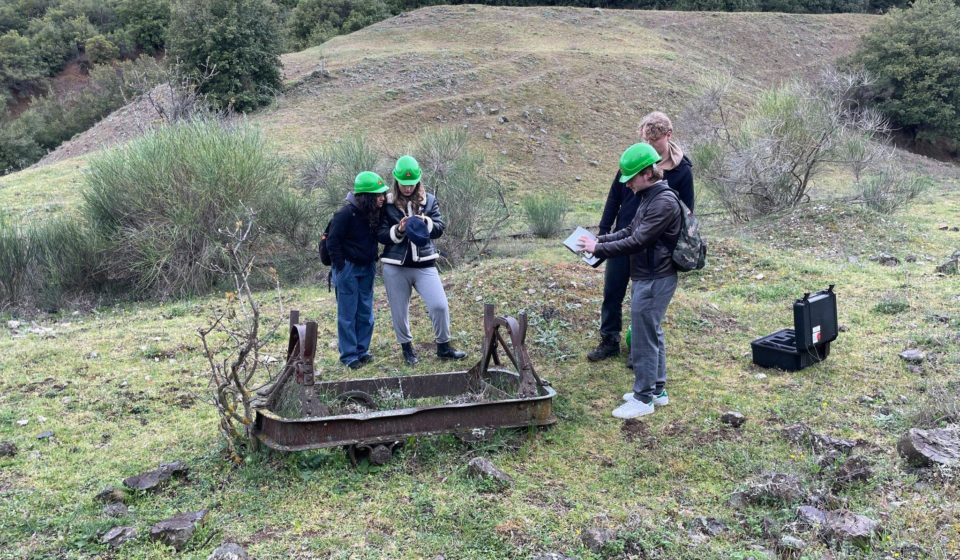
In methodological terms, conflict landscape research combines a set of non-invasive and geophysical techniques with archival source work, cartography, and digital public history. LiDAR remote sensing, magnetometry, ground-penetrating radar, and geoelectrics are used to detect subsurface structures; UAV photogrammetry and 3D scanning capture surface features at high resolution; 360° imaging documents the current condition of sites and renders them accessible through virtual tours. The evidence thus generated enters into an analytical dialogue with archival sources, aerial photographs from the Second World War, post-war satellite imagery, eyewitness accounts, and cartographic records. Only when this multimodality is robust are invasive methods (drilling, test trenches, excavations) considered at all. The methodological sequence is not merely justified on grounds of research economy. It takes an ethical position with respect to sites where human beings were persecuted, tortured, and murdered.
From this practice, the IAK has developed a typology that classifies modern conflict landscapes into three categories: Type 1 exhibits structural remains; Type 2 is characterized by clearly visible surface features; Type 3 possesses neither obvious structural remains nor surface traces. This classification is not merely an academic sorting system. It has consequences: it structures the choice of methods, it determines what can emerge as a finding at all, and it makes visible the fact that many sites of violence from the twentieth century now belong to the third category — that is, they are unmarked sites at which research must first create the preconditions for them to be discussed as sites of memory at all.
The five disciplines involved since the group’s founding (Physical Geography, Archaeology, Computer Science, History, and Artistic Practice) understand themselves neither as additive nor as competing perspectives, but as mutually enriching approaches in constant dialogue. This is a form of interdisciplinarity that goes beyond a mere juxtaposition of disciplinary findings. It demands collaborative engagement with the subject matter and produces a form of evidence that could not arise within any of the participating disciplines alone.
V. Projects, Conferences, Publications
Early Phase 2015–2017: Situating the Approach
The cross-epochal orientation of the group is documented by two inter-epochal excursions that make its profile visible. In 2015, a joint excursion by Christoph Rass and Christiane Kunst (Ancient History) to the Troad in the northwest of present-day Turkey reads the region under the title “Die Troas zwischen Antike und Erstem Weltkrieg” [“The Troad between Antiquity and the First World War”] as a layered conflict landscape in which the Battle of the Granicus (334 BC), the Trojan myths, and the fighting around the Dardanelles in 1915 overlap. From this excursion, Christiane Kunst’s edited volume Alexander der Große am Granikos emerges in 2018; an associated essay by Kunst and Anna Katharina Romund also opens Volume 1 of the Konfliktlandschaften series in 2022 under the title “Granikos. Die Schlacht im Kopf” [“Granicus. The Battle in the Mind”]. Two years later, in 2017, a second inter-epochal excursion by Christoph Rass, Christiane Kunst, and Thomas Vogtherr (Medieval History) follows to Malta, an island landscape whose conflict-generative strata range from antiquity through the Siege of 1565 to the aerial bombardments of the Second World War. Both excursions underpin the claim that conflict landscapes should not be conceived in epoch-specific terms, with concrete fieldwork that in turn is interwoven with university teaching.
As early as June 2016, the IAK presents first results of its multi-perspectival inquiry at the Kunsthalle Osnabrück, together with Forschende Kunst, under the title “Konfliktlandschaften erkunden: Eine Spurensuche zwischen Grund und Gründen” [“Exploring Conflict Landscapes: A Search for Traces between Ground and Grounds”] — tellingly in the format of a workshop with exhibition, a format that places artistic engagement on an equal footing with scholarly inquiry. In November 2016, a second workshop in Kalkriese follows, deepening the cooperation with the museum.
Consolidation Phase 2018–2019
The group reaches a first consolidation phase in 2018/19. In October 2018, it co-organizes, together with the Arbeitskreis Militärgeschichte e.V. and the Museum Kalkriese, the annual conference “Konfliktlandschaften. Militärgeschichte im interdisziplinären Dialog” [“Conflict Landscapes. Military History in Interdisciplinary Dialogue”].
In October 2019, the international specialist conference “Konfliktlandschaft Hürtgenwald” [“Conflict Landscape Hürtgenwald”] follows in Cologne, organized together with the Landschaftsverband Rheinland; in November 2019, a methods workshop in Osnabrück with the Stiftung Denkmal für die ermordeten Juden Europas [Foundation Memorial to the Murdered Jews of Europe] examines the application of conflict-archaeological methods to the documentation of mass graves of the Shoah. Running in parallel are, from 2017, the EVZ-funded project on transnational memories of Nazi forced labor and migration; from 2018, the Schärpenburg prospection in Heede; and from 2019, the cooperation on a database documenting the German occupation of Greece 1941–1944/45.
Peak Phase 2020–2024: Three Parallel Research Fields
The years 2020 to 2024 constitute a particularly dense phase. Three central strands run in parallel: first, the Hürtgenwald; second, the ‘Emsland camps’; third, the extermination sites in Eastern Europe.
Hürtgenwald. In the Hürtgenwald, the IAK carries out from 2020 to 2024 the LVR-funded project “Lernort ›Schlachtfeld‹? Neue Didaktik einer Konfliktlandschaft Hürtgenwald” [“Learning Site ‘Battlefield’? New Didactics of a Conflict Landscape: Hürtgenwald”]. A campaign in August 2020 documents anthropogenic interventions along the Kall Trail and renders visible instances of looting and re-enactor activities; further fieldwork in March 2023 supplements the survey; in November 2023, the closing conference “Lernort Schlachtfeld? Der Hürtgenwald im Blick interdisziplinärer Forschung und kritischer Vermittlung” [“Learning Site Battlefield? The Hürtgenwald in the Light of Interdisciplinary Research and Critical Mediation”] concludes the work. The project combines fieldwork and public engagement with the analysis of a problematic local culture of history in which Militaria literature and re-enactment reproduce revisionist narratives. A series of digital exhibitions on key sites within this conflict landscape is publicly accessible:
→ https://konfliktlandschaften.nghm-uos.de
The IAK’s Hürtgenwald research has also grown into the documentary discourse. In 2019, the working group cooperated with National Geographic on the series “Buried Secrets of WWII”; in the episode “America’s Bloodiest Battle” (Season 1, Episode 4, 24 September 2019), Pete Kelsey and Martin K.A. Morgan investigate the Hürtgenwald using digital 3D modeling. A further episode of the series on the ‘retaliatory weapon’ V2 incorporated magnetometric findings by the IAK at impact sites in southern England and a LiDAR terrain model of the site of the former Mittelbau-Dora concentration camp. In February 2020, WDR broadcast Carsten Günther’s documentary “Die Schlacht im Hürtgenwald” [“The Battle of the Hürtgenwald”], in which Christoph Rass contextualizes the IAK’s findings as historical commentator.
Emsland. In the Emsland context, the IAK cooperates from 2020 onwards within the BKM-funded program “Jugend erinnert” [“Youth Remembers”] with the Gedenkstätte Esterwegen [Esterwegen Memorial] in the project “Boden|Spuren” [“Ground|Traces”], and in parallel with the “Boden erinnert” [“The Ground Remembers”] project funded by the Kulturstiftung des Bundes [German Federal Cultural Foundation]. In August 2020, a team using drone-mounted LiDAR detects the location of burial sites at the Dalum war graves cemetery, where between 8,000 and 16,000 victims of Nazi rule are interred: the scale alone indicates the dimensions of violence within which these projects frequently operate. In December 2022, initial project results go online; in November 2022, the third autumn school in Esterwegen brings the project to a didactic conclusion.
Eastern Europe and Southeastern Europe. In Eastern Europe and the southeastern European region, four interconnected projects emerge between 2021 and 2024. The Federal Foreign Office funds from 2021 to 2023 the “Geoarchäologische Detektion und Dokumentation von Vernichtungsorten der Shoah in der Ukraine” [“Geoarchaeological Detection and Documentation of Shoah Extermination Sites in Ukraine”]. In 2021/22, in cooperation with the Geschichtswerkstatt Minsk [Minsk History Workshop] and with EVZ funding under the “Jugend erinnert” program, the digital development of the Maly Trostenez extermination site is undertaken, resulting in 2022 in the “Virtuelle Lernort Malyj Trostenez/Maly Trascjanec” [“Virtual Learning Site Malyj Trostenez/Maly Trascjanec”]. From 2022 to 2024, also with the EVZ and with Minsk, the project “Гвалт і памяць — Mapping the Co-Presence of Violence and Memory in Belarus” runs, focusing on the history of the ‘burned villages’ and National Socialist ‘anti-partisan warfare’, and finding expression in several publications, most recently in the edited volume Verbrannte Dörfer [Burned Villages] (Berlin 2024) and in Ost-West 26/4 (2025).
Karya. In the Greek village of Karya, a high-profile project of the group’s more recent history is carried out between 2022 and 2024. In the spring of 1943, the German occupiers had deported between 300 and 500 Jewish men from the Thessaloniki ghetto to the Karya railway station in central Greece, forcing them under lethal conditions to excavate a cutting more than 20 meters deep into the hillside. From 30 March to 6 April 2023, an IAK team led by Christoph Rass conducted a geoarchaeological prospection at the site.
The results feed into the trilingual traveling exhibition “Karya 1943 — Zwangsarbeit und Holocaust” [“Karya 1943 — Forced Labor and the Holocaust”] and into the eponymous catalog published in 2026, edited by the Dokumentationszentrum NS-Zwangsarbeit [Documentation Center Nazi Forced Labor], the Stiftung Denkmal [Memorial Foundation], and the University of Osnabrück. The exhibition website makes the results accessible:
The methodology and findings of the prospection are documented in IAK Working Paper 3, and the associated field report in IAK Working Paper 4. In parallel, the IAK produced, in collaboration with VirtUOS, a half-hour documentary film about the work in Karya.
→ Documentary film on the prospection: https://youtu.be/0QFPbqDYm-I
Methodological-Programmatic Projects and Tiny Desk
Parallel to this, between 2023 and 2024, two smaller, methodologically programmatic projects are running. “Pan-history”, developed jointly with Norbert de Lange (Environmental Informatics, University of Osnabrück) and Valentin Schneider (National Hellenic Research Foundation, Athens) and funded by the Lower Saxon Ministry of Science and Culture under the European and International Cooperation programme, develops an app for crowdsourcing-based long-term monitoring of conflict landscapes and field-tests it in 2023 at sites of violence in Greece. Alongside this, “In Stein gemeißelt? Digital erfahrbare Erinnerungsdiskurse im Stadtraum von Niedersachsen und Osteuropa” [“Set in Stone? Digitally Accessible Memory Discourses in the Urban Space of Lower Saxony and Eastern Europe”] is running under the Zukunftsdiskurse programme, jointly with the University of Göttingen, the Geschichtswerkstatt Minsk, the University of Latvia in Riga, and the Museum Friedland. In 2023, the project “Von der ›Grünen Hölle‹ zum ›Grünen Band‹. Gedenkort ›Juliushütte‹” [“From the ‘Green Hell’ to the ‘Green Belt’: Memorial Site ‘Juliushütte'”] of the Stiftung Naturschutz Thüringen is added, which, under the direction of Dr. Frank Wolff, addresses an outpost of the Mittelbau-Dora concentration camp at the former inner-German border. In March 2023, the Tiny Desk Colloquium “Conflict Landscapes: Archaeology, Landscape Conceptions, Narratives and Public History”, co-organized with Kalkriese, also takes place.
Publications
This empirical work is accompanied by a growing number of publications. In July 2022, the first two volumes of the Konfliktlandschaften series appear with V&R/Brill, edited for the working group by Christiane Kunst, Christoph Rass, Thomas Vogtherr, and Lale Yildirim. Volume 1 brings together 16 contributions on sites of violence from antiquity to the present, four of them presenting initial findings from the Hürtgenwald project; Volume 2 is Frank Möller’s analysis of revisionist militaria literature on the ‘Battle of Hürtgen Forest’. Volumes 3 and 4 are in preparation. Articles in Antiquity (on the Vossenack Ridge in 2021 and the Kall Trail in 2022), in the Journal of Conflict Archaeology (on post-battle processes in 2011), in Zeithistorische Forschungen (on GIS applications in 2022), as well as a dedicated working paper and short report series (IAK WP 1–4, IAK SR 1–4), document the individual strands.
VI. Osnabrück Conflict Landscape Research within the Field
More than ten years of work have produced an approach that cannot be reduced to a single site or a single epoch. The work of the group suggests that “conflict landscape” becomes a viable analytical concept when it combines three properties: trans-event temporality, that is, the systematic co-analysis of transformations following the immediate act of violence; methodological multi-layeredness, that is, the interlinking of geophysical, geoarchaeological, cartographic, historiographical, cultural-studies-based, and didactic methods; and reflexive engagement with the production of sites of memory through scholarly, museological, and political practices. The classification of three conflict landscape types developed in Osnabrück is of particular practical research significance at sites without visible traces: it leads to a different perspective on the production of visibility and invisibility, and heightens sensitivity to the conditions under which memorability is produced.
The history of the IAK is at the same time a history of its collaborations. Without the long-standing partnership with Kalkriese, the transfer of methods from provincial archaeology to contemporary history would not have been possible to this depth; without the ongoing collaboration with the Geschichtswerkstatt Minsk, without the networks with the Gedenkstätte Esterwegen, the Stiftung Denkmal, and the Dokumentationszentrum NS-Zwangsarbeit, the LVR, and without the ties to Valentin Schneider in Athens and Gernot A. Fink in Dortmund, the larger projects could not have been carried out. The IAK is therefore less a self-contained research consortium than a platform: a node in a network that, in varying constellations, is sometimes active, sometimes dormant, sometimes newly formed.
It is precisely here that the question arising from the current Emsland camp project lies. The work of Imke Selle and her team at the fifteen camp sites is not merely the digital documentation of a historical camp system. It is also a test of whether the methods developed in Osnabrück conflict landscape research can hold in a constellation in which research, history education, and public history must structurally interlock — that is, across two university sites and a memorial, in teacher training as well as in citizen science, in the archive as well as in the field. What began in 2014 as an interdisciplinary workshop faces the task in 2026 of integrating students, doctoral researchers, and academic staff into the ongoing work in such a way that the method becomes established as an interdisciplinary and trans-epochal approach. Whether this succeeds depends not only on the analytical ambition, but on whether the institutional conditions for this kind of research and teaching continue to exist.
Activities, excursions, and projects of the IAK are continuously documented on NGHM@hypotheses; an overview of members, conferences, working papers, and the book series can be found on the pages of the NGHM professorship.