
This post was automatically translated from the German original at
NGHM-Tracker (6/26).
The monthly newsletter of the Working Group on Contemporary History and Historical Migration Research at the University of Osnabrück
By Eduard Usov & Jessica Wehner
May was marked by a remarkable diversity of activities, ranging from archival research in Paris to lectures and discussions in Osnabrück and beyond, all touching on central questions in historical migration research. Whether tracing Displaced Persons in the records of the International Refugee Organization, engaging with AI-assisted methods in historical scholarship, or exploring new perspectives on Jewish migration and transnational knowledge circulation – the month’s contributions combine empirical research with methodological reflection.
Our April issue of the newsletter reports on the team’s wide-ranging activities.
Insights
Sebastian Huhn took advantage of a brief window in May to once again trace the records of the International Refugee Organization (IRO) at the French National Archives – this time in a springtime Paris. As in autumn 2024, he investigated how, in the early 1950s, the British Military Government and the IRO came to establish the largest “old people’s home” for Displaced Persons in the small Lower Saxon town of Varel, accommodating up to 1,000 residents – those whom the IRO’s resettlement programme had left behind in Germany.
The exhibition developed as part of the project has been accessible since April at displacedpersonsvarel.nghm-uos.de.
In May, the NGHM team also delivered a number of lectures:
On 19 May 2026, Jessica Wehner and Lukas Hennies presented reflections on the use of digital tools and artificial intelligence in historical scholarship as part of the online series “KI.kompakt”. The contribution drew on the work of the Professorship for Contemporary History and Historical Migration Research, where AI-assisted methods are understood as a logical extension of data-driven Digital Humanities in both research and teaching. Alongside fundamental questions of reflective and informed AI use, the presentation also drew on practical teaching experience: in the “NGHM Digital History Workshop”, students used AI-assisted vibe coding to develop their own data-driven web applications on historical topics. This combination of critical reflection and practical application made clear how profoundly competent engagement with AI contributes to digital agency and opens up new forms of independent creative work in the digital sphere for students.
Sebastian Musch delivered a lecture on Rabbi Zvi Asaria at an online workshop of the Working Group on German Rabbis after 1933, convened by Cornelia Wilhelm (LMU Munich).
The lecture focused on Asaria’s return to Germany after the Holocaust and his work as rabbi of the Cologne Jewish community in the 1950s. Sebastian Musch’s research on Zvi Asaria is based on the research project “Hermann Helfgott – Zvi Asaria. Ein transnationales Rabbinerleben im Zeitalter der Extreme (1913–2002)” [“Hermann Helfgott – Zvi Asaria. A Transnational Rabbinical Life in the Age of Extremes (1913–2002)”], funded by the Fritz Thyssen Stiftung. Before returning to Germany, Asaria had served, among other roles, as rabbi at the Displaced Persons camp Bergen-Belsen, which after 1945 soon developed into a centre of Jewish life in the British occupation zone. This subject is also the focus of Imogen Bayley’s book Postwar Migration Policy and the Displaced of the British Zone in Germany, 1945–1951: Fighting for a Future, which Sebastian Musch reviewed for the May issue of the Bulletin of the German Historical Institute London.
On 21 May, Team NGHM welcomed PD Dr. Frank Wolff to the colloquium as a guest speaker. Under the title “Innovation und Frustration: Willy Brandts Nachlass als Zugang zu einer Intellectual History der europäischen Integration jenseits eingespielter Narrative” [“Innovation and Frustration: Willy Brandt’s Estate as a Gateway to an Intellectual History of European Integration beyond Established Narratives”], he presented findings from his current research project at the Bundeskanzler Willy Brandt Stiftung.
History@SFB1604
At the invitation of Prof. Dr. Lale Yildirim, Ahmet Celikten presented the current state of his doctoral project on 12 May as part of her colloquium at CAU Kiel. His lecture, entitled “(Re)Producing the Figure of the Migrantized ‘Other’: Educational Discourse and Turkey-Related Migration”, was followed by a productive discussion with Master’s students, doctoral researchers, and members of Prof. Dr. Lale Yildirim’s research team.
On 27 May, Ahmet Celikten delivered an introductory lecture at a documentary film screening organised by the IMIB student association. Prior to the screening, he offered insights into migration between Germany and Turkey and discussed the role of art in expressing experiences and emotions related to migration, discrimination, and racist violence. Following the screening, participants discussed the documentary as well as broader questions surrounding migration in Germany.
May also brought further welcome news:
The personnel ties between Team NGHM and the Collaborative Research Centre 1604 “Produktion von Migration” [“Production of Migration”] are continuing to deepen – since May 2026, three members of the team have officially joined the CRC as Associates, with the CRC supporting them in their respective research projects. Sebastian Musch is currently researching questions at the intersection of Jewish migration, flight, and forced migration during the National Socialist period, as well as flight and the transfer of knowledge. Valentin Loos is examining, in his doctoral project, the translation of key social-scientific migration concepts in German-American scholarly exchange between 1945 and 2000, asking how these concepts were translated in the course of transatlantic exchange and to what extent these translation processes contributed to the constitution of migration regimes. Jonathan Roters analyses, in his doctoral project, the discursive entanglement of the figures of the “savage” and the “vagabond” in German-language texts of the long nineteenth century, reconstructing how this entanglement gave rise to and consolidated social perceptions of mobility.
Notes
Sebastian Musch’s contribution “Im heiligen Land des Buddhismus. Deutsch-jüdische Migrant:innen auf Sri Lanka” [“In the Holy Land of Buddhism: German-Jewish Migrants in Sri Lanka”] for the online project Geschichte(n) der deutsch-jüdischen Diaspora [Histories of the German-Jewish Diaspora] is now also available in English under the title “In the Holy Land of Buddhism: German-Jewish Migrants in Sri Lanka”. This particular case of the German-Jewish diaspora in the island nation in the Indian Ocean is shaped above all by its close connection to the enthusiasm for Buddhism in the German-speaking world at the beginning of the twentieth century, and produced several significant figures who were active primarily in Asia and remain well known in Sri Lanka to this day.
On 22 May, Team NGHM gathered for a shared afternoon of bowling and pizza. True to the spirit of being historians, the group also discussed the institutional history of the bowling club and the sport of bowling itself.
Blog Posts in May
- Jessica Wehner & Benjamin Look: NGHM-Tracker (5/26), 4 May 2026.
- Team NGHM: NGHM liest | Barbara W. Tuchman: The Guns of August (1962), 9 May 2026.
- Team NGHM: NGHM liest | Michel Foucault: Surveiller et punir (1975), 21 May 2926.
- Team NGHM: Research Revisited | Zwölf Jahre Interdisziplinäre Arbeitsgruppe Konfliktlandschaften an der Universität Osnabrück [Twelve Years of the Interdisciplinary Working Group on Conflict Landscapes at the University of Osnabrück], 28 May 2026.
Outlook & Upcoming Events
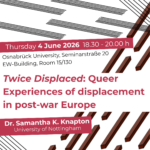
On 4 June, the Professorship for Contemporary History and Historical Migration Research is organising a public evening lecture as part of the Alfred Landecker Lectures. Dr. Samantha Knapton of the University of Nottingham will deliver an English-language lecture entitled “Twice Displaced: Queer Experiences of Displacement in Post-war Europe”. The lecture will take place from 6:30 to 8:00 p.m. in room 15/130. All those interested are warmly invited to attend!
In her lecture, Samantha Knapton examines how the Second World War affected queer people, shedding light on the destruction of social structures as well as the wave of discrimination in the context of the war, extending to criminalisation and persecution. These factors, compounded by the challenges of war, led to decades of displacement for queer people. For those who were both queer and displaced, the end of the war did not mark the end of their displacement; rather, it intensified their exclusion from the reconstruction efforts of the postwar period. The lecture further discusses how we can reconstruct the stories of the “twice displaced” on the basis of surviving sources.