History @ SFB 1604 | Interview with Gerhard Kromschröder for the “Production of Migration” podcast.

This post was automatically translated from the German original at
History @ SFB 1604 | Interview mit Gerhard Kromschröder für den “Production of Migration”-Podcast..
On 21 October 1985, “Ganz unten” by Günther Wallraff was published. Almost exactly three years earlier, on 14 October 1982, another undercover report had already drawn attention to the everyday racism experienced by migrants from Turkey in Germany, published in “Stern“. The following year, journalist Gerhard Kromschröder published his observations and experiences in the book “Als ich ein Türke war” [When I Was a Turk] (several editions from 1983 to 1985) with Eichborn Verlag.
In 1982, Kromschröder had worked for several weeks in the role of an immigrant from Turkey with Frankfurt’s street cleaning service, exploring the everyday life of people read as migrants in early 1980s Germany.
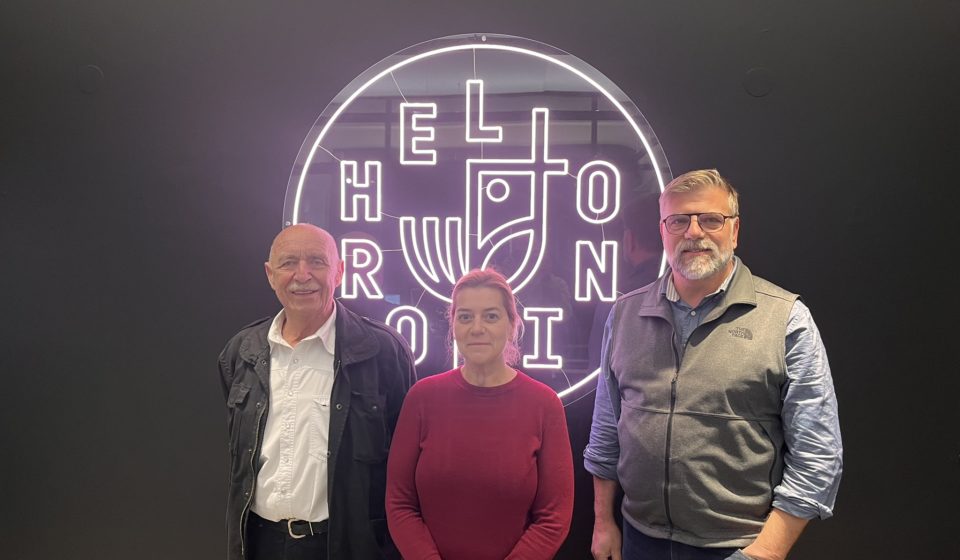
Lale Yildirim and Christoph Rass, who jointly lead subproject A3 of Collaborative Research Centre 1604 (“Ihr seid Gastarbeiterkinder” [You are guest worker children]), have now met with Gerhard Kromschröder to interview him for the CRC podcast and to understand his intervention in German society’s handling of its migration-driven growing diversity. For this, we were guests at the Hamburg studio HelloRobin, a partner of the Bielefeld Podcastfabrik, which produces the CRC 1604 podcast series with us.
Gerhard Kromschröder’s book from 1983 had very early and clearly described exactly how migrants in Germany fared at the end of the social-liberal government period and 10 years after the so-called “recruitment ban” (1973). His alarming conclusion: migrants remained invisible in the middle of society; when they became visible and wanted to participate, racism, exclusion, and violence were the majority’s response.
In spring 1982, STERN reporter Gerhard Kromschröder had dyed his hair, eyebrows, and moustache black, put on an orange overall of Frankfurt’s street cleaning service, and worked for three weeks with the identity of a Turkish street sweeper. His report “Als ich ein Türke war” [When I Was a Turk] appeared in October 1982, a full three years before Günter Wallraff’s better-known book “Ganz unten”. Kromschröder documented with shocking clarity the everyday nature of the brutal exclusion of Turkish workers in the Federal Republic of the early 1980s.
Among his central findings was the systematic non-recognition of migrants as socially belonging and equal. At Frankfurt’s Opera Café, he waits for over an hour – no one serves him. He describes himself as “a glass person, through whom everyone looks”. When the waiter finally has to acknowledge him, Kromschröder is thrown out with the words: “We don’t need dirty Kanaks. Now get lost.” Later, Kromschröder returns in his German identity, with the FAZ under his arm – and is immediately served courteously: “What would the gentleman like?”
What the journalist documented at the time went far beyond individual prejudices. He experienced institutional racism and structural discrimination as a systematic phenomenon through which a German society that did not want to live in an immigration country reproduced a social order marked by racism. At street cleaning, 95 percent of the workers were migrants. Working conditions were harsh, the tone rough. Kromschröder’s undercover report showed that the identity attributed to the speaker determines the validity of his statement, precisely defines and normalises his social role and position.
Kromschröder’s research also brought the experience of physical violence. He was thrown out of establishments, harassed on the street, pressed against house walls and threatened. He had to avoid dark alleys at night and be careful on the underground. The constant fear of violence was part of life as a Turkish worker in Frankfurt. After publication of the report, Kromschröder himself received death threats from neo-Nazis. Arndt Heinz Marx, “leader” of “Storm 7” of the banned “Wehrsportgruppe Hoffmann”, openly threatened: “If we get our hands on him, we’ll wring his neck, we’ll tear him to pieces.”
The public response to Kromschröder’s report revealed the deep division in German society. While Chancellor Helmut Kohl was still claiming in the Bundestag that there was no “hostility towards foreigners” in the Federal Republic, but rather “foreign infiltration”, reality showed a different picture. The letters to the editor documented in the book range from outraged agreement to hate-filled comments: “It would have been best if he had received a beating from a biker gang.”
At the same time, there were also positive reactions: school classes disguised themselves as Turkish children and re-enacted Kromschröder’s experiences; there were demonstrations in Frankfurt; the city parliament discussed the report. Willy Brandt praised the journalist’s work and warned of the consequences of racism and nationalism.
Nevertheless, the method of undercover reporting also raises ethical questions about the production of knowledge about migration. Gerhard Kromschröder could return at any time to his privileged position as a renowned German journalist. The people he portrayed could not. But precisely this asymmetry was part of the moral core of his work: the temporary change of perspective reveals the permanent reality of structural discrimination and exclusion. His work shows how the attribution of social roles and identities is tied to external markers – language, appearance, supposed origin – and how fundamentally these determine treatment by institutions, authorities, and fellow human beings, ultimately “producing” migration.
Kromschröder’s report appeared in 1982/83 at a time when almost five million people without German passports lived in West Germany, the largest group among them being immigrants from Turkey and their children already born in Germany. The political debate at the beginning of the Kohl era revolved around “foreign infiltration”, “return premiums”, and limiting family reunification. Society found itself at a crossroads between the fiction of temporary “guest work” and the reality of an emerging immigration society.
More than 40 years later, many of the questions from that time still persist: How do we produce “migration” and “difference”, how belonging in Germany? Who is recognised as accepted and who remains the “invisible” – marginalisable and excludable – person? Kromschröder’s work reminds us that the way a society deals with diversity is not something natural, but is actively produced – produced through institutions, through everyday practices, through the decision to look or look away.