History@SFB: Projects A3, A5 and T with the DH Team of the University Library as Guests at the German National Library in Frankfurt am Main

This post was automatically translated from the German original at
History@SFB: Projekte A3, A5 und T mit dem DH-Team der Universitätsbibliothek zu Gast bei der Deutschen Nationalbibliothek in Frankfurt am Main.
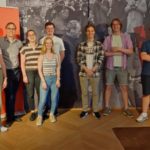
From 10 to 11 July, the team from the Chair of Contemporary History and Historical Migration Research and the Collaborative Research Centre 1604 “Production of Migration” visited the German National Library together with colleagues from the University Library Osnabrück. As part of a joint workshop of the research study programme “Hermes”, they discussed “The needs of the digital humanities – Tasks of cultural heritage institutions: Data competencies between research and the GLAM sector”.
“When I was doing my PhD, data management and data competency played no role at all,” confessed Frederik Döhl, head of the transfer workshop of the research study programme “Hermes” in his welcome address. Now, however, this complex of topics has become a central concern not only in research, but also in the training of future researchers, librarians and archivists.
In a series of workshops, “Hermes” exchanges ideas with actors from the GLAM sector (Galleries, Libraries, Archives, Museums), as well as research institutions and universities, about the challenges of contemporary data management and about transfer processes between science and society.
For the fifth workshop entitled “Needs of the Digital Humanities – Tasks of Cultural Heritage Institutions
Data Competencies between Research and the GLAM Sector”, Christoph Rass (NGHM/SFB 1604), Lale Yildirim (University of Kiel/SFB 1604), Matthias Land (SFB 1604), Jens Schneider (SFB 1604), Maik Hoops (NGHM/SFB 1604), Dominic Sauerbrey (SFB 1604), Lukas Hennies (NGHM) and Annika Heyen (NGHM/SFB 1604) travelled to Frankfurt am Main together with their colleagues from the University Library Osnabrück Felicitas Hundhausen, Anneke Thiel, Marco Gronwald and Kerstin Strotmann-Frehe.
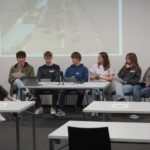
Matthias Land, Scientific Coordinator of SFB 1604, and Jens Schneider, head of the SFB 1604 Reflexivity Laboratory, presented in their contribution “Research Data Management: Needs and Challenges” the research objectives of the Collaborative Research Centre that began in April 2024, as well as the challenges that the disciplinary diversity in the interdisciplinary research consortium poses for its members in terms of data management: Each subproject brings its own research practices and its own perspectives on the collected or examined data material. Christoph Rass noted in the discussion following the presentation that the field diaries of today’s social researchers could become sources for tomorrow’s historians. Philippe Genêt provided insights into the NFDI consortium (National Research Data Infrastructure) “Text+“, which serves to use and preserve text- and language-based research data. Researchers are given the opportunity here to deposit their data – text collections and corpora, editions and lexical resources – and make them available to other scholars for reuse. “Text+” is one of a total of 26 consortia from the fields of humanities and social sciences, engineering, life sciences and natural sciences. Alongside “NFDI4Memory“, “Text+” is one of the most relevant tools in the working area of historical studies and Collaborative Research Centre 1604.
The workshop participants discussed how these standards can find sustainable application in project development and work. The University Library Osnabrück, recognising the signs of the times, has already developed its own infrastructures to support researchers and learners in their work. This process presents challenges: “We are too small to make a big impact, but too big to do nothing,” summarised Felicitas Hundhausen, Director of the Osnabrück University Library, about the role of what she called a medium-sized university library in the development of research data management. With the medium-term goal of establishing a Digital Humanities Center at the University of Osnabrück, tools such as the publication server “OsnaDocs“, the research data repository “OsnaData” and the tool “OsnaPlan” for designing research data management plans have already been developed.
During the subsequent guided tour through the permanent exhibition of the German Exile Archive 1933-1945, the Osnabrück delegation gained insights into the collection consisting of publications and institutional as well as individual estates.
In three chapters – “On the Run”, “In Exile” and “After Exile” – the exhibition explores questions such as “What does it mean to have to go into exile? What does one experience there? Is there an end to exile? And what remains of exile?”. Told through the fates of the approximately 500,000 people who fled Germany between 1933 and 1945 from the Nazi regime and its repression, the exhibition commemorates people who today become refugees due to violence, political repression or armed conflicts.
The Osnabrück team particularly benefited from the many exhibits that dealt with the biography and actions of Thomas Mann in exile. In the coming semester (WS 25/26), the Chair of Contemporary History and Historical Migration Research will offer a block seminar that will examine Thomas Mann’s radio addresses “Deutsche Hörer!” [“German Listeners!”] between 1940 and 1945 and, using this example, the resistance of intellectuals and refugees in history and the present.
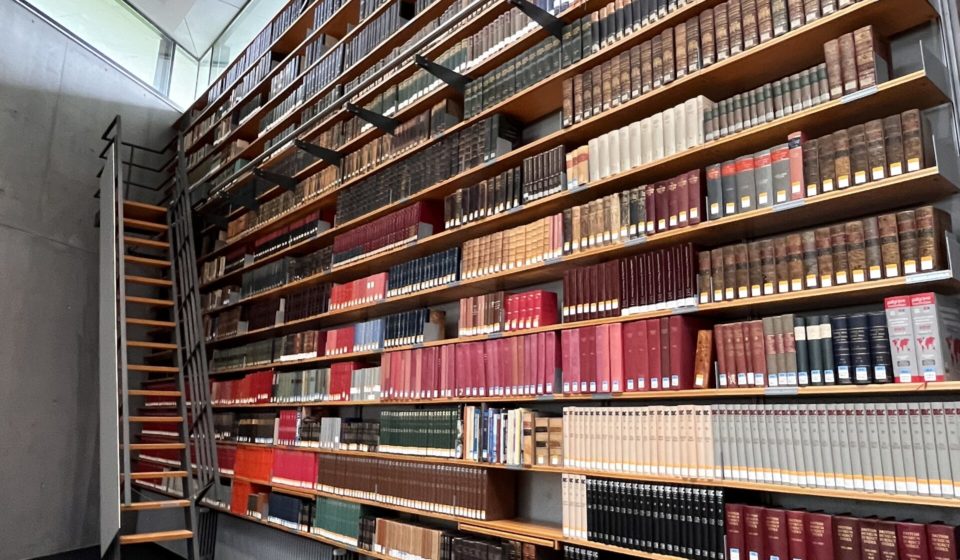
The second workshop day began with a tour of the reading rooms as well as the three underground storage levels normally hidden from visitors, with more than 30,000 square metres of storage space where the German National Library in Frankfurt keeps its collections.
Everything that is published in Germany, about Germany or in the German language is collected here – as well as at the Leipzig location. The collection grows annually by 6.05 kilometres of shelving, not including digital publications.
Maik Hoops and Dominic Sauerbrey addressed “The Library as Corpus” in their presentation, in which they provided insights into SFB 1604 projects A3 “‘You are guest worker children!’ Science, school and the production of figures of migration” and A5 “‘Refugees’ and others: The production of flight-related figures since the 1970s“.
In both projects, digital corpora are used – in the case of the A3 project specially compiled, in the case of the A5 project building on existing ones – to examine through systematic coding how migrantised figures are produced in specific discursive contexts. The interfaces between the SFB projects and the DNBLabs became clear, which provide a central point of contact for researchers who want to use the National Library’s data holdings for systematic text and metadata mining.
Through the DNBLabs, the German National Library makes its bibliographic data and also its digital object collections freely accessible and machine-readable. In the context of this programme item, the question arose of how important programming skills actually are and will be for professions in the GLAM sector. The ensuing discussion revealed that some of those present had acquired such skills as autodidacts. However, systematic training under the motto “Computing for the Humanities” still represents a desideratum.
To conclude the workshop, Christoph Rass provided insights into the transfer project “Reflexive Migration Research in the Museum” of SFB 1604 under the title “Digital Data in the Museum Context”. After a brief introduction to the concept and the initial progress of the project, he addressed challenges that working with larger digital data packages brings to the project, such as the storage of non-text-based research data like the digital 3D models of objects used in the project.
The presentations and debates of the two workshop days revealed how strongly all professional and action fields of the GLAM sector are challenged by digital transformation, but also how great the potential of a critically-reflexive and scientifically framed digital transformation is. The joint workshop of the HERMES project, Collaborative Research Centre 1604 and the Osnabrück University Library demonstrated how important and productive the dialogue between central and decentralised infrastructure institutions with science, research and mediation is.