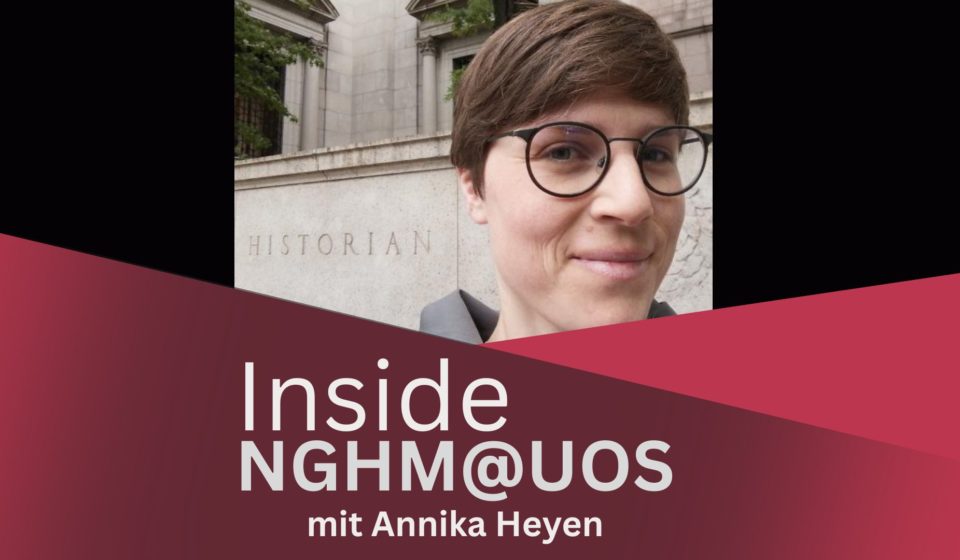
Inside.NGHM | Annika Heyen

This post was automatically translated from the German original at
Inside.NGHM | Annika Heyen.
With the new series Inside.NGHM, we regularly provide insights into research and teaching at the Chair for Contemporary History and Historical Migration Research at the University of Osnabrück, but above all, we introduce the scholars who work behind the scenes.
In the third issue, Annika Heyen reports on her work as a historian.
Annika Heyen studied History and Cultural Studies in the two-subject bachelor’s programme at the University of Bremen as well as the specialised master’s degree in Historical Studies with a focus on Contemporary History and Historical Migration Research at the University of Osnabrück. Since 2022, she has been pursuing her doctorate on “The Bermuda Conference 1943: Negotiations for the Rescue of Jewish Refugees and their Failure?” and since 2024 has been project coordinator of the transfer project “Historical Migration Research in Museums” of the Collaborative Research Centre 1604 “Production of Migration”.
How did you become a historian?
I am what is called a “working-class child”, meaning: there were no academic professions in my family environment. “Historian” was therefore not a profession that existed in my microcosm. After finishing school, I planned to become a journalist. At that time, I had already been a member of the youth editorial team of the Nordsee-Zeitung for several years and enjoyed writing. To try out whether this was really a good profession for me, I worked for several months as an intern at the Nordsee-Zeitung as well as in the press and marketing department of the German Emigration Center in Bremerhaven. There, in the first weeks, I shared an office with one of the historians, Christoph Bongert, and realised: Press work? Interesting, but what Christoph is doing there interests me much more! Journalism wasn’t completely off the table for me yet, but for the next winter semester I enrolled in the two-subject bachelor’s programme with History as my major and Cultural Studies as my minor at the University of Bremen. During my bachelor’s studies, it was particularly the history of slavery – a focus of the local chair for Early Modern History – that sparked my interest. I was fortunate to work as a student assistant for Rebekka von Mallinckrodt in the EU-funded database project “German Slavery” and thus gain first insights into the work of historians at the university. At the same time, however, I also remained as a guide at the German Emigration Center, where books by a certain Jochen Oltmer repeatedly caught my eye in the museum shop. Through him, I became aware of the Institute for Migration Research and Intercultural Studies (IMIS) and the resulting focus on migration research in the field of History as well. For my master’s studies, I transferred to the University of Osnabrück. During my specialised master’s programme with a focus on Contemporary History and Historical Migration Research, I was able to work as a student assistant for Jochen Oltmer and support him, among other things, with research for his publication “Die Grenzen der EU” [The Borders of the EU]. At the beginning of 2022, my master’s studies seamlessly transitioned into doctoral studies, funded by a scholarship from the Gerda Henkel Foundation. Without this scholarship, I would probably have left the university after graduation to switch to archival service, museum traineeship, or journalism again; the working-class child in me hadn’t even thought about pursuing a doctorate until the concrete opportunity arose. Parallel to my doctorate, I supervised smaller projects on Digital Public History and memorial culture regarding the crimes of the Nazi regime both in Lower Saxony and in Eastern Europe. This went quite well, and when the German Research Foundation approved the Collaborative Research Centre 1604 “Production of Migration”, Christoph Rass suggested me for the position of project coordinator of the transfer project.
What are your tasks as project coordinator of the transfer project “Reflexive Migration Research in Museums” of the Collaborative Research Centre 1604 “Production of Migration”?
Transfer projects in collaborative research centres usually have the task of bringing knowledge from the CRC to the public, i.e., establishing knowledge transfer. Therefore, it is somewhat unusual that we already have a transfer project in the first funding phase, because knowledge must first be generated before it can be carried outward. However, our transfer project “Reflexive Migration Research in Museums” goes a step further and also wants to bring knowledge from civil society into the CRC. Specifically, we examine to what extent digital tools, especially Virtual Reality, can be used to shift agency in the production and narration of history away from established actors and towards migrantised and therefore often marginalised persons.
For this purpose, we have developed two tools and project branches. The so-called Exhibition Builder enables members of civil society groups to tell their own stories in VR exhibitions. Here we work closely with our external application partner, the Documentation Centre and Museum on Migration in Germany (DOMiD), which brings both Germany’s largest collection of migration-related objects and experience in museum education and exhibition design to the project. The so-called Place Changer works with real existing places, of which we create digital and modifiable twins. For example, we can erect monuments at places where people have become victims of racist violence. Seeing the place digitally transformed can in turn trigger debates about the real existing place.
The transfer project involves four different chairs from four different disciplines and subdisciplines at three locations within the CRC alone: the Chair for Contemporary History and Historical Migration Research under Christoph Rass and the Chair for Social Psychology under Julia Becker in Osnabrück, the Chair for History Didactics under Lale Yildirim at Kiel University, and the Chair for Migration and Educational Sociology under Aladin El-Mafaalani at TU Dortmund University. In addition, there is our external application partner, DOMiD, as well as our technical application partners, Michael Brinkmeier from the Chair for Computer Science Didactics and Thomas Jarmer and Marcel Storch from the Remote Sensing and Digital Image Processing working group. My task as coordinator is to ensure that all project participants remain in dialogue with each other, to coordinate appointments, monitor the project budget, and direct the student assistants. At the same time, I am the spokesperson to the other projects of the CRC and to the so-called “Reflexivity Lab” as well as to the administration. Externally, I am the contact person for potential cooperation partners, most recently for the “Hermes” project of the German National Library.
What does your daily work routine look like? What do you enjoy most?
There really isn’t such a thing as a typical working day. While this is challenging on one hand, it’s also one of the beautiful aspects of our profession: every day is different; we meet many interesting people and get to travel to exciting places. What our days look like is ultimately determined by what’s currently on the agenda. Right now, for example, we’re in a very productive phase of the transfer project, where we’re revising our existing workshop concept for the Exhibition Builder and consulting with our partners about how to proceed. During such times, I might spend one or another working day in video conferences or answering emails, creating concepts, organising workshops, and preparing conference presentations.
Additionally, my working day thrives on exchanges with my colleagues in the Collaborative Research Centre, at the professorship, and especially in the working group “Negotiating Migration“, where we all work on topics related to violence-induced migration following the Second World War. Apart from regular presentations in the professorship’s colloquium and in the Integrated Graduate School of the CRC, the discussions in this small group and the critical engagement with one’s own research are an important and inspiring component of my university routine.
However, there are also quieter working phases, especially during lecture-free periods, when I can focus more intensively on my dissertation. This primarily means engaging with and analysing my source material, as well as intensive writing phases where I put my findings to paper in the form of essays or dissertation chapters. I’ve just completed work on a contribution for a special issue on “Refugee Agency” for the Journal of Contemporary History. During such phases, I sometimes sit at the computer from morning to evening, writing.
Writing is one of three aspects I particularly enjoy about my profession, even though this process sometimes demands blood, sweat, tears, and considerable nerves from me. In such moments, I understand very well what Dorothy Parker means when she writes: “I hate writing, I love having written.” However, writing is also an opportunity for creative expression. Perhaps not exactly something that outsiders would associate with academic work, but it’s true: historians question existing narratives about our past and interpret and retell history anew, based on their source findings and guided by questions from the present.
The second aspect I particularly enjoy about my profession is travelling. I have the great fortune and privilege that the scholarship from the Gerda Henkel Foundation also included a budget for research trips. This enabled me to travel to London, New York, Washington, D.C., and even to Bermuda for archival research. Conferences, workshops, summer schools, and project work have also taken me to various cities within Germany as well as to Brighton, Warsaw, Vilnius, and Odense.
The third favourite element is closely linked to travelling: archival visits. Archives always have this bustling, excited yet meditatively quiet atmosphere. Everyone is absorbed in their project and source material, yet curiosity about the secrets of the past hangs in the air as a connecting moment, along with the smell of dust and paper. A certain reverence for the old as well as for the archivists as strict yet service-oriented guardians of these treasures, the subtle thrill of the historian’s actual detective work, and – ideally – the occasional eureka moment make archival visits repeatedly exciting experiences that cannot be replicated in museums or libraries.
Why did you choose your dissertation topic? What fascinates you about it?
Actually, it was the other way around: the dissertation topic chose me. My colleague and co-supervisor Sebastian Musch had stumbled upon the Bermuda Conference during his research and had applied for a project on this topic with the Gerda Henkel Foundation in 2021, but couldn’t carry it out himself due to other commitments. Since I was in the final stretch of my Master’s studies at the time – I was writing my thesis on the phenomenon of “resettlements” in the Kingdom of Hanover between 1830 and 1866, supervised by him and Christoph Rass – and I showed great interest in topics of historical migration research and specifically the development of the post-war refugee regime, he proposed me as an alternative recipient of the scholarship. To my great fortune, the Gerda Henkel Foundation agreed to the change, and I was able to begin my doctorate in February 2022 under the working title “The Bermuda Conference 1943. The Negotiations to Rescue Jewish Refugees and Their Failure?”
In my dissertation project, I attempt to retell the Bermuda Conference, which particularly attracted historians’ interest in the 1970s and 1980s, from the perspective of historical migration research as a formative moment of the modern migration regime. Since the older research literature primarily stems from Holocaust studies, little to no attention has been paid to this aspect so far. Moreover, there is still no dedicated monograph dealing exclusively with the Bermuda Conference. Therefore, the existing chapters and essays on this topic do not, in my view, do justice to the complexity of the conference.
The Bermuda Conference was a meeting between representatives of the United States of America and the United Kingdom, during which they discussed what these two countries could do to solve the “European Refugee Problem”. In the midst of the Second World War, despite pressure especially from Jewish non-governmental organisations, the answer was: not much. The passivity of the Allies in the face of the murder of millions of European Jews – which was actually what it was about – triggered massive disappointment in world public opinion, and the Bermuda Conference, branded as “failed”, soon fell into oblivion.
The deeper I delve into the source material, the more previously unnoticed nuances become visible to me. Who were the actors involved in the events – organisations, government departments as well as individuals – and what mandates did they pursue? What power did they possess to influence the refugee policies of the USA and the United Kingdom? And where were they limited? What institutional, ideological, legal, or political path dependencies can be observed starting from the Bermuda Conference? Which ones is it the result of? How does the conference fit into the course of the war, into the progression of the Shoah, and into the already advancing development of the post-war refugee regime? These and many other questions occupy me, and even when I think I’ve found an answer, it can be further developed and changed through the discovery of new documents in archives or conversations with colleagues.
What advice would you give to students who aspire to pursue a doctorate in history/would like to work as student research assistants?
For me, it paid off on the path to a doctorate to have worked as a student research assistant at the university early on. Both at the University of Bremen and at the University of Osnabrück, I owed my employment to recommendations from lecturers who made them based on the interest I showed and my participation in discussions in their courses, as well as my written performance. As a student research assistant, I not only had the opportunity to support my supervisors in their research for their publications and thus develop a rough sense of the post-Master league in academia, but also to participate in conferences and engage in conversations with scholars at various career stages. This not only makes you visible within your own university to potential supervisors for a doctorate; as mentioned above, I didn’t find the dissertation, but the dissertation along with its supervisors found me.
Even as a student and as a student assistant, it was therefore worthwhile to participate actively and with genuine interest in courses—not just with the prospect of earning credit points—and to put that extra bit of effort into term papers and even simple presentations; this way, the right people took notice of me.
Perseverance, a certain degree of ambition, and interest in historical topics and research about them are no less important after completing a master’s degree, but rather all the more essential. Beyond that, however, one also needs some—let’s call them—technical skills. First: writing. In our work, we primarily produce one thing: text. This means we must be able not only to string words and sentences together grammatically correctly, but also to carefully construct our arguments and support them with evidence across texts of varying lengths. The end product should also be pleasant to read. At least in my research field, a major challenge is that I cannot write many of my publications in my native language German, as they are better suited for the Anglo-American sphere. The research literature and source material on my topic are also available almost exclusively in English. This means a second hard skill one should bring to doctoral studies: foreign language skills, particularly English proficiency. The Latinum is already a basic requirement for history studies anyway. Every additional foreign language opens new research possibilities and access to further source material.
What interests/hobbies do you have outside your work at the university?
As much as my work as a historian brings me joy: sometimes I too need a break. And it’s here at the latest that the complete nerd in me comes to the fore.
Nerd activity No. 1: Classical choral music. My chamber choir Corona Vocalis works primarily on a cappella music from Renaissance to modern times, but sometimes also pieces with instrumental accompaniment. We’re already rehearsing for the Christmas season, with the last concert of the year traditionally on the Thursday before Christmas Eve in the Small Church at the Cathedral. Twice a year, however, I also still meet with other alumni from the children’s and youth choir groups in Bremerhaven and work on pieces with them in women’s choir formation, usually also a cappella. Why this hobby? Apart from the fact that choral singing is demonstrably health-promoting—breathing technique, posture technique, social interaction, etc.—it’s sometimes simply good to force the brain not to think about work. Learning new pieces in mixed formation—that is, not sorted by voice parts—by reading one’s own staff line in a sometimes four-part, but often also eight-part or even more complex system, while taking along the text, paying attention to the conductor, and watching what the other singers around you are actually doing is cognitively so challenging that not much brainpower remains for anything else.
Nerd activity No. 2: Pen and Paper Roleplay. I’ve been playing for about ten years. Brief explanation: A group of players invents and creates characters according to certain rules, with whom they experience adventures under the guidance of a game master and tell a shared story that is recorded via pen and paper—Pen and Paper, exactly. Polyhedral dice serve in the game as random generators that sometimes give the stories very unexpected turns. Currently, I’m participating as a player in one campaign and leading another as a master. The appeal of this hobby? Collaborative storytelling, thinking oneself into characters and figures whose character traits don’t necessarily have to correspond to one’s own, jointly developing problem-solving strategies, and not to forget: the thrill when the dice fall.