
This post was automatically translated from the German original at
Inside.NGHM | Eduard Usov.
With the Inside.NGHM series, we regularly provide insights into research and teaching at the Chair of Contemporary History and Historical Migration Research at the University of Osnabrück, but above all we introduce the scholars who work behind the scenes.
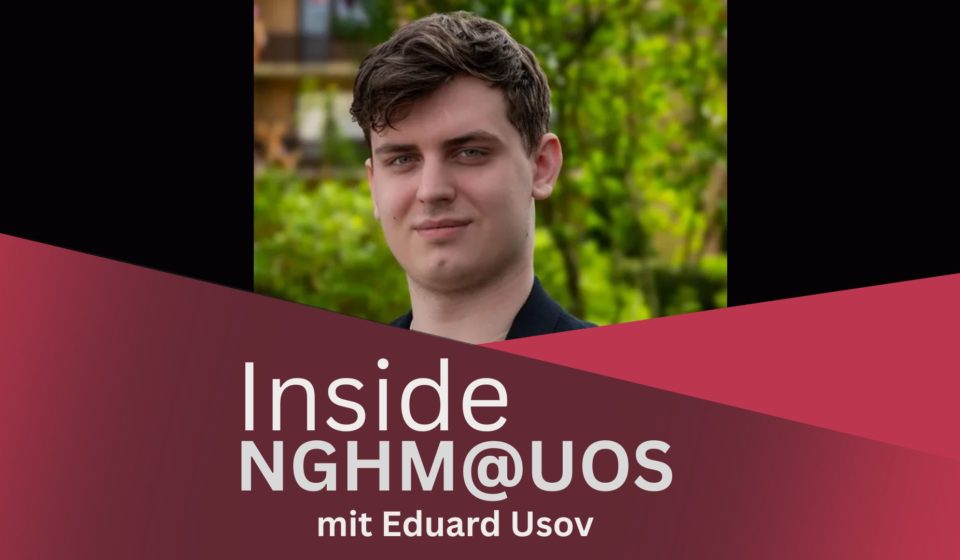
In the second issue, Eduard Usov reports on his studies at UOS and his activities as a student research assistant.
Eduard Usov has been studying History and Philosophy in a two-subject Bachelor’s programme at the University of Osnabrück since the winter semester 2023/24. Since April 2024, he has been a student research assistant at the Chair of Contemporary History and Historical Migration Research in Subproject A3 of SFB 1604.
Why did you decide to study history? What career goal are you currently pursuing?
Actually, I hated history as a school subject during my school years (with few exceptions). I found the lessons boring, but the material very exciting. I often watched documentaries about the Nazi era or the Cold War because I had a human interest in history, but not really a scholarly one. When it came time to decide on a career path, I wanted to become a Latin teacher and thought that history would certainly be a good complement. There was a certain appeal to rummaging through the estates of “great men” (and of course women too) and experiencing their thoughts, feelings, but also living conditions and crises from a third-person perspective. Although the frustration of no longer learning about the lives of “ordinary people” in class, but having to deal with things that one would probably never need in life, was probably the decisive factor.
Fast forward, I didn’t like Latin at university (or I simply wasn’t cut out for Latin studies) and my expectations from school were not fulfilled. History, contrary to my initial scepticism, was the best decision and continues to be a lot of fun for me to this day!
My current career goal is definitely academia. Since I cannot enter teacher training with my current subject combination, I would like to teach at university. Sometimes one finds it quite a pity that Eastern European contemporary history (or migration research) doesn’t get its own seminar. Perhaps it will be something with a professorship in Eastern European or Contemporary History, perhaps not. Plan B would be the archive.
What interests you about (Contemporary) History and Historical Migration Research?
That’s a really good question. It’s actually rather philosophical. If you take a bird’s-eye view of the selection of courses in history, everyone will probably notice that some are closer to one’s own reality than other courses. One person likes Roman antiquity, another the Middle Ages. I’ve never asked myself why I specifically prefer contemporary history most.
Good thing I don’t need to answer this philosophical question at all. As perhaps indicated earlier, I find Eastern Europe (including Ukraine, Poland, Belarus and Russia) quite interesting. It’s nice that there isn’t “the German” here, but rather human beings. Everyone has their own story of origin. I’m therefore interested in migration from precisely those states of the former Soviet Union. Otherwise I probably wouldn’t be here either.
How do politics, society, culture, media deal with people who have migrated? What hurdles, problems, what (in)justice exists/existed for people who come to Europe? How do they describe their situation themselves? What characteristics and stereotypes are attributed to them, and by whom? How does the scholarly discourse around immigrants change? And what narratives do we actually produce in the process? What agency do immigrants have in the 20th century? How does the production of the category of the migrant change? Is “the migrant” (whatever this word may mean; I personally find this generalisation nonsensical) burdened with the same stigma today as “the migrant” 50 years ago? And what does the production of categories, which are supposed to capture subjects in an overly simplistic way, say about the production of history?
Certainly some of these questions are not purely thematic complexes of history. But sometimes we should shift our gaze from the pure research question to the second-order meta-level. In contemporary history we see the effects of our research subjects directly, sometimes they are even still alive. This makes research tangible and gives meaning-producing activity actual meaning.
What are your tasks in the NGHM team?
I still remember that I was originally hired to code segments in MAXQDA, a software for qualitative content analysis. There are probably never really typical tasks as a student research assistant. There’s always something that comes up, that’s important and must also be given priority. Apart from that, there are certain basics: Scanning and researching literature would probably be the activities that have taken up the most time in the project so far. Beyond that, I maintain our project in MAXQDA. Scan is not the same as scan. Processing requires a few more steps. Among other things, scans must be made readable through OCR. Then they are entered into the Citavi database until they finally end up in MAXQDA. And no, it’s not as boring as it sounds. You have many great colleagues who always ensure good spirits.
What does your working day look like? What do you enjoy most?
If I had a routine, this question would be really easy to answer. It would be boring if you always did the same thing at the same time. I usually work in the evenings, sometimes, when it’s necessary or something urgent comes up, I naturally do it immediately. Then you sit down at the computer and get your things done. Or you’re in the wonderful building 03 (Institute for Migration Research and Intercultural Studies) and scan the acquired literature or return it. It just depends on what’s currently pending.
What’s most fun is definitely not the activity itself. To claim that would also be a great injustice to my colleagues. Progress is fun. Recognition from one’s supervisors is fun. Much in the environment is fun. Cake days on Monday are also fun, very much fun indeed! It’s the people you work with who bring the fun factor. You definitely have a lot of fun here. You never get bored because there’s always something to do. The work naturally doesn’t suffer!
Professionally, you naturally pick up a lot. You’re right there seeing how science “works”. For me it’s fun insofar as I see what awaits me on my own life path. The perspective-taking is also quite interesting.
What topic would you definitely like to attend a university course on?
A course on the topic of “Spätaussiedler” [late repatriates] would certainly be interesting. I believe this topic has great potential for transnational perspectives on this phenomenon. I hear the term frequently in my environment, but what does it actually mean to be a “Spätaussiedler”? How did people actually come to the Federal Republic and what drove them? Above all, however, one should consider whether these people arrive as “Germans” or as “Poles”, “Romanians”, “Russians” or similar. How is this term “Spätaussiedler” actually constructed? And what resonates when one uses this term, what characteristics do we attribute to this collective? How does this legal category become a social reality and identity formation?
On the other hand, one could also examine how this migration affects the countries of origin demographically. How do the affected states react? What discourses are conducted?
I would definitely be pleased if the focus shifted towards Eastern Europe.
What should every history student definitely have seen?
I think this question raises unrealistic expectations of something that I couldn’t really define. Finding one thing that seems appropriate to the magnitude of the question will be really difficult. I want to give a boring answer to it, but one that seems important:
“People, go to archives!“
When you think about academia as a student, you have the feeling that something has already been written about everything. Surely someone has already looked at the great things of humanity. But what about the small things and estates that are just waiting to be discovered by you? How cool is it to see a document from 1540 that would otherwise only be accessible to you in photos or not at all? The archive is like a lucky bag. Those who seek will also find something interesting that no one has done before. And if we’re being completely honest, wouldn’t it be really great if your own work during your studies still receives attention in 20, 30, 100 years because you’re the only one who has researched that topic (But that doesn’t mean you should write any nonsense just because there’s no contradiction).
What motivates you during the challenging phases of your studies?
I always have a certain ambition. There’s this inner voice, perhaps it’s conscience, who knows, that drives you. But sometimes you’re just knocked out and simply want to have your peace. That’s normal.
What motivates me most is probably my family. It’s nice to have someone who listens to you when you have problems, even if they can’t offer a solution. But my friends are also super important! You perhaps also understand each other as fellow sufferers. In the end, however, you shouldn’t lose sight of what’s essential during challenging phases. University is primarily not a phase of life that you simply slide through and end up with a degree. It’s probably the most formative time you experience. Therefore, you shouldn’t lose sight of fun and sociability.
Unfortunately, fun and sociability alone don’t help you write exams (what a shame). Two principles help me:
1. No one has ever died from content, only from the pressure you put on yourself.
Sometimes a break helps to find new motivation for the challenge. Perhaps you get a different perspective on your work, new approaches and ideas that you didn’t have before. Michelangelo’s David wasn’t created in an hour either. But it wouldn’t have turned out as good if someone had tried to chisel it in an hour. I start early to become aware of the exams and accordingly make a plan for when I should start studying.
2. No master has ever fallen from heaven.
Failing is probably a fundamental experience that one should have in life. At university, however, failing is also necessary to grow beyond yourself. If you perceive every challenge as an opportunity to fail, get up and improve yourself, the challenge no longer seems like a challenge. I’ve come to terms with being allowed to fail too, that helps immensely!
I draw a lot from these two mottos for my studies when things aren’t going so well.
Which exhibition/Which museum did you last visit that you can really recommend?
I really rarely go to exhibitions or museums. What I can really recommend is POLIN in Warsaw. Apart from the fact that Warsaw is really beautiful, this museum is impressive and stands opposite the Monument to the Ghetto Heroes, which is anchored in memory as the setting of Willy Brandt’s genuflection. It addresses the history of Polish Jews, a topic that is closely interwoven with German history. The guided tour there personally opened my eyes to the extent that we should leave our comfort zone to broaden our perspective.
But anyone who wants to visit a regional attraction can also check out the German Salt Museum in Lüneburg. Salt sounds boring, but it doesn’t have to be! It’s really amazing how important such an everyday object used to be for people’s lives. Perhaps some people will also question their own salt consumption.
But my last visit was also quite a while ago, so I don’t want to give a quality seal at least for the Salt Museum. But POLIN is highly recommended!
What interests/hobbies do you have outside your work at the university?
Besides university, I have several hobbies. I’m engaged (only recently) politically in the mentoring project “DEMOCRACY. POWER. INTEGRATION.” There I gain insights into Osnabrück local politics and attend committee meetings as well as faction meetings. The whole thing is “only” designed for one year, but it’s a lot of fun because I experience the decision-making processes up close and understand a bit more about what’s currently on the political agenda.
I also read a lot. My interest lies in both non-fiction books and philosophy. Most recently I read Antigone by Sophocles. That was an interesting book, even though it’s not very long. Currently I’m working on Dostoyevsky’s “Crime and Punishment,” which demands perseverance from you. Generally, I like diving into the “classics.” You don’t just see the book, but also the person who wrote it and their life circumstances. For historians, it’s always interesting when Tolstoy writes about Napoleon’s Russian campaign of 1812 in “War and Peace.” In a certain sense, your studies do rub off on you.
I also really like to travel, although I myself would never have the initiative to go anywhere. Usually I join other people. Unfortunately, I’ve never been outside Europe. Perhaps it will be time for that someday. My last stay took me to Croatia for 2 weeks.
I’m also a big sports fan. I used to be an active competitive athlete in track and field and then played handball. Today I’ve moved to the spectator stands and mainly follow volleyball at my home club SVG Lüneburg.