NGHM engaged | The Day of Teaching and the Relevance of Historical Studies.

This post was automatically translated from the German original at
NGHM engagiert | Der Tag der Lehre und die Relevanz der Geschichtswissenschaft..
December 3, 2025, was dedicated to two central aspects of university work for the Research Group for Contemporary History and Historical Migration Research: innovative teaching and critical reflection on the social role of historical scholarship.
In the afternoon, the NGHM team presented two LehrZeit projects at the first “Day of Teaching” at the University of Osnabrück, which exemplarily demonstrate how digital methods and social responsibility can work together in teaching.
In the evening, Christoph Rass discussed with colleagues from the Historical Seminar within the framework of Forum HistOS the question “What is history for?” – a debate about the social relevance of historical scholarship that extends far beyond academic legitimation discourses.
Both events represent the conviction that historical scholarship unfolds its social effectiveness where research, teaching, and public engagement productively intertwine.
What is good teaching?
On December 3, the University of Osnabrück held its first “Day of Teaching.” This event both honoured the new LehrZeit award winners of the 2025/26 funding round and presented the LehrZeit projects from 2022/23 to 2024/25.
The university-internal funding format “LehrZeit” has existed since 2018 and supports projects that explore new paths in university teaching while strengthening the university’s quality and qualification goals (Q-goals) – scientific rigour, interdisciplinarity, profile development, and personal development. The central idea is to involve both teachers and students in the conceptual development of teaching and learning formats and to create targeted spaces for this purpose.
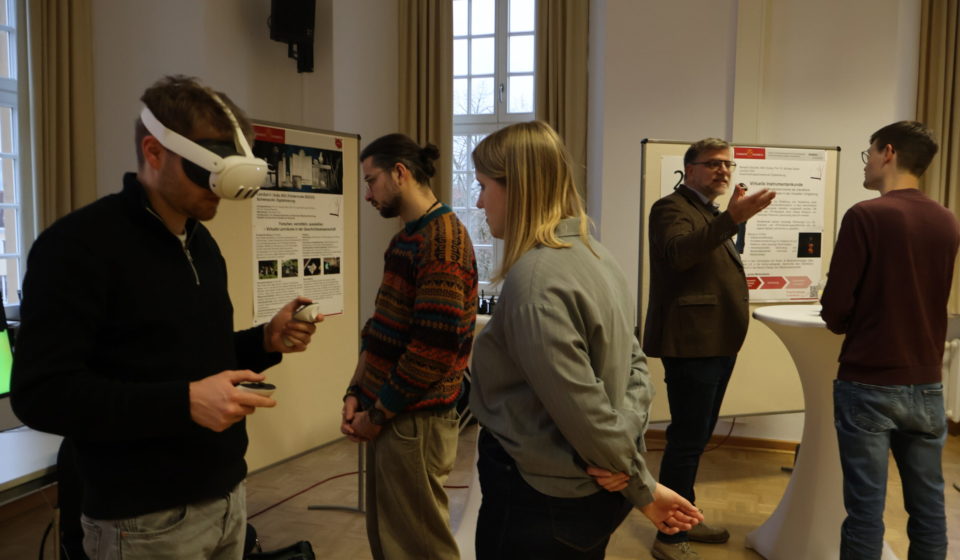
The “Day of Teaching” offered teachers and students the opportunity to learn about the diverse LehrZeit projects from various funding rounds through a world café and poster pitches, and to engage in conversation with one another.
The Chair for Contemporary History and Historical Migration Research was also represented at the “Day of Teaching” with two projects focusing on Digitalisation and Personal development and civil society competence, which we presented during the event.
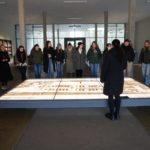
Prof. Dr. Christoph Rass and Imke Selle presented the results of the LehrZeit project “Research, communicate, exhibit. Virtual learning spaces in historical scholarship” from the 2022/23 funding round. Within this project – together with Prof. Dr. Lale Yildirim (Didactics of History, now at University of Kiel) and Prof. Dr. Michael Brinkmeier (Didactics of Computer Science) – interdisciplinary teaching-learning formats were developed and tested in which students of history and computer science jointly conceived a virtual exhibition. The foundation consisted of 3D scans of historical monuments that were digitally reconstructed, historically contextualised, and finally made experienceable in a hybrid exhibition setting.
The project not only opened up new technical approaches to historical objects for the participating students, but also provided a deeper understanding of how digital reconstruction, research-oriented learning, and historical communication can be interconnected.
Furthermore, Dr. Sebastian Musch (Alfred Landecker Lecturer in the NGHM research group), Maria Flores Rojas, Bjarne Groß, and Gloria Sherif presented the LehrZeit project “Antisemitism and anti-Muslim racism: Understanding, Reflecting, Acting” from the 2024/25 funding round, which is affiliated with the Institute for Migration Research and Intercultural Studies. Helen Schwenken, Jamila Brüggemann, and Mira Hazzaa were also involved in the project.
The project’s goal was to develop a teaching concept that examines both phenomena together in order to sensitise students to their historical and contemporary interactions. The focus was on critical reflection, building analytical competencies, and developing practice-oriented approaches for racism- and antisemitism-critical teaching.
Both projects exemplarily demonstrate how diverse the content-related and methodological approaches of the NGHM research group are at the intersection between historical scholarship and migration research – and how research, teaching, and social responsibility can be productively combined. The “Day of Teaching” provided us with the opportunity to make these approaches visible, exchange experiences, and collectively reflect on how innovative teaching formats can be permanently integrated into university practice.
What is history for?
Also on December 3, 2025, a roundtable discussion on the social relevance of historical scholarship took place within the framework of Forum HistOS, in which Christoph Rass, Professor of Contemporary History and Historical Migration Research at the University of Osnabrück, also participated. The discussion, moderated by Dr. Jörgen Wolf with colleagues from various epochs – from Ancient History through Medieval History and Early Modern Period to History Didactics – made clear that the question of historical scholarship’s social contribution is not an abstract legitimation debate, but rather concerns a core area of our professional practice: How do we make the findings of our scholarly work socially effective – in teaching, but also beyond the education of students?
Rass argued that not least two fields of action prove central for making the insights and findings of historical scholarship socially effective: social engagement, an intervention in debates with successful translation of scholarly knowledge for diverse target groups, and professional innovation with regard to methodological aspects – especially in the context of the current digital technology leap – and with regard to the questions that historical scholarship addresses.
Social engagement means not only providing expert knowledge, but specifically communicating historical knowledge in an understandable form, actively participating in shaping memory culture, constantly critically questioning dominant historical narratives, and reflexively making visible the political dimension of history production. This virtually demands collaboration with civil society actors as well as memorial sites, museums, and educational institutions – and it requires our willingness to take public positions when history is instrumentalised or facts are distorted.
Professional innovation is understood by the Osnabrück historians as continuous methodological development that enables new questions to be asked and complex historical processes to be captured more precisely and from multiple perspectives with regard to the event horizon and the translation of past into history.
For the Research Group for Contemporary History and Historical Migration Research, this explicitly includes the integration of digital methods – from GIS-based analysis through the development of archival holdings using artificial intelligence to the development of virtual communication formats. Methodological innovation in research and teaching thus not only opens up new research perspectives, but also creates new communication formats that make history more accessible while simultaneously training critical engagement with history production. Particularly this semester, Rass reported, Osnabrück history students are programming their own web apps for the first time in one of his courses to make historical scholarship content readable in new ways through digital formats.
Another point in the discussion revolved around a sometimes overlooked aspect of historical education and its social relevance: The competencies that historians acquire during their studies have a value that extends far beyond scholarly work within the discipline.
Critical thinking, the questioning approach to complex and always incomplete information, the ability to contextualise and analyse sources, the competency to develop new knowledge according to scholarly standards – all of these are abilities that are urgently needed in society in a time of increasing information overload and targeted disinformation. When we teach our students, especially those who will later become teachers, to check their sources, deconstruct narratives, and deal with uncertainty in a methodically controlled manner, we enable them not only for academic careers, but for reflexive participation in social negotiation processes – and for communicating these core competencies of the modern world to their future students.
Historical scholarship cannot simply postulate its social relevance or lament that it might be losing it. We can continuously re-establish the relevance of the discipline through continuous engagement as well as content-related and methodological innovation. The answer to the question “What is history for?” then becomes not a defensive justification, but a confident reference to what we can and want to achieve as a discipline – in research, in teaching, and in the public sphere.