NGHM reads | A knowledge graph with literature recommendations for studying at the Chair of Contemporary History and Historical Migration Research at UOS

This post was automatically translated from the German original at
NGHM liest | Ein Wissensgraph mit Literaturempfehlungen für das Studium an der Professur für Neueste Geschichte und Historische Migrationsforschung der UOS.
Reading as Critical Practice: The NGHM Reading List and its Digital Exploration. Studying Contemporary History and Historical Migration Research means more than just familiarising oneself with methods, facts and data. It is about developing critical thinking, questioning analytical categories and understanding the construction processes of history itself.
This is precisely where the NGHM reading list aims to support Osnabrück students: It brings together 65 works that should not be understood as a canon, but rather as a starting point for critical engagement with the foundations of our discipline and the specific perspectives and research fields in which the Contemporary History and Historical Migration Research working group operates.
Why exactly these works?
The selected books and articles do not primarily focus on the latest research literature. Instead, we concentrate on a selection of works of outstanding academic significance that raise fundamental questions and have developed methodological approaches that have sustainably shaped historical scholarship. From Hannah Arendt’s analysis of totalitarian rule through Michel-Rolph Trouillot’s reflections on the production of history to Edward P. Thompson’s examination of the English working class: These texts show how historical scholarship makes social power relations visible, questions narratives and develops alternative perspectives.
The list connects very different historiographical traditions and research approaches. It encompasses classic works of Holocaust and Nazi research (Friedländer, Hilberg, Browning), postcolonial theory formation (Said, Spivak, Fanon, Mbembe), foundational texts in migration history (Bade, Noiriel, Gatrell) and theoretical reflections on history (Bloch, Koselleck, White). This thematic diversity is no coincidence: It reflects that historical thinking must be multi-perspectival and can productively bring different analytical traditions into dialogue with one another.
The Knowledge Graph as a Tool.
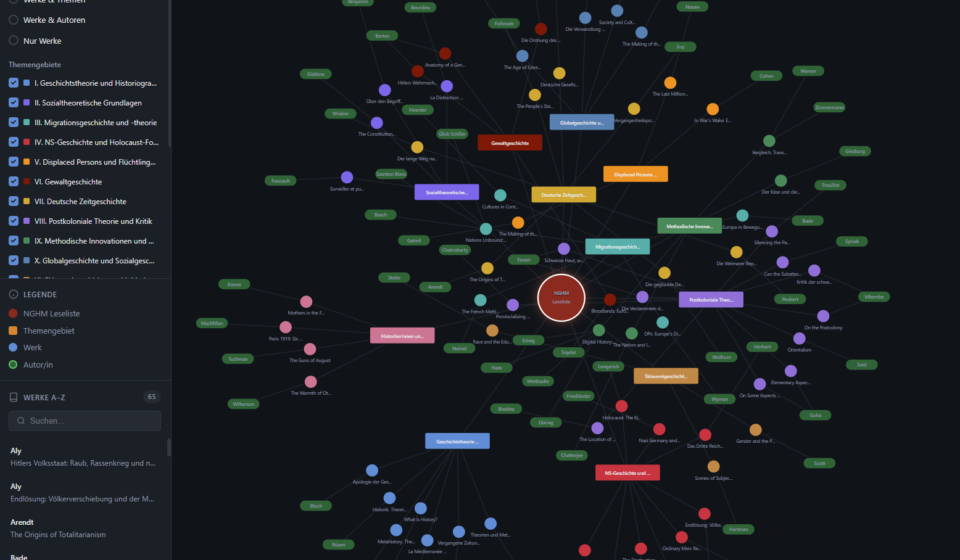
What distinguishes the NGHM reading list from conventional reading lists is its digital presentation as a knowledge graph. Our (experimental) web app at https://reader.nghm-uos.de makes it possible not only to work through the 65 titles linearly, but to explore their connections and contexts. You can filter the collection by thematic fields, consider difficulty levels or orient yourself according to language skills. These functionalities make the list a living instrument that opens up various approaches to the literature. And incidentally: all titles are available directly through Osnabrück University Library, either in analogue or digital form.
The graph visualises relationships between works, authors and between subject areas. This intuitive access reveals – at least to some extent – how individual texts are embedded in larger debates and how certain questions develop across different historiographical schools. This form of presentation aims to encourage the discovery of cross-connections: How do postcolonial theories relate to the analysis of forced migration? What methodological parallels exist between microhistorical studies and the examination of everyday practices in totalitarian regimes? Such questions can be productively investigated through the exploratory structure of the graph.
Reading as Process, Not as Checklist!
The reading list is not a catalogue to be worked through mechanically. Rather, it functions as orientation in an almost unmanageable field of historical and theoretical literature. Some texts will repeatedly encounter you in lectures and seminars of the first study phase, others students will only meet in advanced phases of their studies. Some works want to be read several times because they offer new insights depending on context. Others serve as reference works that can be consulted selectively.
It is important not to view the texts in isolation, but to learn to understand them as part of larger discussion contexts. A book like Carlo Ginzburg’s “The Cheese and the Worms” represents a microhistorical approach that takes individual lifeworlds seriously. It can be productively connected with Natalie Zemon Davis’s work on early modern cultural history or Edward P. Thompson’s social historical perspective. At the same time, it raises questions about the representativeness of individual cases that can be contrasted with quantitative or structural historical approaches.
Critical Thinking as Core …
All works on the list share a critical impetus. They ask about the conditions of historical knowledge, about the construction of categories as well as about power and domination relations. Marc Bloch’s “The Historian’s Craft” formulates fundamental questions about the profession of the historian. Hayden White’s “Metahistory” analyses how narrative structures shape historical representations. Michel-Rolph Trouillot’s “Silencing the Past” examines how power relations determine which stories are told and which are not.
This critical perspective is central to the research and teaching of the Contemporary History and Historical Migration Research working group. Whether we are dealing with the analysis of migration regimes, with the history of organised violence or with questions of memory culture: It is always about questioning categories and concepts, reflecting on our positions and methods and developing and conveying new knowledge about the past and the production of history.
Practical Use of the List!
How can you work concretely with the reading list? Some suggestions:
Thematic Approaches: If you are interested in a particular topic, use the theme filters of the web app to identify relevant foundational texts. A seminar on the history of the Cold War could lead you to Hobsbawm’s “Age of Extremes”, but also to postcolonial perspectives on this epoch.
Methodological Orientation: Are you interested in Digital History? The list contains, with the volume by Döring, Haas, König and Wettlaufer, a current overview of concepts and methods. Link this reading with classic theoretical texts on history to place methodological innovations within larger historiographical debates.
Biographical Contexts: The web app provides biographical information for many authors. Use this to understand the intellectual traditions from which the works emerged. Frantz Fanon’s writings can only be understood against the background of his experiences as a psychiatrist and anti-colonial activist. Hannah Arendt’s theory of totalitarianism is closely connected with her own flight history.
Comparative Reading: Read texts deliberately that offer different perspectives on similar phenomena. Combine, for example, Omer Bartov’s work on the Wehrmacht with Christopher Browning’s study of Reserve Police Battalion 101. Compare structural historical approaches (Wehler) with cultural historical perspectives (Koonz, Fulbrook).
An Open Offer …
The NGHM reading list and its digital presentation understand themselves as a service for students, not as a prescription. We want to continuously expand the list, supplement digital and analogue location references and add short reviews of the titles as well as biographies of the authors. This development is deliberately designed as an open process: feedback, suggestions for additions and critical comments are expressly welcome.
The project shows exemplarily how digital tools can support historical learning without replacing critical reading. The knowledge graph provides orientation and opens up approaches, but the actual intellectual work remains unavoidable for you and us: precise reading, critical questioning, linking arguments, developing one’s own positions. These skills are central to any historical practice, whether in research, teaching or public knowledge dissemination.
Why the Effort is Worth It!
Developing critical historical thinking is not an easy task. It requires time, patience and the willingness to engage with complex arguments. The works on the NGHM reading list are not always easily accessible. Some texts presuppose theoretical prior knowledge, others work with empirical details that can initially seem overwhelming. But this is precisely where their added value lies: They challenge, they force one to think, they open up new perspectives.
Historical education does not only mean acquiring knowledge about the past. It trains analytical skills that are relevant far beyond the discipline: the ability to critically evaluate sources, to reconstruct and assess arguments, to structure complex matters, to develop alternative explanations. These competencies are more important than ever in a world where information is ubiquitously available, but at the same time disinformation and simplifying narratives are increasing. Further texts for orientation in these thematic fields can also be found in the “Teaching” section on the NGHM website.
The NGHM reading list and its digital presentation are a tool for developing these skills. Use them as an instrument for your own learning, as a starting point for discussions, as a foundation for your own research projects. Read critically, discuss controversially, question also the selection we have made. Because here too it is not simply about reproducing knowledge, but about developing an independent, critical historical perspective.
Discover the NGHM reading list: reader.nghm-uos.de
This blog post is part of the teaching materials of the Chair for Contemporary History and Historical Migration Research at the University of Osnabrück. Feedback and discussion contributions are always welcome at nghm@uni-osnabrueck.de or on our blog nghm.hypotheses.org.