
This post was automatically translated from the German original at
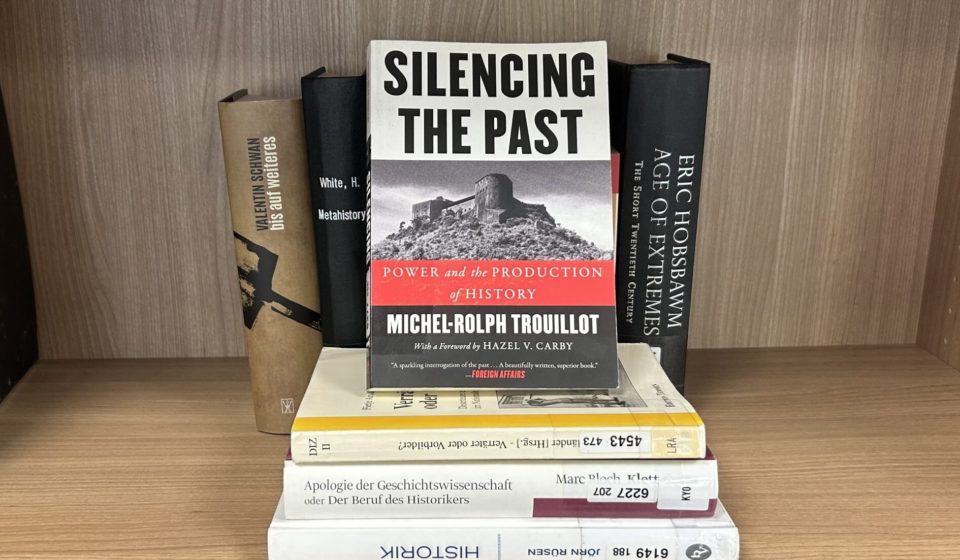
NGHM liest | Michel-Rolph Trouillot: Silencing the Past (1995).
What happens to a revolution that the dominant thinking of its time deemed ‘unthinkable’? Michel-Rolph Trouillot’s Silencing the Past: Power and the Production of History, the eighth title on the NGHM reading list and on this occasion assigned to the field of postcolonial theory and criticism, answers this question through the example of the Haitian Revolution. In doing so, the book develops a model that continues to shape critical historical, archival, and memory studies to this day.
When the book appeared in 1995 with Beacon Press in Boston, Trouillot was teaching at Johns Hopkins University, where he had moved in 1988 as Associate Professor; he later served there as Krieger/Eisenhower Distinguished Professor of Anthropology and directed the Institute for Global Studies in Culture, Power and History, which he had founded. It was not his first book, but the one through which he came to be read far beyond Caribbean studies. It was preceded by Ti difé boulé sou istwa Ayiti (1977), the first book-length work of non-fiction in Haitian Creole, which he wrote while still a student, as well as Peasants and Capital: Dominica in the World Economy (1988) and Haiti: State against Nation (1990). Silencing the Past brought together what these works had been circling: a question about power in the production of historical knowledge, posed from a position rooted equally in Haitian intellectual history and in North American anthropology.
This dual position had biographical foundations. Trouillot, born on 26 November 1949 in Port-au-Prince, came from a family in which the production of historical knowledge and the practice of the archive were part of intellectual socialization: his uncle Hénock Trouillot directed the Archives Nationales d’Haïti for many years and was regarded as one of the most influential Noiriste historians of his generation; his father Ernst Trouillot was a lawyer and teacher at the Lycée who pursued historical writing as a secondary occupation, including a television programme on Haitian history. In 1968, Trouillot left Haiti together with a larger group of students to escape the repression of François Duvalier’s regime. He completed a B.A. in Caribbean History and Culture at Brooklyn College in 1978 and received his doctorate in Anthropology from Johns Hopkins University in 1985, under Sidney W. Mintz and Richard Price. To write about the Haitian Revolution from that vantage point is not to write from the detached distance of a remote research question, but from an inheritance in which the gaps of the archives themselves belong to family history. The dedication of the Beacon Press edition to the memory of his father Ernst Trouillot inscribes this connection at the very opening of the book.
At the center of the book lies a simple yet consequential model. History carries two meanings: what happened and what is said about it. The transition between the two is not a neutral operation. ‘Silences’ enter the process of historical production, as Trouillot argues in his central thesis in the first chapter, The Power in the Story, at four distinct moments: in the making of sources, in the construction of archives, in the retrieval of facts for narratives, and finally in the retrospective attribution of significance. At each of these moments, unequal power relations distribute traces unevenly. ‘Silence’ here is not an absence of sources, but a result.
Trouillot demonstrates this concretely.
Through the history of the palace complex Sans Souci and its near-forgotten namesake Jean-Baptiste Sans Souci, he shows in the second chapter how an actor can be made to disappear entirely without anyone having actively sought to forget him. The Haitian Revolution itself was, as he argues in the third chapter, An Unthinkable History, not merely misrepresented by Western thought but rendered unthinkable: a successful slave revolution fit none of the categories through which contemporary European observers conceived of politics, reason, and agency. What is unthinkable cannot be adequately narrated even in retrospect: it remains at the margins, in the footnote, in the exception. In the concluding chapters, Trouillot shifts his gaze to the present of history, to the controversies surrounding Christopher Columbus and, through the example of a planned Disney theme park, to the public production of history. The epilogue returns to the question of how the analysis of power in historiography can itself become a political practice.
The impact has been broad and enduring. Hazel V. Carby, in her preface to the 20th anniversary edition of 2015, outlines the book’s influence on anthropology, history, and African American, Caribbean, and postcolonial studies, while also highlighting it as an introduction to historical analysis for a new generation of readers. Appreciative assessments came from Eric R. Wolf, Arjun Appadurai, and Kenneth Maxwell. That Raoul Peck, decades later, made Silencing the Past one of the three central references for his HBO documentary series Exterminate All the Brutes—alongside Sven Lindqvist and Roxanne Dunbar-Ortiz—points to a reach that has long since transcended the boundaries of academic discourse. The terms ‘silencing’ and ‘unthinkable history’ now belong to a shared vocabulary through which colonial knowledge orders and archival critique are discussed.
Those who in previous entries in this series have followed Carr’s question about who actually decides what counts as a ‘historical fact’, and who have read with Foucault that knowledge orders are products of power relations, will find in Trouillot a specific application of both questions to historiography itself. Trouillot does, however, shift the emphasis: the concern is not only with what is said, but also with those moments in the production process at which nothing can be said at all. Later in this series, Frantz Fanon’s Black Skin, White Masks will raise a related question from a different tradition, thereby demonstrating that reflection on colonial knowledge formations has multiple strands that require one another in order to achieve precision.
Trouillot’s model relocates the site of critique: the problem does not begin with the narrative itself, but with the conditions under which it becomes tellable in the first place.
Students in Osnabrück will find Trouillot’s Silencing the Past in the B-Freihand-Magazin under the shelf mark 6277-556 4 (OPAC).
Michel-Rolph Trouillot (1949–2012), Silencing the Past: Power and the Production of History, Boston: Beacon Press 1995.
This post is part of the series NGHM liest [NGHM Reads], in which the 65 titles of the NGHM reading list are presented. The list can be explored as a knowledge graph.