
This post was automatically translated from the German original at
NGHM WebApp-Slam am 21. Januar 2026.
How can historical questions be reconceptualised using digital tools? Students from the Historical Seminar explored this question during the winter semester 2025/26 in the NGHM Digital History Workshop.
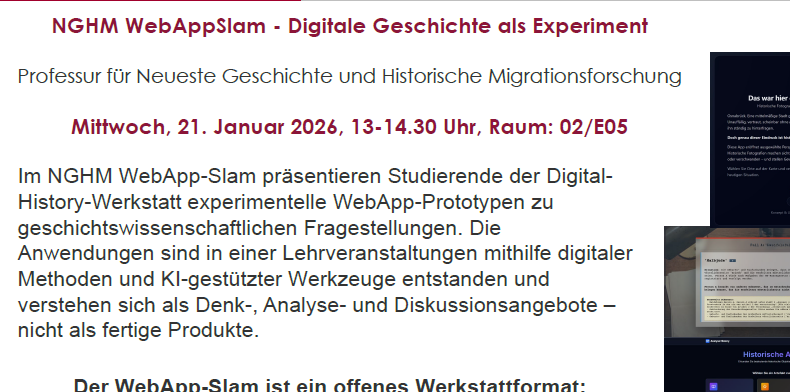
At the NGHM WebApp Slam, students will now present their experimental WebApp prototypes – developed with historical questions, critical reflection, and AI-supported tools. We cordially invite the interested university community to discover digital history as an experimental field and space for discussion.
21 January 2026 | 1:00–2:30 PM | Room 02/E05
Digital History as Experiment
On Wednesday, 21 January 2026, the Contemporary History and Historical Migration Research (NGHM) team together with students from the Historical Seminar’s Digital History Workshop of winter semester 2025/2026 will host the first NGHM WebApp Slam.
Between 1:00 and 2:30 PM, students will present their WebApp prototypes developed in the seminar around historical topics and questions to the interested university community.
Location: University of Osnabrück, Room 02/E05
(The building can be found using the NGHM Campus Navigator, among other tools.)
Insights into Workshop Practice
The WebApp Slam is neither a competition nor a product presentation. It is designed as a workshop format in which students present their digital prototypes, explain them, and discuss them together with the audience. The focus is on historical questions that have been modelled, refined, and experimentally addressed using digital methods.
The WebApps created in the seminar are deliberately provisional prototypes. They do not see themselves as completed research instruments, but as offerings for thought and discussion: they make assumptions visible, open up perspectives, and encourage critical engagement with historical processes, narratives, and sources.
Vibe Coding, AI and Academia
In the Digital History WebApp Workshop, students also work with AI-supported development environments. This approach is often referred to as “Vibe Coding”: ideas, questions, and academic requirements are translated into structured descriptions from which initial digital prototypes can be developed. These are then tested, adapted, extended – or deliberately discarded.
Our approach is clear: Artificial intelligence does not replace (historical) academic analysis. However, it can help make ideas visible more quickly, test models, and formulate new questions. Historical judgement, source criticism, contextualisation, and interpretation remain unequivocally the task of historians.
The WebApp Slam makes this approach concretely tangible – through the projects themselves, their possibilities, but also their limitations.
Projects, Topics, Perspectives
The prototypes presented in the slam cover a broad thematic and methodological spectrum. These include, among others:
- Simulations of historical decision-making and negotiation processes,
- interactive models of historical organisational and administrative systems,
- narrative experiments that reflect on roles, perspectives, and forms of knowledge,
- spatial visualisations of historical routes, infrastructures, and urban spaces,
- analytical interfaces that make history accessible through 3D models or structured artefact data,
- as well as initial AI-supported approaches to historical analysis and communication.
All projects share an experimental character: they are open, open to discussion, and designed to pose questions – not to provide definitive answers.
Invitation to Discussion
With the NGHM WebApp Slam, we invite everyone interested in Digital History, Historical Studies and AI, as well as new teaching and learning formats. Students, teachers, and staff from all disciplines are welcome.
The slam offers an opportunity to try out prototypes, engage in conversation with students about their concepts, and discuss together what role digital methods can play in historical academic practice – today and in the coming semesters.
On 20 January 2026, Prof. Dr. Christoph Rass will give a lecture in the lecture series “Teaching and Learning in the Digital World” of the Centre for Teacher Education (ZLB) at the University of Osnabrück. His lecture entitled Historical Studies^(Digital History × AI): Potentials and Challenges for Research and Teaching addresses the impact of artificial intelligence on historical studies.
Tuesday, 20 January 2026, 4 to 6 PM, Room 01/B01, University of Osnabrück.