
Research Revisited: NGHM Publications on the Production of Figures of Migration 2024/25

This post was automatically translated from the German original at
Research Revisited: NGHM-Publikationen zur Produktion von Figuren der Migration 2024/25.
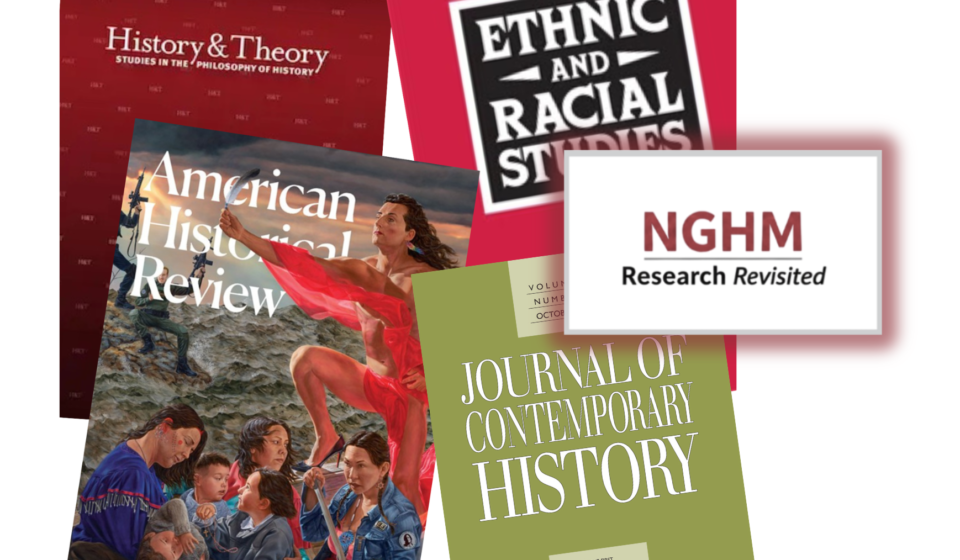
In the section Research Revisited the NGHM team presents completed research projects and publications in an informal series. This edition provides insights into four internationally published journal articles from the academic year 2024/25:
Julie M. Weise & Rass, Christoph: Migrating Concepts: The Transatlantic Origins of the Bracero Program, 1919–42, in: The American Historical Review 129/2024, pp. 22-52. https://doi.org/10.1093/ahr/rhad500
Sebastian Huhn & Rass, Christoph: Displaced Person(s): The Production of a Powerful Political Category, in: Ethnic and Racial Studies 48/2025, pp. 718-739.
https://doi.org/10.1080/01419870.2024.2404488
Catherine S. Ramírez & Rass, Christoph: Producing Integration: The Translation of Non/Belonging in Germany and the United States, in: History and Theory 64/2025, pp. 375-386. https://doi.org/10.1111/hith.12390
Jessica Wehner & Christoph Rass: Disputed (Non-)Belonging: Migrant Agency in the European Displacement Crisis 1945–56. in: Journal of Contemporary History (online first). https://doi.org/10.1177/00220094251396890
Transatlantic Conceptual History and the Critical Analysis of Migration Policy Categories
How are people transformed through migration policy categories into specific “figures” – into “guest workers,” “displaced persons,” or “foreigners”? Four research contributions from the academic year 2024/25, published in the American Historical Review, the Journal of Ethnic and Racial Studies, History & Theory, and the Journal of Contemporary History, examine the production of such categories as a historical process.
This research perspective, which Christoph Rass has developed in subproject A3 of the Collaborative Research Centre 1604 “Production of Migration”, analyses migration policy categories not as neutral descriptions of social realities, but as political instruments that are actively produced through conceptual translation and circulation processes.
The four articles by Christoph Rass together with Julie M. Weise, Catherine Ramirez, Jessica Wehner and Sebastian Huhn connect the analysis of how migration policy concepts and their translation produce the meaning of migration and make it regulatable. They examine the genesis of the Bracero Program under the influence of knowledge transfer from European labour migration systems, the historical production of the category “Displaced Persons” as a bureaucratic control instrument, the creation of categories to subjectivise non-Western DPs as culturalised Others, and finally the discursive construction of “integration” as a medium of migrantisation. It becomes clear that such categories circulate across national and disciplinary as well as spatial and temporal boundaries and structure social hierarchies and access rights. However, it repeatedly becomes apparent that the addressees of such mechanisms develop remarkable agency to challenge and transform dominant categorisations.
Migrating Concepts: Award-winning Transatlantic Migration History
In March 2024, the article “Migrating Concepts: The Transatlantic Origins of the Bracero Program, 1919–42” (AHR 129/2024, pp. 22–52) co-authored by Christoph Rass and Julie M. Weise (University of Oregon) appeared in the American Historical Review. The study examines the little-known transatlantic roots of one of the most important labour migration programmes of the 20th century. The Bracero Program (1942–1964), the bilateral agreement regulating labour migration between the USA and Mexico, enabled more than four million work contracts for Mexican men in the United States.
Previous research has interpreted this programme primarily in the context of hemispheric power relations and US hegemonic politics. However, the new article shows that the negotiation of the programme was preceded by two decades of intensive transatlantic exchange. During the interwar period, Mexican politicians, intellectuals, and migration activists participated in transatlantic and inter-American dialogues on migration policy, compared their situation with that of Italy, and were interested in the bilateral labour migration systems that had emerged in Europe. US authorities, on the other hand, initially rejected recommendations from migration scholars and the International Labour Organisation (ILO) to adopt European models.
When World War II prompted the USA to suddenly propose a corresponding agreement to the Mexican government for recruiting people as temporary workers, the transatlantic knowledge of Mexican actors significantly influenced the design of the programme. The article thus argues for a historiography that goes beyond mere comparisons and focuses on the entanglements and circulation processes of migration policy ideas across continental boundaries.
The significance of this study was recognised in 2025 through the award of the Premio al Mejor Artículo en Ciencias Sociales by the Latin American Studies Association (LASA).
Displaced Person(s): The Production of a Powerful Political Category
In October 2024 (online first, in print 2025), the article “Displaced Person(s): The Production of a Powerful Political Category” (ERS 48/2024, pp. 718-739) co-authored by Christoph Rass and Sebastian Huhn followed in the Journal of Ethnic and Racial Studies. This study examines the conceptual history of one of the central categories of 20th-century migration policy and responds to a current tendency in migration research to use the term “displaced persons” as a broader and more inclusive alternative to the term “refugees.”
The article traces the historical genesis and transformation of the concept “Displaced Persons” and argues that this term was created in the 1940s primarily as a “category of action” for bureaucratic and political purposes, not as a neutral description of social realities. The study shows how the category emerged and developed in the context of controlling violence-induced mobility after World War II. It served international organisations and states as an instrument for regulating and managing flight and forced migration.
The study thus calls for a reflexive approach to terms that were often initially introduced to control people and their (im)mobility. It demands a historically informed and self-reflexive debate about the use of such process-generated taxonomies for the analytical description of mobility in academic literature. Understanding this historical context shows that categories like “displacement” have always been and continue to be instruments of political control, which underscores the necessity of reflexivity in migration research.
Producing Integration: Translation of Belonging and Exclusion
The third publication appeared in 2025 in History and Theory: the article “Producing Integration: The Translation of Non/Belonging in Germany and the United States” (History and Theory 64/2025, pp. 375-386) co-authored by Christoph Rass and Catherine S. Ramírez (University of California, Santa Cruz). The article is part of the forum “Translation, Migration, Narrative“, edited by Julie M. Weise and Christoph Rass. This forum was preceded by a multi-year interdisciplinary and transatlantic research process initiated and coordinated by the two historians.
The research collaboration began in 2020 as a cooperation between Julie Weise (University of Oregon), Christoph Rass and Peter Schneck (both IMIS Osnabrück) within the framework of the “Migration Societies” research profile at the University of Osnabrück. It expanded into an international and interdisciplinary network of scholars from the fields of history, cultural studies, literary studies, and anthropology. Between 2020 and 2025, the group organized a series of online “Tiny Desk Conferences” and collectively explored very different modes of translating migration concepts between cultural spheres, languages, academic disciplines, as well as across time and space.
The exchange culminated in two international conferences: In April 2022, the first “Translations of Migration Conference” took place at the University of Oregon in Eugene, where scholars discussed the application of translation as an analytical tool. The second conference took place in October 2023 at the Simpson Center for the Humanities at the University of Washington in Seattle under the leadership of Prof. Dr. Anand Yang. From this intensive research and discussion process, the forum in History & Theory finally emerged, which consolidates the methodological and conceptual results of this transnational cooperation.
The essay by Ramírez and Rass examines how the concept “integration” was produced, translated, and institutionalized in Germany and the United States as a key element of political framings—framings that make certain people into “migrants” and thereby mark them as outsiders. By combining conceptual history and translation theory, the authors analyze how the meaning of integration has evolved in academic and political discourses, tracing its emergence as a central category in migration administration.
The approach, which combines translation theory with conceptual historical analysis, challenges the traditional understanding of the evolution of what “integration” means. The study shows how political, economic, and historical forces actively shape the meaning of integration and use it as a medium to translate individuals into “migrantized figures.” It thus examines fundamental processes of knowledge production and meaning constitution as acts of translation that both regulate belonging and reinforce social hierarchies.
Disputed (Non-)Belonging: Migrant Agency in the European Displacement Crisis 1945–56
Migrant Agency and the Limits of Categorization Practices
This line of research is now complemented by another publication that appeared online first on December 1, 2025: the article “Disputed (Non-)Belonging: Migrant Agency in the European Displacement Crisis 1945–56” co-authored by Christoph Rass and Jessica Wehner in the Journal of Contemporary History (JCH 2025). The study examines how “Displaced Persons” marked as “Muslim” strategically navigated the categorization practices of UNRRA, IRO, and local authorities between 1945 and 1956, challenging institutional practices through their own agency.
The article analyzes three dimensions of migrant agency: recognizing contradictions in institutional classifications, strategically manipulating these categories to avoid forced repatriation, and cumulatively influencing institutional practices through individual and collective actions. The study thus expands the perspective on the production of migration policy categories to include an analysis of the agency of those people who were made into marginalized groups through such categories, showing how processes of categorization and exclusion could paradoxically open up spaces for agency.
Translational Turn and Reflexive Migration Research
An approach to migration policy categories as historically produced and contested instruments of political regulation connects the four publications. While the articles in the American Historical Review and History and Theory employ translation-theoretical approaches to examine the transnational production and circulation of migration policy concepts, the contribution in the Journal of Ethnic and Racial Studies pursues a conceptual historical approach. The essay in the Journal of Contemporary History expands this perspective to include the dimension of migrant agency. The studies refer to methodological approaches that are being further developed in the Collaborative Research Centre 1604 “Production of Migration” and are attracting increasing international interest.
The four works argue that migration policy categories represent neither neutral descriptions of social realities nor static ordering systems. They emerge through translation processes across national, linguistic, and conceptual boundaries and are transformed through the practices of those people who are designated by them and are thus made socially locatable and governable. The authors simultaneously make clear how central the historical analysis of the genesis, circulation, and negotiation of such categories is for a reflexive understanding of the contemporary production of migration.