
This post was automatically translated from the German original at
Sussex Depesche #1.
This week, the NGHM team travelled with a delegation to the University of Sussex to participate in the Landecker Digital Memory Lab inaugural Expo, which is dedicated to digital public history in the context of Holocaust history under the title Exploring the Future of Digital Holocaust Memory.
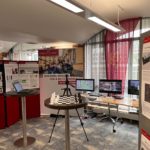
From Tuesday to Thursday, the Osnabrück researchers are presenting their approaches and methods for researching, digitising and communicating sites of violence under Nazi rule, the German war of extermination and the Holocaust at their own exhibition stand. The Research Group for Contemporary History and Historical Migration Research provides insights into their projects with students, pupils and representatives of civil society in Greece, Belarus, Ukraine and Germany.
After today was devoted to arrival and setting up, Johannes Pufahl, Imke Selle, Annika Heyen, Lukas Hennies and Christoph Rass will lead the workshop Mapping the Past and the Production of History: Low-Tech, Participatory Approaches to Documenting Holocaust Sites and Conflict Landscapes at the conference opening on 24 June.
The Osnabrück research group has been connected to the Alfred Landecker Foundation and its support for Holocaust research and documentation since 2021 through the work of Dr Sebastian Musch, who conducts research on the Holocaust Migration Regime as a Landecker Lecturer.