
This post was automatically translated from the German original at
Sussex Depesche #3.
On the second full conference day of the Landecker Digital Memory Lab inaugural Expo – Exploring the Future of Digital Holocaust Memory at the University of Sussex, the programme continued to offer fascinating and inspiring insights into projects on digital public history of the Holocaust. At the same time, the Exhibition Spaces remained open, where participants could familiarise themselves more closely with selected projects.
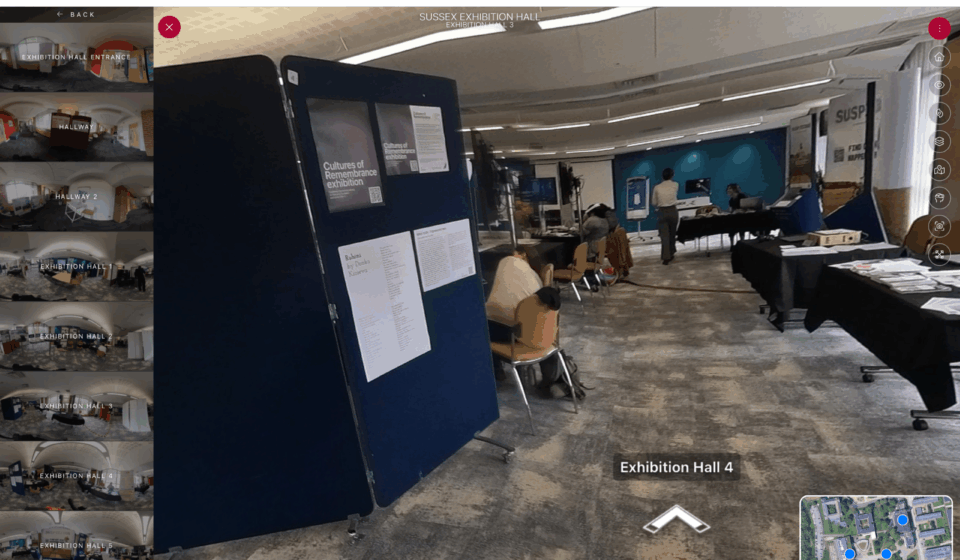
The Osnabrück team led by Prof. Dr. Christoph Rass not only used the day to attend lectures and workshops, but also practically demonstrated the potential of simple digital approaches by creating a digital tour through the project exhibition:
360-Exhibition-Tour (Pre-Release): Recording, interviews and design: Johannes Pufahl, Imke Selle, Annika Heyen, Lukas Hennies & Sebastian Musch.
In parallel, the workshops, lectures and project presentations of the conference programme continued. Among these were, to highlight just a few contributions, for example the research project “Trawniki: Nexus of the Final Solution”, which was presented by an international consortium led by Caroline Sturdy-Colls (University of Huddersfield). The interdisciplinary team, which includes archaeologists, historians and computer scientists, is working on the digital visualisation of the “Trawniki” camp near Lublin at the village of Trawniki (SS training and labour camp) and its multi-layered microhistories. The project’s methodological approach makes it possible to visualise both the physical structure of the camp and the individual experiences of the people interned there, thus opening up a new dimension of historical education.
In another presentation, Andrés Bartos Amory and Lucija Stojević from Noon Films presented their project “A Dangerous Journey”, which is dedicated to the cinematic processing of escape stories during the Nazi period. Their work demonstrates how audiovisual media can make complex historical narratives accessible while maintaining both scientific accuracy and emotional authenticity.
Also very innovative was the presentation of the “Mercy Squad Immersive” project by Angela Shapiro (Gathering the Voices/Glasgow Caledonian University) and her colleagues Ben Shepherd and Hamid Homatash. The project reconstructs the complex dynamics between perpetrators and protectors during the German war of extermination against the Soviet Union using immersive technologies. This approach makes it possible to explore and communicate the moral ambivalences and scope for action in extreme historical situations in new ways.
The day was rounded off by a specialised networking session on “Digital Holocaust Memory”, which was conceived as a “Mini-Hack”. This innovative event format underscores the collaborative character of modern historical research and the necessity of interdisciplinary cooperation in developing digital memory tools. Overall, these and the many other contributions of the second conference day demonstrated how digital transformation opens up new possibilities for Holocaust research and education, and how scholars can seize these opportunities without abandoning a scholarly and respectful approach to the historical legacy of the Holocaust and its victims.