There and Back Again | Excursion to the Documentation Centre Haren/Mazków, the Former Camp Site Oberlangen and the War Cemetery Groß Fullen

This post was automatically translated from the German original at
Hin und wieder zurück | Exkursion zum Dokumentationszentrum Haren/Mazków, dem ehemaligen Lagerstandort Oberlangen und zur Kriegsgräberstätte Groß Fullen.
Following the Traces of Haren/Maczków: A Post-War History in the Emsland
by Lisa Marie Schophuis
On the morning of 16 May 2025, a group of history students gathered to make their way to the Emsland. The students were accompanied by Lukas Hennies, Lea Horstmann and Imke Selle. In total, the group visited three destinations in the Emsland: the site of the former ‘Emsland camp’ Oberlangen, the Documentation Centre Haren/Maczków and the war cemetery Groß Fullen.
During the preparatory session on 2 April, the students’ wishes and expectations were already expressed and discussed. There was particular interest in the coexistence of the residents of Haren and the predominantly Polish inhabitants of Maczków and their biographies. Imke Selle presented a brief historical overview of the Emsland camps and a short documentary1 provided insight into the history of Haren/Maczków. Shortly after the end of the Second World War, this small town was evacuated by its German inhabitants and made available as a place of residence for the many former Polish forced labourers, members of the Polish army in exile in the region, as well as former Polish inmates of the ‘Emsland camps’.
After approximately an hour’s journey, the group arrived at the former camp site of Oberlangen. First, the group went to a Polish memorial stone that was erected in memory of the Polish prisoners of Oberlangen camp
Accompanying a brief introduction by Imke Selle, the students were given the opportunity to take in the memorial stone and information panel. The memorial stone commemorates, in Polish and German translation, the Polish prisoners of war, which included more than 1,700 soldiers of the Polish Home Army Armia Krajowa who were imprisoned in Oberlangen after the Warsaw Uprising. Further information can be found on the adjacent information panel about the Emsland camp Oberlangen. The former camp itself is no longer visible – with the exception of a ‘potato bunker’ – and the area is now used for agriculture. Only the name of the adjacent street, Lagerstraße [Camp Street], remains.
Subsequently, the group continued to a memorial pavilion erected in 2014,2 which was built somewhat further from the road at the beginning of a small wooded area. Here too, there are additional information panels dealing with the Emsland camps, Oberlangen camp and its liberation.
As one of a total of 15 concentration, penal and prisoner-of-war camps established in the Emsland under Nazi rule, Oberlangen camp was part of the camp system operated by the SA and SS, the judiciary and the Wehrmacht. In total, approximately 80,000 political prisoners and convicts, as well as more than 100,000 prisoners of war from various countries during the Second World War, were held in the Emsland camp system. The number of deaths among the inmates has not yet been precisely determined in current research, but estimates range from 20,000 to 40,000 people.
Oberlangen camp was used from 1933 to 1934 as a training facility for SA guard units. Until 1939, it was operated as a penal camp by the judicial administration, before being taken over by the Wehrmacht at the beginning of the war and converted into a prisoner-of-war camp. The daily routine of the prisoners included forced labour in bog cultivation as well as mistreatment and violence by the guards. The convicts who were imprisoned in the camp between 1934 and 1939 were either punished for criminal offences, such as theft, or for offences that the Nazi regime had newly introduced or intensified – such as alleged preparation for high treason or homosexuality. The prisoners of war who were brought to Oberlangen after the beginning of the war were mostly of Polish or Soviet origin. For a brief period in 1944, Italian military internees were also among the prisoners.
When the camp was liberated on 12 April 1945 by the 1st Polish Armoured Division, the group of inmates consisted of approximately 1,700 Polish soldiers who had been interned there as part of the Polish underground army Armia Krajowa after the Warsaw Uprising. After the end of the war, around 25,000 Polish Displaced Persons – including former prisoners of war, forced labourers and soldiers of the 1st Polish Armoured Division – were initially accommodated in former prison camps in the Emsland. When these became overcrowded, the British occupation authorities evacuated surrounding settlements in the Emsland and East Frisia, including the town of Haren. This was renamed first to ‘Lwów’ and then to ‘Maczków’ in 1945 and served for three years as a Polish enclave with approximately 4,000 inhabitants.3
Particularly surprising for the excursion participants was how public Oberlangen camp was during its existence. The guards organised camp tours and folk festivals for people in the surrounding area and also played football matches against local clubs. All of this was done with the purpose of winning over the predominantly Catholic population of the Emsland to the ideas of National Socialism and demonstrating closeness to the people. The number of 15 camps in the Emsland alone also surprised the majority of students. The widespread ‘We knew nothing about it’ narrative therefore appears implausible, according to the results of the reflection session.
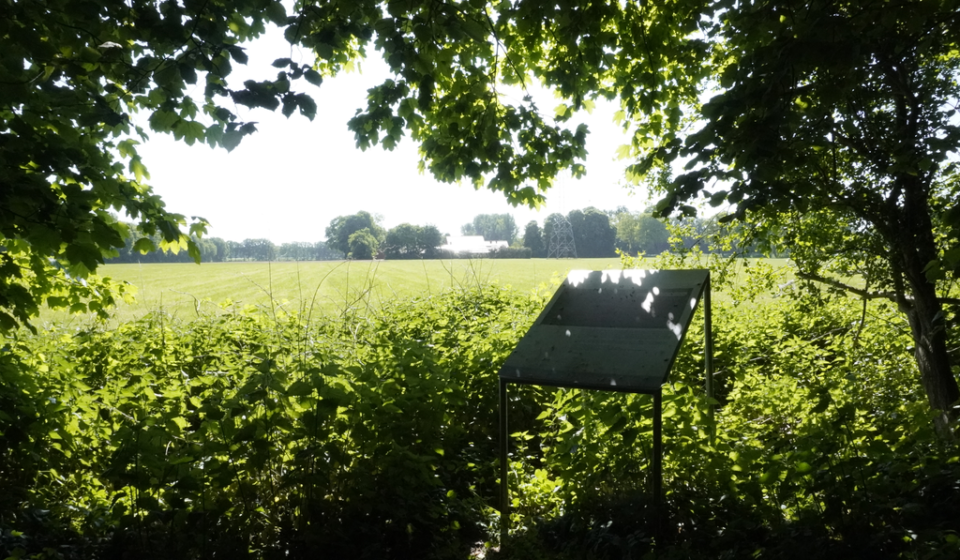
Subsequently, the group took a small path to the right of the pavilion deeper into the small wooded area to a hidden information panel. This displays an image of the current topography of the area, overlaid with an aerial photograph of Oberlangen camp. This allows visitors to better imagine the dimensions of the camp on the area now used for agriculture.
After the visit to Oberlangen, the group continued to the Inselmühle [Island Mill] in Haren. The Documentation Centre Haren/Maczków is located in this building, which was restored in 2020, and presents a permanent exhibition on the ground floor that particularly focuses on the years 1945-1948, the period when the small town bore the name Maczków.4 The students were able to explore this exhibition independently.
The permanent exhibition begins with a brief presentation of the history of the town of Haren. The place was first mentioned around the year 890 in a register of Corvey Abbey, before Haren Castle was acquired by the Bishop of Münster in 1076. The first documentary mention of the parish of Haren is dated to the year 1379.5
During the Nazi period, forced labourers were employed for work in the Haren area. There was also persecution and humiliation of Jewish residents here. Jewish people also became victims of the Shoah in this small town. The synagogue, which had only been consecrated in 1909, burned down on the night of 9 November 1938. Resistance against the regime was almost non-existent, and when it occurred, it was only in small actions. The Second World War reached Haren on 8 April 1945, when both the Haren church tower and the Inselmühle were shelled by Canadian and Polish troops. Sister Kunigunde was able to persuade other Haren residents to show the white flag by hoisting a white bedsheet on the church tower. This led to negotiations between Haren and the Allied soldiers, and the shelling was stopped, so that only minor material damage occurred. The first evacuations took place as early as 12 April 1945, and the occupation forces also demanded the surrender of blankets and other essential items for the Polish women who were liberated from Oberlangen camp by the 1st Polish Armoured Division on that day.6
The real shock came for the residents of Haren on Whit Sunday 1945. The inhabitants received orders to leave their houses within the next 24 hours. They were only allowed to take the bare necessities with them and had to leave behind most of their household belongings. The residents of Haren were now to be accommodated for the next two years predominantly with relatives and acquaintances on farms in the surrounding area, where the hygienic conditions were inadequate. In Haren itself, predominantly Polish Displaced Persons and soldiers of the Polish Army in Exile now moved in. The residents of Haren were forbidden to enter the town, which was now called Maczków – unless they could present an exceptional permit, such as the one the local postman received. Officially, Haren/Maczków was now a Displaced Persons Camp, established by the British occupying forces and administered by the UNRRA (United Nations Relief and Rehabilitation Administration). The goal of the British occupying forces was the repatriation of the Displaced Persons to their countries of origin – which was rejected by most Poles, however, as the country had changed significantly and they feared sanctions in now communist Poland. The soldiers of the 1st Polish Armoured Division, on the other hand, pursued different goals than the British. They wanted to create a Polish model community in Maczków – in close coordination with the Polish government-in-exile in London. Thus they had a mayor elected and initiated a municipal council. All streets in the town were renamed and now bore Polish names. A separate Polish school system developed in Maczków with primary school, Polish gymnasium and a lyceum; altogether three graduating classes obtained their Abitur in the town. A theatre and cinema also found their place in the Polish enclave – on the one hand, people were to have the opportunity to process the cruel past of forced labour, imprisonment and war, and on the other hand, they were to be reintroduced to civilian life. Polish theatre groups performed Polish plays and the cinema showed predominantly films by the Western Allies. This offering was supplemented by musical performances and their own newspapers. Religious services, weddings, baptisms and funerals also took place in Haren’s church.7
That Haren would not remain Maczków forever became apparent as early as the beginning of July 1945. Through the British government’s recognition of the newly founded People’s Republic of Poland, Maczków lost the support of the Western Allies. The return of the houses to the residents of Haren took place gradually – beginning in March 1947 and continuing until September 1948. Some of the Polish residents of Maczków moved to the USA or Great Britain, as they did not want to return to Poland. The town received its original name back on 4 August 1948 – an event that the residents of Haren celebrated with a thanksgiving service. However, the joy over the now possible return to Haren was relatively soon followed by disillusionment – most houses had meanwhile become uninhabitable. This was due to the fact that they had been partially misused, wooden floors had been torn out and used for heating, and a five-day flood in 1946 had made many houses uninhabitable.9
The exhibition consists not only of information panels, but also of a table with a touch display showing a map of the town. Visitors can have displayed here where in the town, for example, the theatre or schools in Maczków were located. In addition, a digital media wall invites visitors to look at some digitised photo albums.
Following the independent exploration of the documentation centre, PD Dr Rüdiger Ritter, the director of the Haren/Maczków Documentation Centre, introduced himself and answered the students’ questions. He provided insight into the two archive rooms of the Inselmühle and gave a brief introduction to the Archive Information System of Lower Saxony and Bremen10, where the archive of the documentation centre as well as the Haren city archive can be found. In addition, Rüdiger Ritter reported on the work with the local people. When asked by a student, Rüdiger Ritter said that the documentation centre was well received by the residents of Haren and that private individuals sometimes approached them with additional documents. This required a great deal of trust-building and understanding, as for many families the time when Haren was called Maczków was a very sensitive topic. Interest had only begun in 1995, and in 2015 the demand for a reappraisal of the history had finally become vocal.11
The conversation with Rüdiger Ritter ended with a friendly invitation to the students to contact the documentation centre if interested – for this, and for the many insights, a heartfelt thank you!
In the afternoon, the excursion group continued on. The third and final destination of the excursion was the war cemetery Groß Fullen. After a brief presentation by Lea Horstmann about the cemetery, where presumably 2,000 to 4,000 deceased Soviet prisoners of war rest – most of them unknown by name – Lukas Hennies drew attention to the memorial plaque erected in the 1980s. The students were irritated by the wording, particularly by the formulation there of the reasons for the death of those buried here. They had supposedly died of “tuberculous lung disease” or “malnutrition” – not a word mentions National Socialism or the imprisonment that at least accepted these consequences for the inmates.
But this memorial plaque is not the only one to be found at the war cemetery; if one explores the site more intensively and keeps to the right side, one reaches memorial plaques for Soviet prisoners of war that were erected in a project by pupils. There – but also on other parts of the cemetery – stood some flower arrangements and candles, a sign that the war cemetery is still used as a memorial site today.
After the war, Italian military internees originally also buried in the cemetery were exhumed and transferred to Italy or to the cemetery of honour in Hamburg-Öjendorf.12 The deceased residents of Maczków were now transferred from Haren municipal cemetery to this war cemetery. The reasons for this reburial are unknown. A separate memorial stone can also be found for them in the cemetery, on which the names and birth and death years of the deceased are legible. The students were particularly surprised by the number of very young children who were buried here. Was this due to the hygienic conditions in Maczków, to the poor care of mothers during imprisonment and the post-war period, or to entirely different reasons? This question could not be definitively answered on site, but it prompted reflection. Subsequently, the students were given the opportunity to walk independently through the war cemetery.
After a concluding reflection, the group set off on the way back to Osnabrück.
Heartfelt thanks to Imke Selle, Lukas Hennies and Lea Horstmann for preparing, conducting and accompanying the excursion!
For Further Reading:
- Documentation Centre Haren/Maczków (ed.): Permanent Exhibition Haren/Maczków 45/48, Haren 2021.
- Esterwegen Memorial (ed.): War Cemetery Gross Fullen, in: Esterwegen Memorial. History. Camp Cemeteries, no date, URL: https://www.gedenkstaette-esterwegen.de/geschichte/lagerfriedhoefe/kriegsgraeberstaette-gross-fullen.html (last accessed: 29.05.2025).
- Esterwegen Memorial (ed.): Camp VI. Oberlangen, in: Esterwegen Memorial. History. The Emsland Camps, no date, URL: https://www.gedenkstaette-esterwegen.de/geschichte/die-emslandlager/vi-oberlangen.html (last accessed: 29.05.2025).
- Porta Polonica – Polish Traces in Germany (ed.): Short Documentary: “Paradise for a Time” – How Haren became Maczków, in: YouTube, URL: https://www.youtube.com/watch?v=vaicu2nIPM0 (last accessed: 23.05.2025).
- City Archive Haren (Ems) (ed.): Haren on the Ems – A Brief Local Chronicle of Important Events in the City’s History, Haren 2025.
- City of Haren (Ems) (ed.): Island Mill – House of Haren History, in: City of Haren (Ems). Family and Life. Culture, no date, URL: https://www.haren.de/portal/seiten/inselmuehle-haus-der-harener-geschichte-900000044-31540.html (last accessed: 29.05.2025).
References
1 Cf. Porta Polonica – Polish Traces in Germany (ed.): Short Documentary: “Paradise for a Time” – How Haren became Maczków, in: YouTube, URL: https://www.youtube.com/watch?v=vaicu2nIPM0 (last accessed: 23.05.2025).
2 Cf. Esterwegen Memorial (ed.): Camp VI. Oberlangen, in: Esterwegen Memorial. History. The Emsland Camps, no date, URL: https://www.gedenkstaette-esterwegen.de/geschichte/die-emslandlager/vi-oberlangen.html (last accessed: 29.05.2025).
3 The information was taken from the information boards of the memorial pavilion for Camp Oberlangen.
4 Cf. City of Haren (Ems) (ed.): Island Mill – House of Haren History, in: City of Haren (Ems). Family and Life. Culture, no date, URL: https://www.haren.de/portal/seiten/inselmuehle-haus-der-harener-geschichte-900000044-31540.html (last accessed: 29.05.2025).
5 Cf. City Archive Haren (Ems) (ed.): Haren on the Ems – A Brief Local Chronicle of Important Events in the City’s History, Haren 2025.
6 Cf. Documentation Centre Haren/Maczków (ed.): Permanent Exhibition Haren/Maczków 45/48, Haren 2021.
7 Cf. Ibid.
8 Cf. Ibid.
9 Cf. Ibid.
10 For those interested: https://www.arcinsys.niedersachsen.de/arcinsys/start.action (last accessed: 29.05.2025).
11 Cf. Documentation Centre Haren/Maczków (ed.): Permanent Exhibition Haren/Maczków 45/48, Haren 2021.
12 Cf. Esterwegen Memorial (ed.): War Cemetery Gross Fullen, in: Esterwegen Memorial.History. Camp Cemeteries, no date, URL: https://www.gedenkstaette-esterwegen.de/geschichte/lagerfriedhoefe/kriegsgraeberstaette-gross-fullen.html (last accessed: 29.05.2025).