Keynote | ICDAR 2026 Vienna | History and Document Analysis in Dialogue

By Christoph Rass · Originally published on nghm.hypotheses.org
On 1 September 2026, I delivered the second of three keynotes at ICDAR 2026 in Vienna, under the title “From Archives to Algorithms and Back: What Historians Need from Document Understanding.”
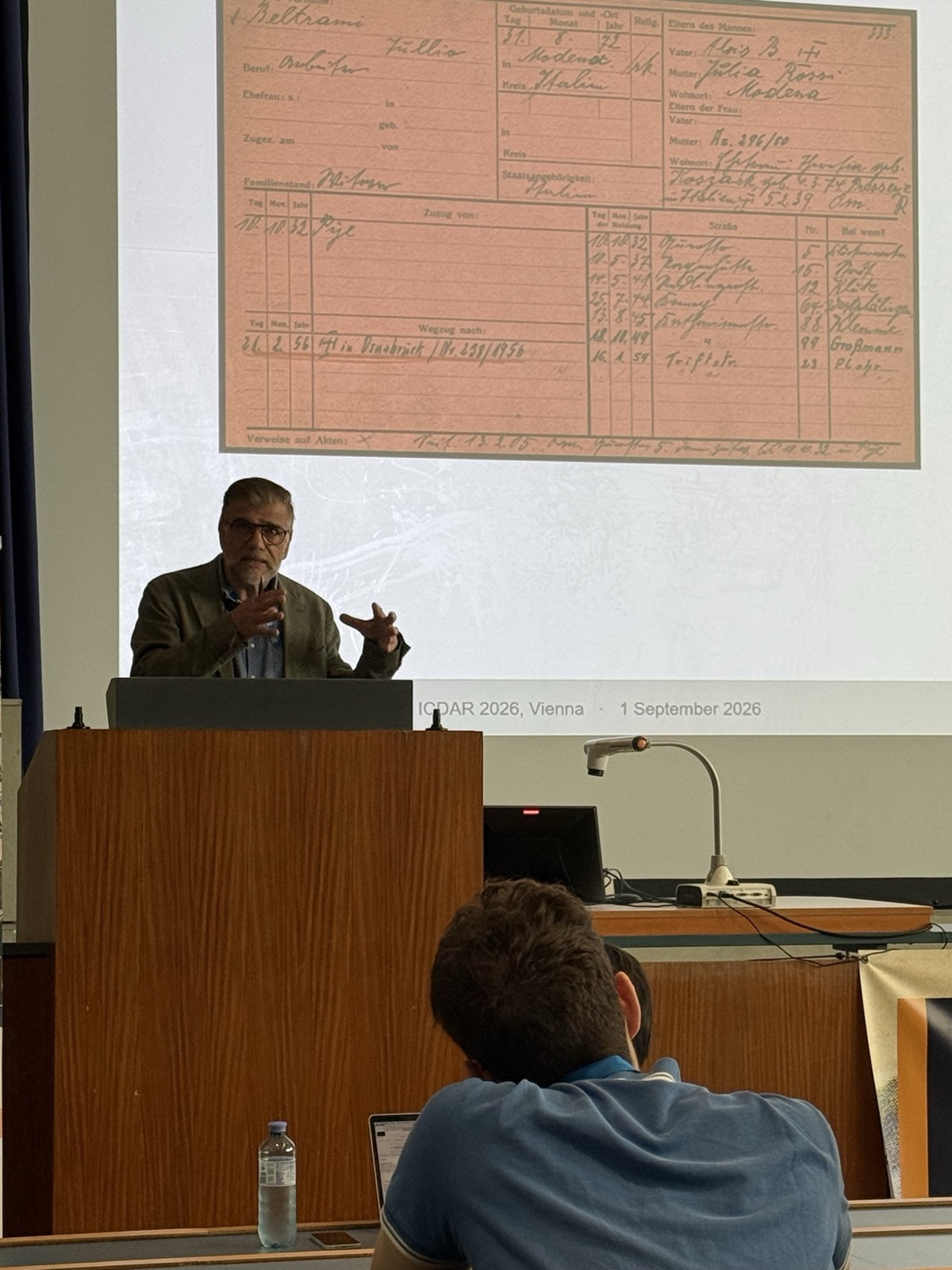
A historian stood before a plenary audience of computer scientists, negotiating not historical findings but the collaboration between document analysis and historical scholarship. This report first situates the conference and the cooperation from which the invitation arose, then highlights several contributions to the conference that my talk drew upon, and subsequently introduces the keynote’s argument in three steps: how administrative categories come into being and what happens to them on the way into the data, the three sites at which the tools of document analysis enter into historical research practice, and a proposal addressing how a system can differentiate between a read value and the process-generated category represented by that value.
The Conference
The International Conference on Document Analysis and Recognition is the preeminent international conference of a research field concerned with the machine-based analysis and recognition of documents. It is supported by the International Association for Pattern Recognition, specifically by its Technical Committees TC10 for Graphics Recognition and TC11 for Reading Systems, the former of which lists it alongside the GREC Workshop as a flagship event. The first edition was held as early as 1991 in Saint-Malo. Until 2023 the conference met biennially, and since 2024 annually, making Vienna already the twentieth edition.1
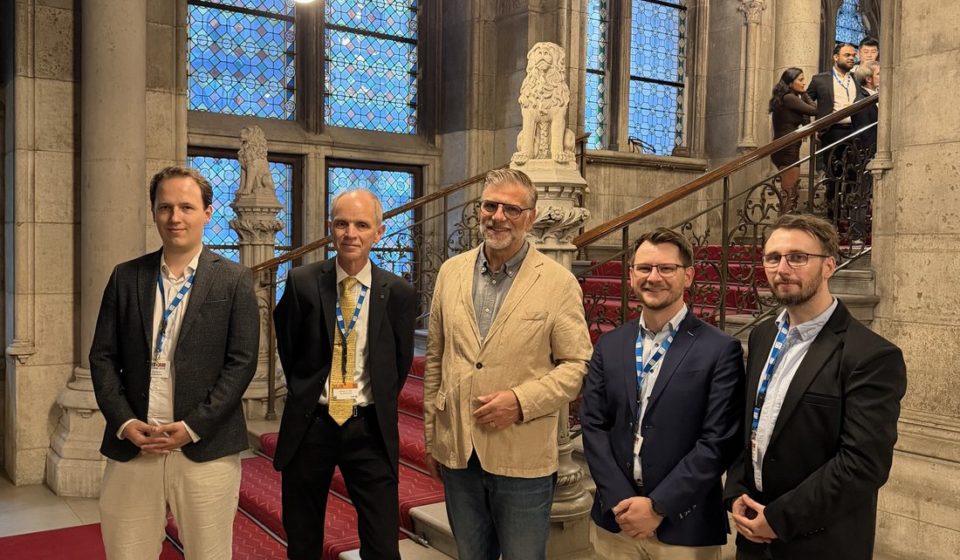
The conference was hosted by TU Wien, organized by the Computer Vision Lab under General Chairs Robert Sablatnig and Florian Kleber. Sessions took place on the Gußhaus campus in Vienna’s 4th district. The main conference ran from 31 August to 2 September 2026, framed by a tutorial day on 30 August and two workshop days on 3 and 4 September. The program comprised 140 peer-reviewed full papers selected from 300 submissions, along with twelve Journal Track contributions and eight competition reports.2
Three keynotes structured the three conference days. C. V. Jawahar from IIIT Hyderabad opened on Monday with “The Changing Landscape of Document Understanding.” Tong Sun, Senior Director at Adobe, closed on Wednesday with “The Next Frontier: From Document Understanding to Document Agency,” thus shifting the focus, as the title announces, from understanding documents to their agency. The Osnabrück contribution occupied Tuesday noon, positioned between and at the same time transverse to both, since it neither narrated a history of document analysis nor forecast its future prospects, but instead viewed the field from the outside and asked what understanding demands in principle when the object is a corpus of administrative documents from the twentieth century.3
The Cooperation with TU Dortmund
Behind the invitation lies work that began in Osnabrück in 2018. The research group NGHM began at that time to develop machine-based access to historical mass sources, initially two card indexes held at the Lower Saxony State Archive, Osnabrück Branch: the registry of the local Gestapo with approximately 50,000 cards and the Foreigners’ Registration Card Index with approximately 80,000 cards. Both were converted into data models with the aid of handwriting recognition and in collaboration with external partners. What had previously taken years was accomplished within months in these projects.
Working through a commercial service provider, however, reached its limits once the project grew, because the cost for the three million cards of a follow-up project was so far beyond what historical research can fund that the endeavor never came to fruition. This touches on a point that extends beyond the individual case: historical data must remain in the public domain as cultural heritage, and so must the tools used to make them accessible, because otherwise research on this scale will in future only be possible through subscriptions to proprietary services. In this respect, our pioneering endeavor served as a proof of concept that motivated us to search for open solutions.
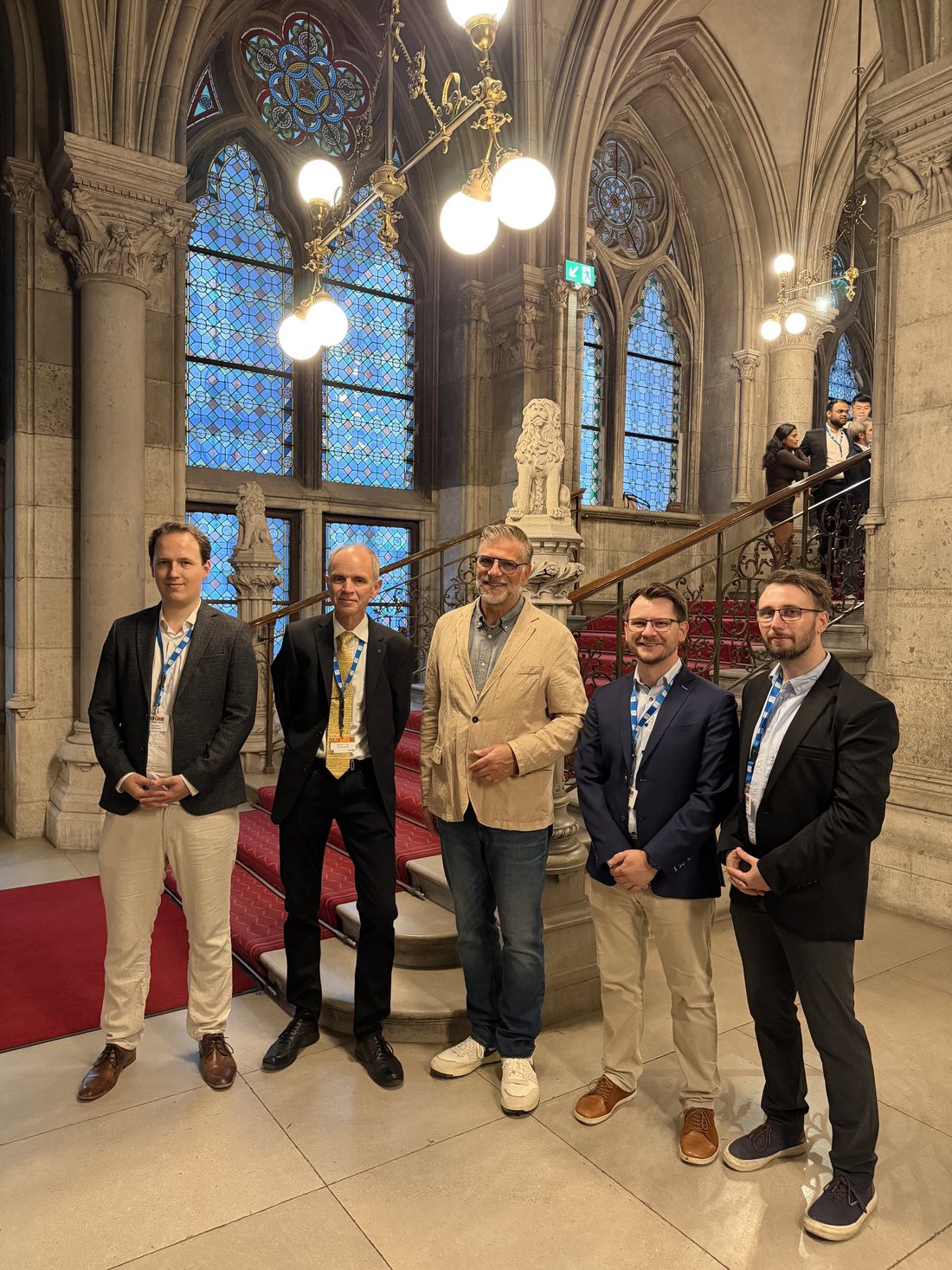
Since then we have been working together with Gernot A. Fink and the Pattern Recognition Group at TU Dortmund. Professor Fink served at ICDAR 2026 as one of four Program Chairs and as a co-editor of the proceedings. The group’s first contribution, in which we were also involved, appeared in 2025 in the proceedings of ICDAR in Wuhan and used the CM/1 forms to create a dataset for testing how well large vision-language models (models that process image and text in a single pass) can read a handwritten name and date of birth from very few training examples.4
The CM/1 files are the applications through which Displaced Persons in Europe applied to the International Refugee Organization for assistance after the Second World War. The collection 3.2.1.1 “CM/1 Files from Germany” at the Arolsen Archives comprises, according to the finding aid, over 196,000 files with references to approximately 578,000 names; the dataset published in 2025 counts differently, namely in cases and persons, and is based on 140,114 individual cases, of which after cleaning 135,951 cover sheets with 203,112 persons remain. The current contribution from the Dortmund group, which we as historians were once again able to support, goes deeper into the files in 2026 and extends data extraction to additional fields.5
What Was on Show at the Conference
The keynote itself was able to refer on several occasions to the conference program, in which numerous contributions engaged directly with our own questions and offered compelling solution perspectives.
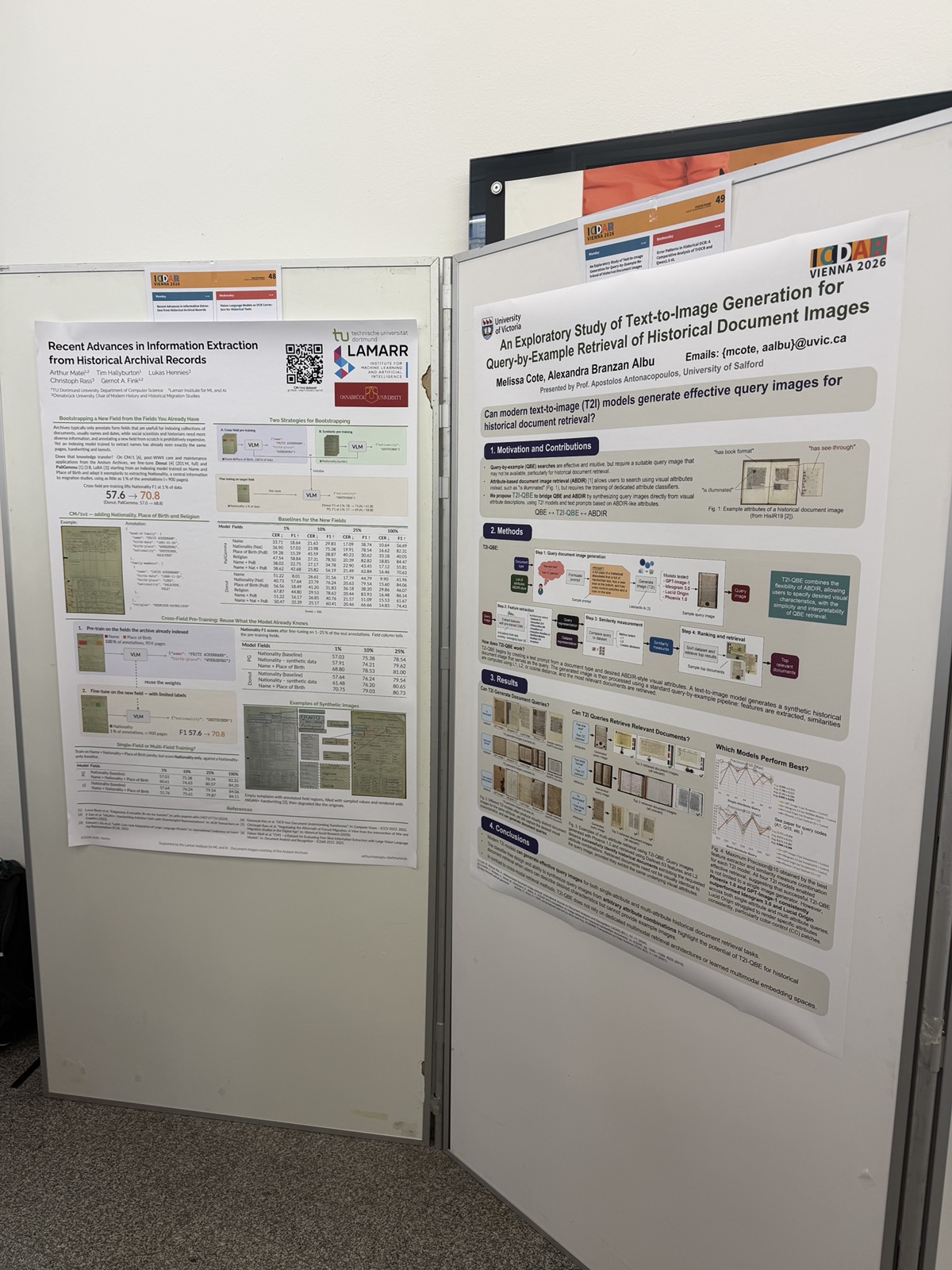
I was able to read such cross-connections very clearly from the project presentation poster wall. Two works hung there side by side, each representing one side of the same problem. The first, which emerged from the Osnabrück and Dortmund collaboration, was presented under Dortmund first authorship and is also situated at the Lamarr Institute for Machine Learning and Artificial Intelligence in Dortmund; it deals with information extraction from twentieth-century administrative records — in this case the CM/1 files, that is, legible, standardized forms of which there exist far more than any single person could ever examine. The second, by Melissa Cote and Alexandra Branzan Albu, investigates the retrieval of historical document images on the basis of their visual appearance, targeting older manuscripts and illuminated pages that must be deciphered before they can be read. In my talk I referred to these two dimensions as “the flood” and “the cipher,” because pattern recognition addresses both spheres of historical scholarship simultaneously. On the same poster wall, “Writer Retrieval at Scale” by Tim Raven, Tim Hallyburton, and Gernot A. Fink represented a further contribution from Dortmund.6
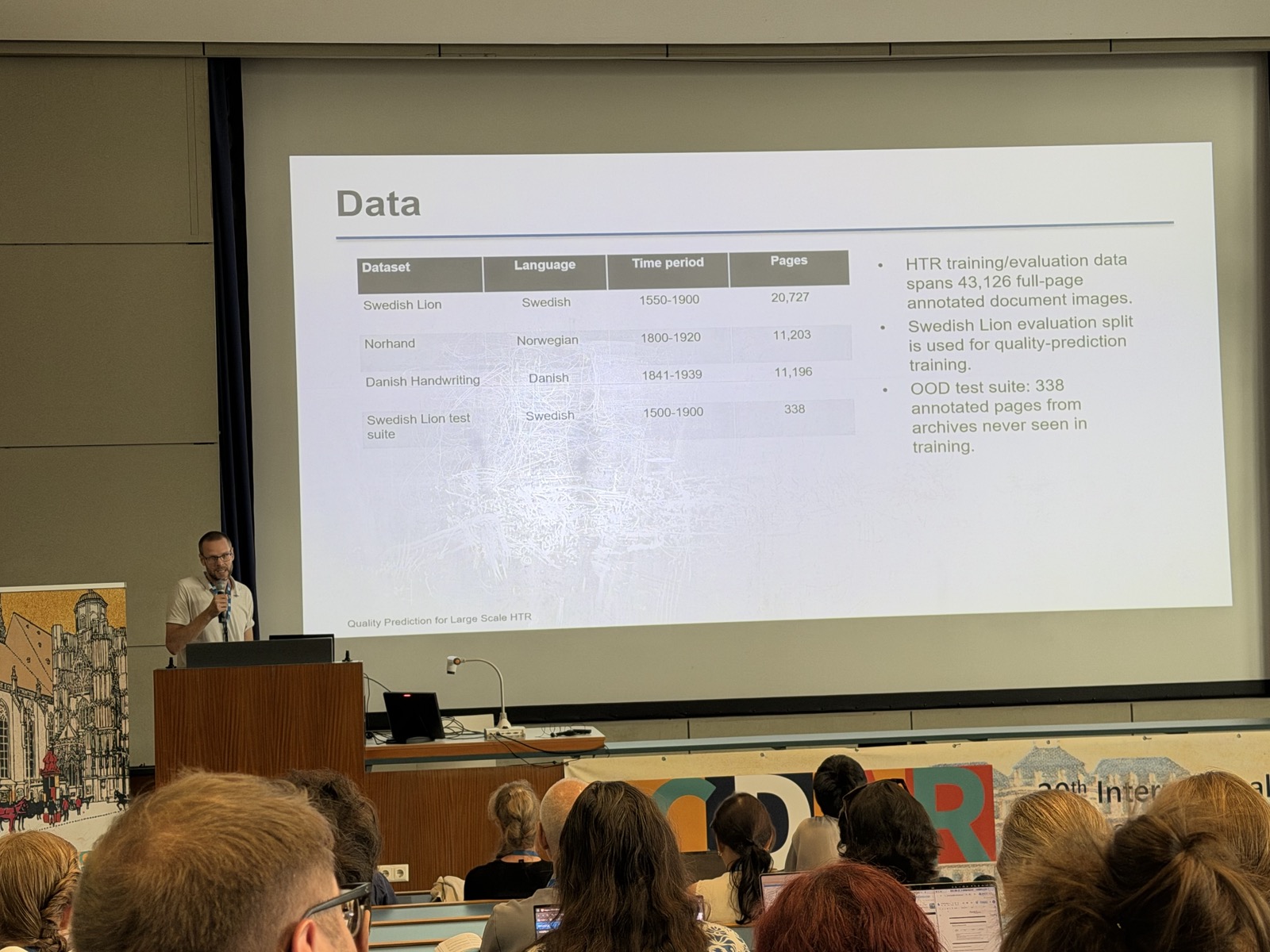
Two further presentations that I was still able to attend on the morning of talks have likewise made their way directly into my slide deck. Erik Lenas, Viktoria Löfgren, and Olof Karsvall from the Swedish National Archives addressed, in the session on historical document analysis, under the title “Quality Prediction for Large Scale HTR – Confidence Is All You Need,” the problem of how to estimate the quality of a handwriting recognition system in production settings where no reference transcription is available. They frame the task as page-level regression that predicts, from the image and the runtime outputs of the recognition pipeline, both the quality of the segmentation and that of the transcription, and find that the distribution of confidence scores across a page carries more weight than the mean value and renders image and language features largely redundant. The foundation, according to the overview shown in the presentation, consists of 43,126 fully annotated pages drawn from three datasets: the Swedish Swedish Lion with 20,727 pages from the years 1550 to 1900, the Norwegian Norhand with 11,203 pages, and the Danish Danish Handwriting with 11,196 pages, together with a test set of 338 pages from archives not seen during training. For an archive that is in the process of processing millions of pages of historical documents and cannot examine each one individually, this is the prerequisite for being able to steer quality control at all.7
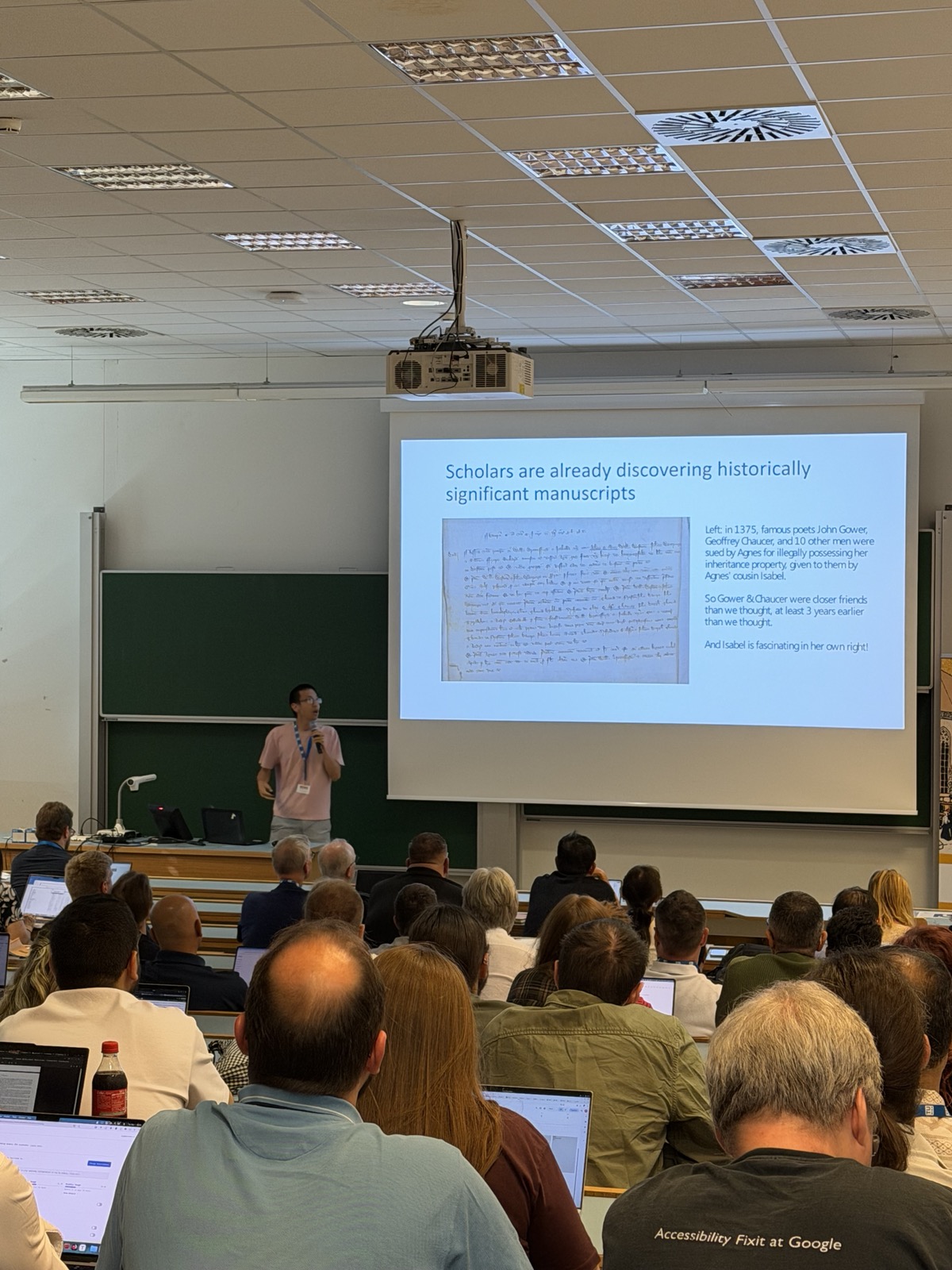
Michael Zhang, Elise Wang, Charlotte Whatley, Seth Strickland, and Dylan Bannon presented their work “Democratizing the Medieval English Legal Tradition” during the same morning session on handwriting recognition. The documentary tradition of English law survives in handwritten rolls in heavily abbreviated medieval Latin that only a small number of specialists worldwide can read, while the digitized portion, as they showed in their presentation, already amounts to approximately four million pages. From 193 criminal and civil proceedings spanning the years 1272 to 1461, they constructed a dataset of 4,029 lines, achieving a word accuracy of 82 percent, which a downstream correction by a language model raises to 88 percent. The implications of this were illustrated through a case from 1375 in which the poets John Gower and Geoffrey Chaucer, together with ten other men, were sued by one Agnes for unlawfully holding her inheritance: the two were accordingly acquainted with one another more closely, and at least three years earlier, than scholarship had previously assumed.8
Both presentations addressed the question of how reliable historical data can be derived from more documents than any single person could read in a lifetime — and thus precisely what I describe below as the first of the three sites. On Thursday, the Workshop on Historical Document Image Processing will feature a further contribution from the Dortmund context that pursues this question from a research-practical perspective.9
What Historians Need
For the handwritten and typewritten materials and document types with which I engage in my work, the recognition task alone is no longer a genuinely difficult problem. Multimodal models achieve single-digit character error rates on complex historical manuscripts. Where a second model corrects the reading of the first, they approach the quality of human transcriptions. On printed material, error rates are substantially lower still. Entire datasets are now being assembled automatically from archival scans.10 What historical scholarship requires beyond this, I argue, is the distinction between a correctly read value and a category that a bureaucratic authority, for instance, has imposed upon a person. The question to be asked is therefore not only what value a model should return, but what a system does with a value it has read without error and which, at the same time — as in many of the documents that our NGHM group processes in the context of our research on displaced persons — constituted a move in a negotiation over one’s own survival.
My first example, however, comes from our analysis of the Osnabrück Ausländermeldekartei [foreigners’ registration card index]: Tullio and Theresa Beltrami came to Osnabrück from Italy in February 1905 and remained there for the rest of their lives. The city’s Ausländermeldekartei has been kept since 1930 and contains retrospective entries reaching back to the turn of the century. The family does not appear in it until 1932. A household that had lived in the city for a quarter of a century was retrospectively inscribed into the register as “Ausländer” [foreigners]. The card index carried this status forward across decades, down to a granddaughter who married a German national in 1957 and was transferred to the general residents’ register with the annotation “see also Ausländerkarte” [foreigners’ card]. The Italian nationality of the family was a factual circumstance predating all of this. The greater part of the family never obtained German citizenship. What the card in the Ausländermeldekartei produced, however, was a status as administered “foreigners” in the very city the Beltramis called home and in which their daughters were born. The card index did not merely record the family; it assigned them a position and reproduced it across three generations.
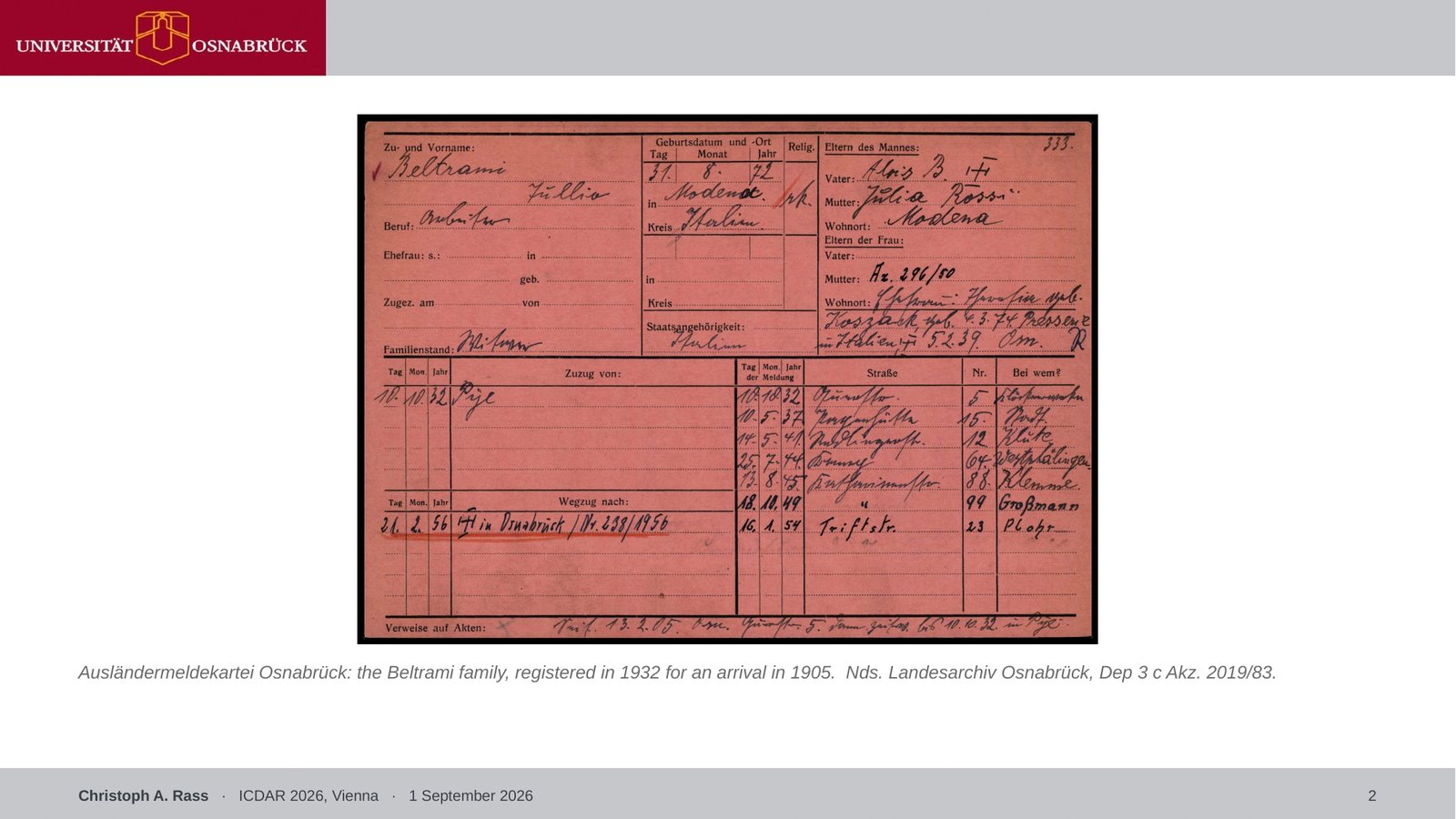
This is precisely what we mean in reflexive migration research when we speak of a category. The distinction from the usage of the term in computer science must be explicitly noted here: in computer science, a category is a class that is assigned and for which a ground truth determines which assignment is correct, whereas in critical historiography (or migration research) it designates a decision that an administrative office made about a person, entered into a field, and subsequently enforced against that person, without any reading of the card being able to determine whether this categorization was correct or true.
The fact that categories are not discovered but produced is not simply a singular observation made about this one card. This insight is the working premise of the Collaborative Research Centre 1604 “Production of Migration”, within which we conduct research in Osnabrück and which understands migration as the “product of a social process of production” in which “categorizations of people, groups, and practices” condense into social figures and shape subsequent negotiations.11 An aliens registration index is a site at which this process can be observed card by card across half a century. From this perspective, whoever indexes such holdings computationally is not uncovering the properties of individuals but tracing the residues of a process of production.
My own discipline has played its part in this. It has employed words like “Ausländer” [foreigner/alien] as though they designated a kind of person who can be studied, counted, and explained, even though these words originated in an administrative office and record a categorization decision. Rogers Brubaker and Frederick Cooper coined a term for this error: the conflation of categories of practice, by which people were governed, with categories of analysis, by which we seek to explain them.12 The card is not the error; it is the material. The error lies in a scholarly discipline that adopts the vocabulary of the categorizing apparatus and makes it its own instrument. A count can therefore already be wrong in the way it counts a category, long before any of its figures fail to add up.
In my contribution I have distinguished three sites at which the tools of document analysis enter into historical work. Each of them has its own criterion of validity. The first site is that of indexing: a source is converted into digital, readable, structured data. A ground truth exists here, because the sign stands in a document against which every reading can be verified. The second site is computation, at which measurements are taken on the indexed data. Here ground truth is replaced by reproducibility, because what is being examined is no longer a single value but the manner in which that value is generated. A faulty script can be read and checked; a result hallucinated by a model cannot. Construction takes place at the third site, where the corpus is assembled within which a historical question can be posed at all. No label awaits on the page there, for whether a document belongs to a given question is not a property of that document but a judgment that someone makes and takes responsibility for.
What working at these three sites feels like I experienced in August 2026 during my research in four archives in Oregon. Using a document scanner that does not touch the paper, digitized images of approximately 6,000 pages of historical documents were produced by hand, while a simultaneously running analysis indicated which boxes from the stacks I might have overlooked in my order list and which, in the light of initial evaluations, might yet prove relevant. In parallel, a generative system wrote and executed scripts that, on the basis of the initial document analysis, searched dozens of already digitized collections and assembled around four hundred thousand further documents relating to my research question, each result furnished with source, repository, date of access, and verification record.
One corpus came into being at the pace of a human being, the other at the speed of a digital research process. Both bodies of material now reside in the same working collection from which I am developing my analysis. This collection is therefore an uneven structure: of the pages photographed on site, it is known why they lay in the box and why I selected them; of the four hundred thousand computationally retrieved documents, only the search criteria by which they were found are known—not what lies in the repository alongside their digital representations, nor what remained in the analog archive and was never digitized. Anyone arguing from such a collection must be able to specify which part of it a given statement draws on, and requires an interpretive approach that bridges the pattern in the mass and the individual, eloquent document. Martin Mueller has called this scalable reading.13
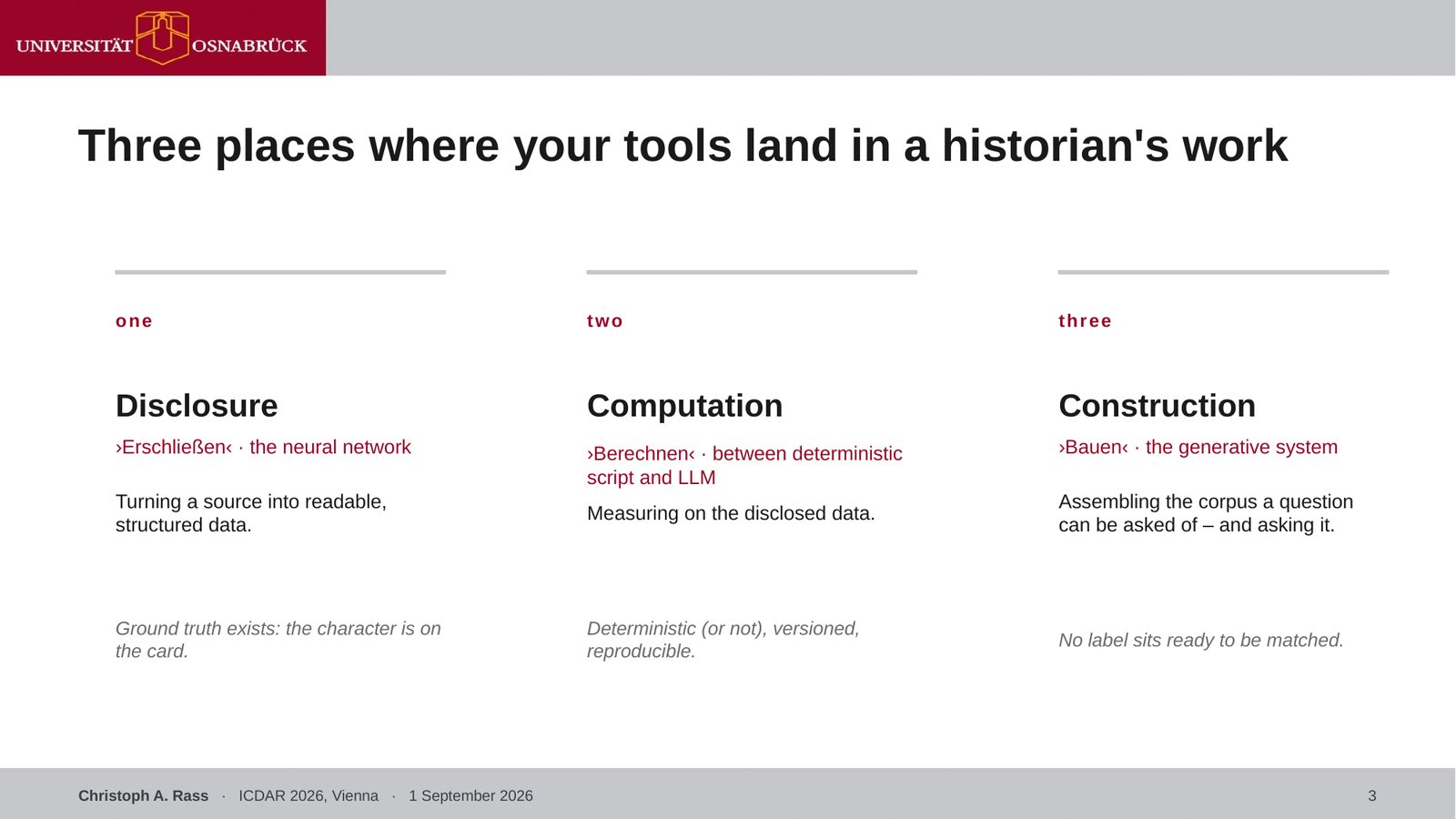
From the first site, that of indexing, historical work requires three things. The first is a confidence score for every value read—that is, an indication of how certain the model is of its own reading. To this must be added a provenance: what is meant here is not the archival origin within a collection, but the reference to the precise location on the card from which the value derives. A value without these two pieces of information is, for us as historians, a fact without a footnote. As a third requirement, the work may also call for an attribute indicating whether a field already contains a decision. Where an authority has determined which values may appear in a field at all, interpretation is already constrained before any historical question has been posed. A system that records this circumstance rather than overwriting it renders visible the point that must be interrogated further at a later stage.
Here is the translation of Part 4:
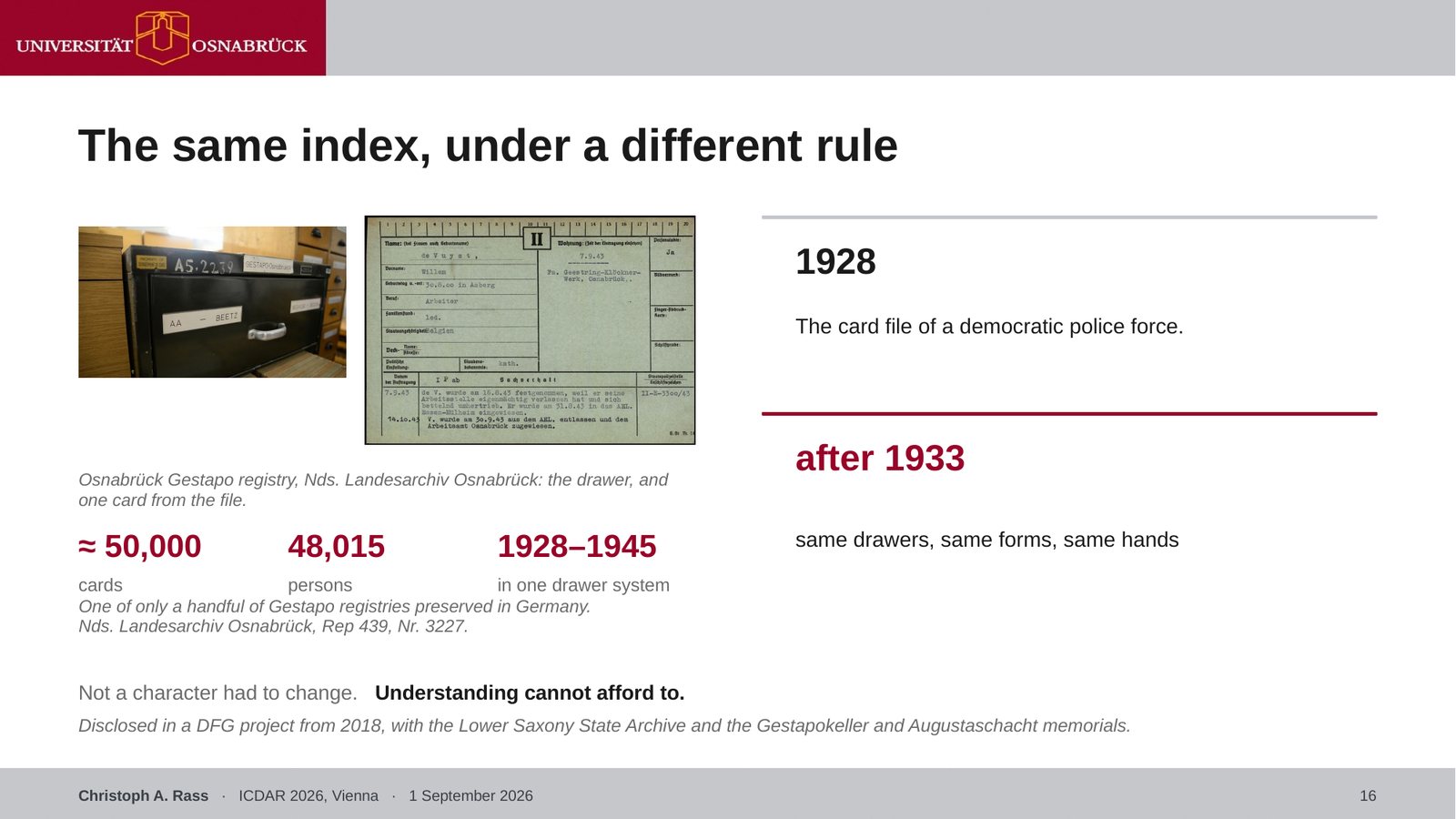
The example of the Osnabrück Gestapo registry also illustrates what happens to a category as it travels through time. The card index (one of only a few surviving Gestapo registries in Germany) was established in 1928 as the card index of a democratic police force. After 1933, it became an instrument of the Secret State Police of the National Socialist regime — using the same card file boxes, the same forms, and the same handwriting. Not a single sign needed to change for the meaning of the cards to be entirely transformed. A straightforward document analysis reads the card from 1928 and the card from 1938 in the same way. An interpretive understanding cannot afford to do so, because a change of regime lies between the two cards.
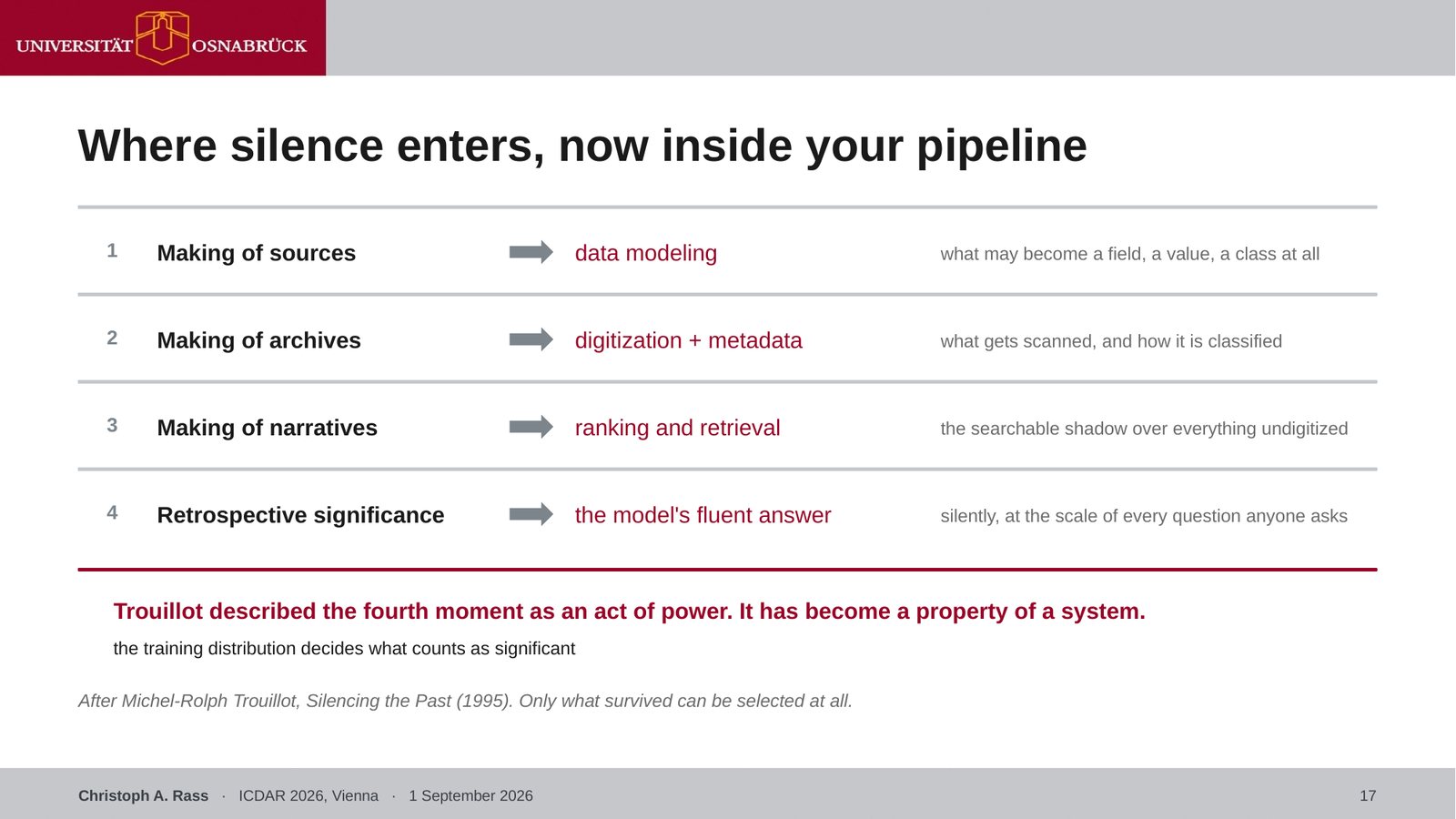
Michel-Rolph Trouillot demonstrated, using the example of the Haitian Revolution, how the past is silenced within history. His theoretical model of history locates the production of this silencing in four moments: in the making of sources, in the making of archives, in the making of narratives, and in the making of meaning — the retrospective significance that a society attributes to events as narrated history.14
These four moments now also migrate into the processing chains of digital document analysis and the further processing of the data thereby obtained: into data modelling, which decides in advance what may become a field at all; into the selection of what is digitized and how it is classified; into ranking and retrieval, which give the digitized material a searchable shadow that makes it appear larger than all non-digitized material alongside it; and finally into the fluid response of a model to the question of what a “displaced person” was. One precondition underlies all four: only what has been transmitted can be selected, digitized, modelled, and generalized. The holdings examined in this lecture are entirely administrative records, produced by a bureaucracy and held in trust by an archive.
The distortion inherent in the transmitted record does not necessarily increase through digital processing; it may, however, alter the visibility of that distortion. In an analog historical document, the decisions made are openly apparent; in a relational schema, they have already receded somewhat; in a trained AI model (LLM), they are buried deep within the system, distributed across its weights. Finola Finn and Donal Khosrowi have termed the product of this production of history instant history — the fluid, immediate response of an LLM that conceals how every source has always already been mediated.15
A case from the CM/1 files illustrates how practically significant this problem is. In January 1948, a person applied to the International Refugee Organization for assistance, stating their nationality as “Turkish” and their place of birth as “Istanbul.” The responsible eligibility officer recorded this information but doubted the account and enquired with the city of Osnabrück under which category this physician was registered there. The answer came from the same card index from which the Beltrami card also derives: from 1 October 1943, the individual in question had been registered in Osnabrück with the place of birth listed as “Baku” in the Soviet Union. Both entries are clearly legible and readily accessible to document analysis; yet both cannot simultaneously be true.
Abdulhalik Aleskerow was in fact a Red Army field physician from Azerbaijan who was taken prisoner by German forces in 1942, passed through the Wustrau camp — where the Wehrmacht screened Soviet prisoners of war willing to collaborate — and was deployed from 1943 onwards as a physician in a forced labor camp in Osnabrück. He had altered his biographical account because repatriation to the Soviet Union would in all likelihood have meant his death.
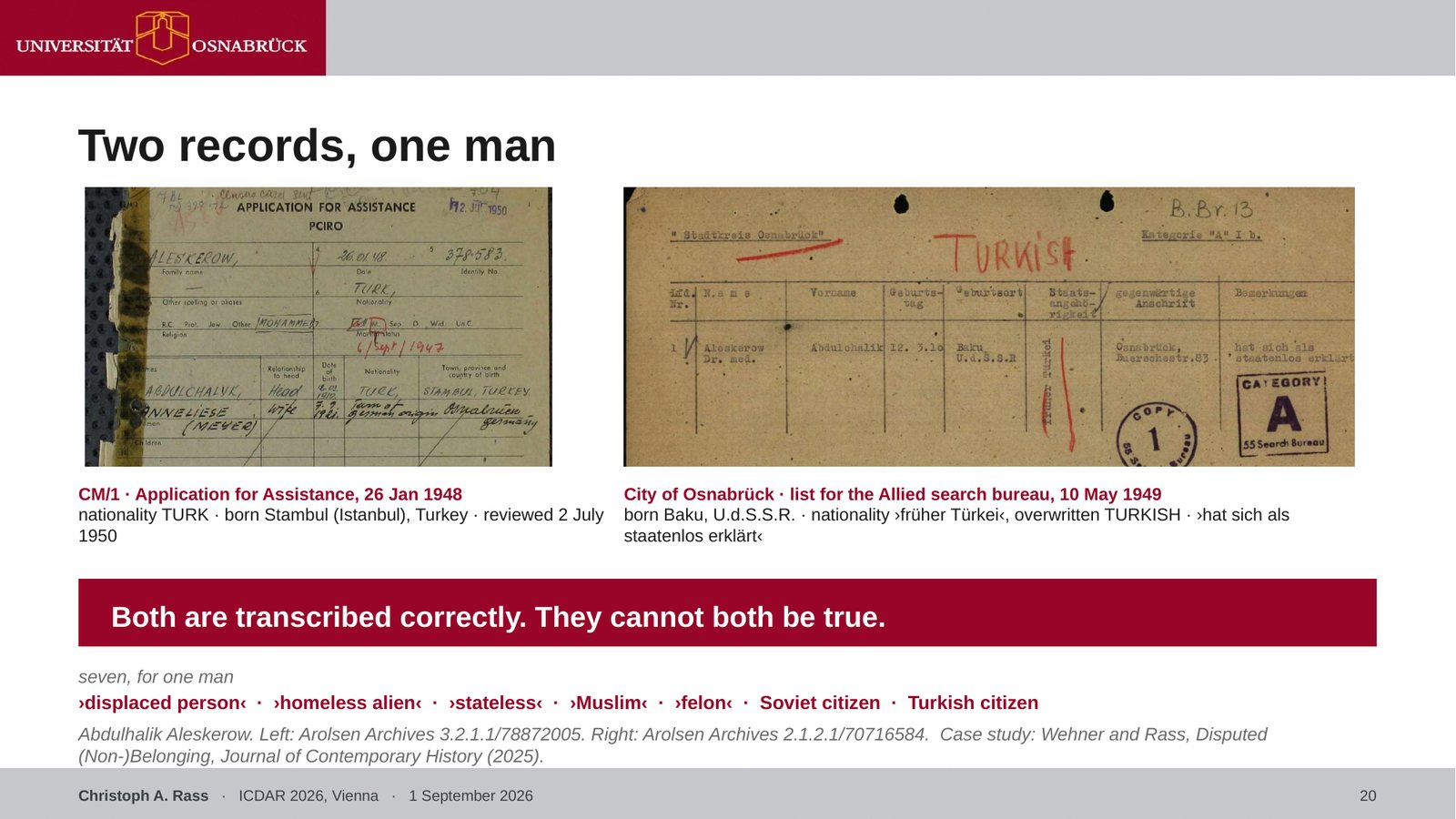
In June 1950, his DP status was ultimately revoked, presumably because someone had inferred from the phrasing that he had left Turkey “of his own accord” that a person who had migrated voluntarily could not have been forcibly displaced. For six years thereafter, authorities and courts disputed what he was, employing seven categories in the process: “displaced person,” “stateless foreigner” [heimatloser Ausländer], “stateless,” “Muslim,” “criminal,” “Soviet citizen,” “Turkish national.” In 1956, a court overturned the deportation order. Aleskerow lived in Osnabrück until 1977.16
For system architecture, this entails that a confidence score can only indicate legibility; Aleskerow’s file was legible. Whether a category is contested, how it was produced, and to whom it was assigned cannot be inferred from the legibility of an entry. A complex confidence value of the kind that historical scholarship could productively employ requires more.
My proposal for thinking through this problem further therefore distributes the work across two models that communicate with one another and with us as historians. The first, the source model, asks what a document is materially and in terms of its transmission. It delivers structured fields, attaches a confidence score and a provenance to each field, and concludes in a source-anchored graph — a data structure in which every statement remains bound to its evidence base; it makes no claims about meaning; its work might remind us of the external source criticism taught in historical methodology seminars. The second, the expert model, asks what the document means and how far it is to be trusted. It marks “foreigner” [Ausländer] as a category produced by an administrative office, dates the retroactive entry of the Beltramis from 1932 as an interpretive event, keeps ambiguity open where the source has left it open, and links the cross-reference from 1957 across two separate holdings.
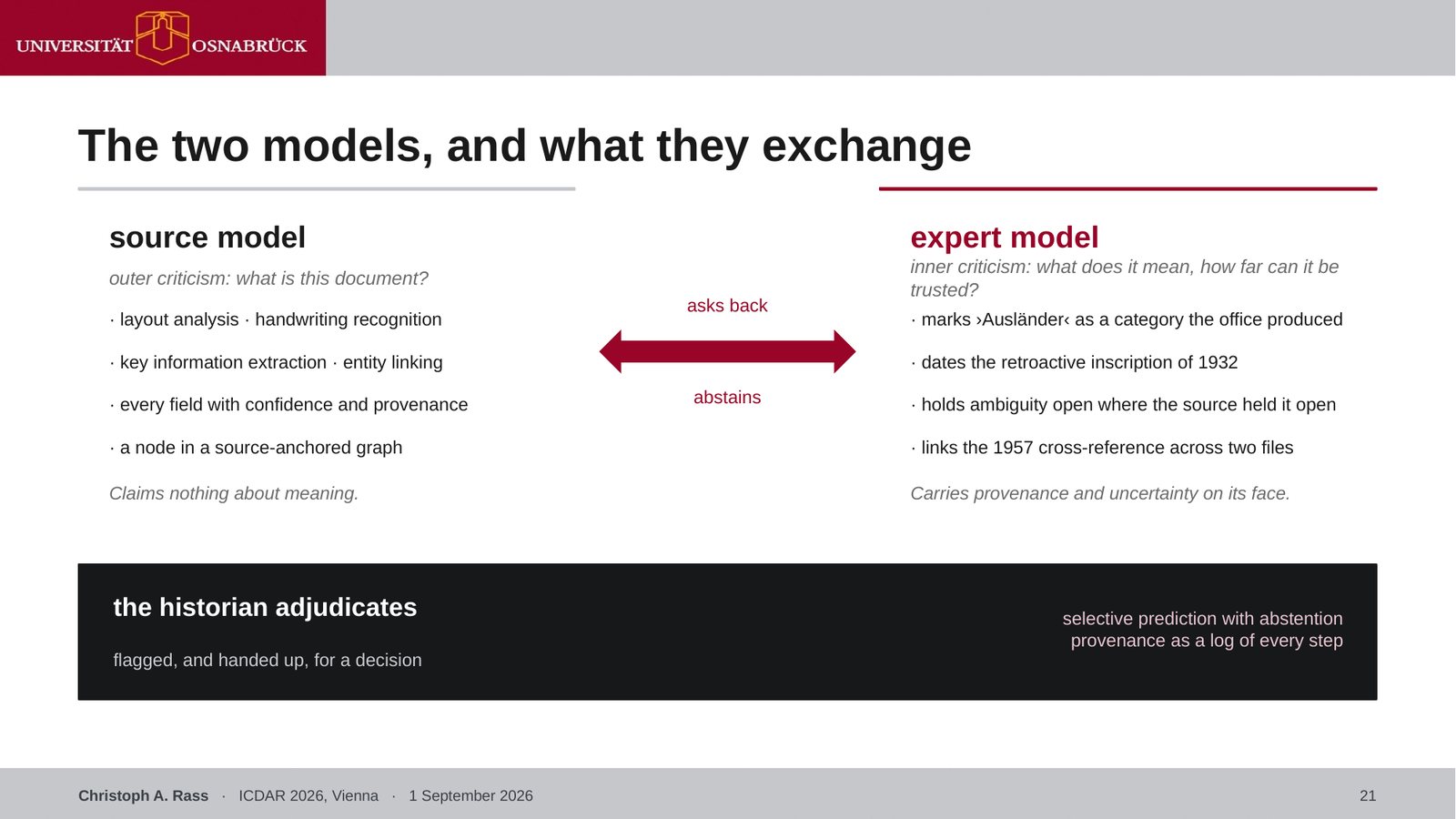
The actual proposal lies in the exchange between the two. Where the source model is uncertain, the expert model does not silently fill the gap — it requests the image region behind the value and withholds a response when that region is not unambiguous. A contested value is flagged and passed on to another instance or to a human. Every step is logged; this produces the traceability that, at the second site, takes the place of ground truth, and it allows even complex analyses of this kind to be examined intersubjectively. In the language of document analysis, this constitutes selective prediction with abstention and a provenance log. Neither element is new. What this loop means for historical scholarship is what Andreas Fickers has called digital hermeneutics — the old craft of interpretation, updated for sources that a machine has already processed.17 One question remains open: how such an expert model would be built and trained.
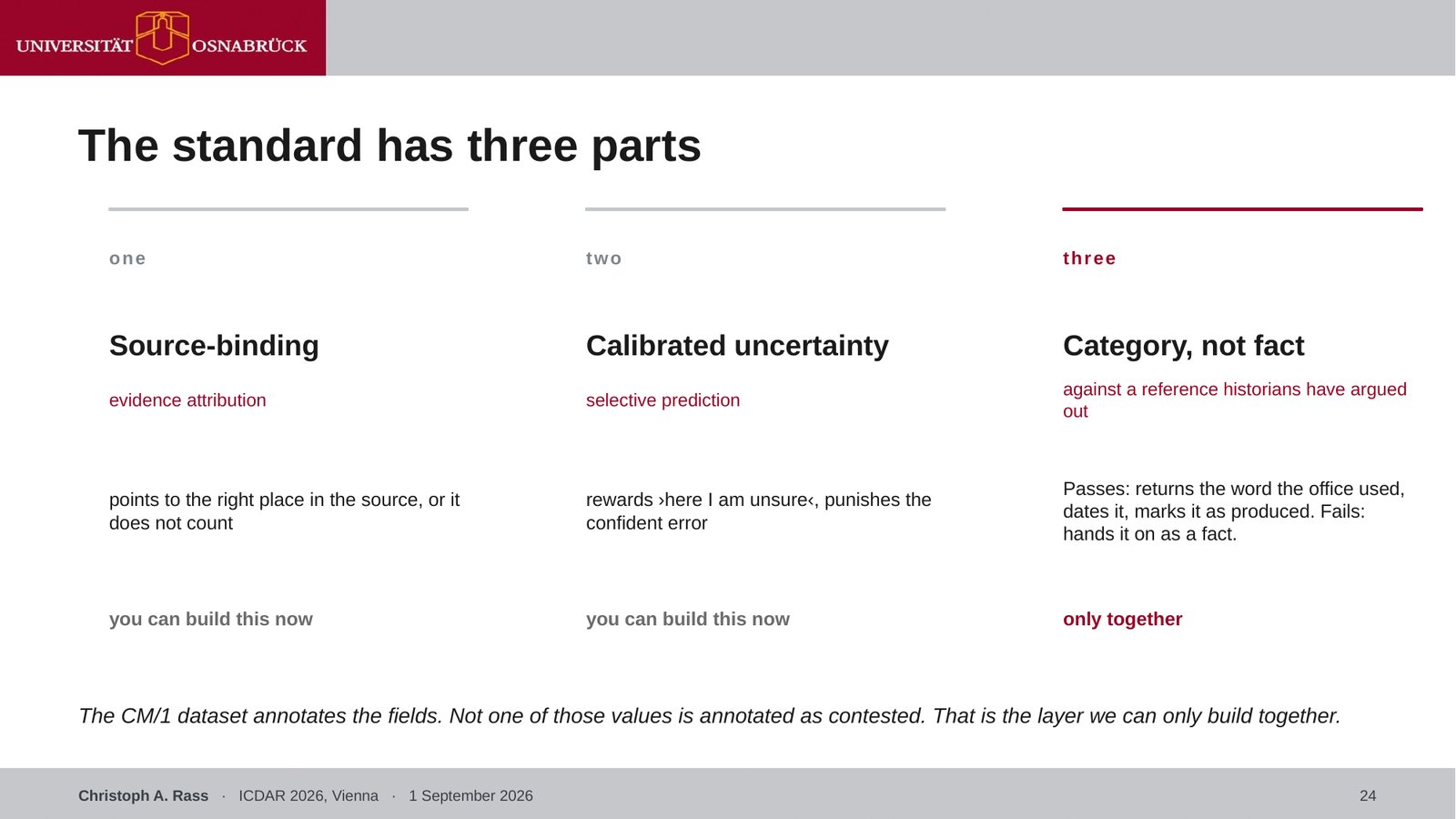
In Vienna I presented one idea toward this as a contribution to discussion: a benchmark in three parts. The first two can be specified by document analysis alone: source binding, measured as evidence attribution, in which a finding only counts if it can be demonstrably traced back to the corresponding passage in the source; and a calibrated uncertainty that rewards an open acknowledgement of doubt by the system and penalizes the production of false confidence more severely than the honest restraint that names gaps. The third part would emerge only collaboratively. It examines whether a model recognizes a category as such — that is, whether it flags the term produced or reproduced by an authority as a constructed category, rather than passing it on as a simple fact about the person.
How helpful this would be is illustrated by the subset of CM/1 files evaluated for Osnabrück: among 575 entries containing a statement of religion and 584 containing a statement of nationality, there are sixteen different values each, in which “Muslim” appears alongside “Mohammedan,” “Jewish” alongside “Hebrew,” and in which “Jewish” appears simultaneously as a nationality.18 None of these values has been normalized. As a result, the negotiation represented by these values has survived in the disorder of the source material. To date, even our published dataset in its second version annotates nationality, place of birth, and religion — yet not a single one of these values is flagged as contested. The logical next step would accordingly be a pass in which two historians mark each value as settled or contested, log their disagreements, and a model is measured against this, until it becomes visible where the model fails and how the third dimension of the benchmark can be achieved.
What Remains Open
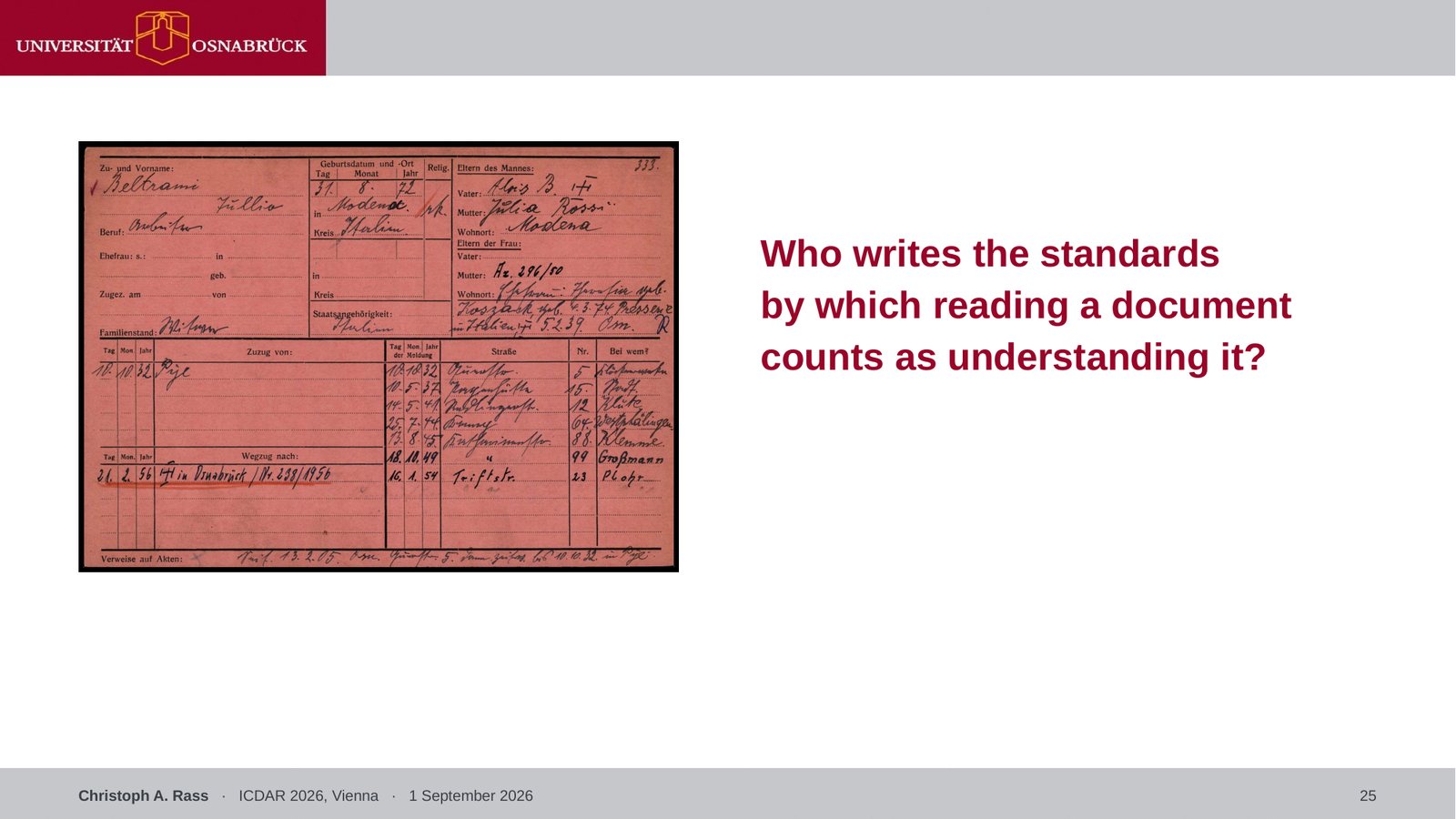
To what extent do our methodological decisions contribute to the production of the epistemological frameworks within which we ultimately work with digital methods? The Beltramis have a name in my lecture because handwriting recognition read their entries scattered across many cards of the alien registration index and record linkage — the consolidation of entries relating to the same person across holdings — gave them back a history spanning more than fifty years. Yet the same tools that can open up a collection in this way can also close it. Recovering a life as a dataset can simultaneously make that life an object a second time. Which of the two occurs depends on the perspective we develop empirically and methodologically. That the deployment of complex digital tools, and of course artificial intelligence as well, changes the way in which the past is translated into history is already settled; what remains open is how we as a discipline of history, in dialogue with other disciplines, shape this technological leap with all its consequences. This is not merely a technical or disciplinary question, but ultimately, above all, a cultural one.
Notes
- ICDAR 2026. The 20th International Conference on Document Analysis and Recognition, accessed 02.09.2026; International Association for Pattern Recognition, Technical Committees; IAPR TC10 Graphics Recognition; IAPR TC11 Reading Systems,
iapr-tc11.org(accessible via HTTP only).↩︎ - On the venue and committees of ICDAR 2026, see Conference Venue and Committees, accessed 02.09.2026. The number of accepted and submitted papers as well as the eight competition reports are taken from the back cover of the conference proceedings: Document Analysis and Recognition – ICDAR 2026, ed. by Gernot A. Fink, Alicia Fornés, Koichi Kise, and Daniel Lopresti, Lecture Notes in Computer Science 16972–16975, Cham 2026; the twelve contributions of the Journal Track are taken from the Programme, accessed 03.09.2026.↩︎
- ICDAR 2026, Keynote Speakers and Programme, accessed 02.09.2026. In addition, Tuesday also featured two talks for the Young Investigator Award by Silvia Cascianelli and Jorge Calvo-Zaragoza.↩︎
- Fabian Wolf, Oliver Tüselmann, Arthur Matei, Lukas Hennies, Christoph Rass, and Gernot A. Fink: CM1 – A Dataset for Evaluating Few-Shot Information Extraction with Large Vision Language Models, in: Document Analysis and Recognition – ICDAR 2025, Part II (Lecture Notes in Computer Science 16024), Cham 2025, pp. 23–39, DOI 10.1007/978-3-032-04617-8_2; preprint arXiv:2505.04214. Caution is advised regarding the figures cited, as three different counts exist side by side: the collection description of the Arolsen Archives lists over 196,000 files and references to approximately 578,000 names for collection 3.2.1.1; the paper cited speaks of approximately 350,000 surviving case files from the entire CM/1 programme; and the spoken version of the keynote mentioned approximately 155,000 files. The figures relating to the dataset itself (140,114 cases, 135,951 cover sheets, 203,112 individuals) are taken from the paper.↩︎
- Arthur Matei, Tim Hallyburton, Lukas Hennies, Christoph Rass, and Gernot A. Fink: Recent Advances in Information Extraction from Historical Archival Records, in: Document Analysis and Recognition – ICDAR 2026, Part III (Lecture Notes in Computer Science 16974), Cham 2026, pp. 87–103, DOI 10.1007/978-3-032-36039-7_6.↩︎
- Poster Session #1, Monday, 31 August 2026. Melissa Cote and Alexandra Branzan Albu: An Exploratory Study of Text-to-Image Generation for Query-by-Example Retrieval of Historical Document Images; Tim Raven, Tim Hallyburton, and Gernot A. Fink: Writer Retrieval at Scale.↩︎
- Oral Session #7, Historical document analysis, Tuesday, 1 September 2026. Erik Lenas, Viktoria Löfgren, and Olof Karsvall: Quality Prediction for Large Scale HTR. Confidence Is All You Need, in: Document Analysis and Recognition – ICDAR 2026 (Lecture Notes in Computer Science 16972), Cham 2026, pp. 450–466, DOI 10.1007/978-3-032-36023-6_26. All three work at the Swedish National Archives in Stockholm. The information on the datasets used is taken from the overview shown during the presentation, reproduced as Figure 4.↩︎
- Oral Session #6, Handwriting recognition, Tuesday, 1 September 2026. Michael Zhang, Elise Wang, Charlotte Whatley, Seth Strickland, and Dylan Bannon: Democratizing the Medieval English Legal Tradition, in: Document Analysis and Recognition – ICDAR 2026 (Lecture Notes in Computer Science 16972), Cham 2026, pp. 378–394, DOI 10.1007/978-3-032-36023-6_22; preprint arXiv:2605.00977. The material is drawn from the King’s Bench Rolls, Common Pleas Rolls, and Justices Itinerant Rolls of the Anglo-American Legal Tradition Archive. The figures on the extent of the digitized holdings and the case from 1375 are taken from the presentation.↩︎
- Tim Hallyburton, Anna Scius-Bertrand, Arthur Neto, Andreas Fischer, and Gernot Fink: Reconstruction Error Ratios for Prototype-Anchored Unsupervised Learning in Optical Character Recognition, 8th International Workshop on Historical Document Imaging and Processing, Thursday, 3 September 2026.↩︎
- Mark Humphries, Lianne C. Leddy, Quinn Downton et al.: Unlocking the archives. Using large language models to transcribe handwritten historical documents, in: Historical Methods 58 (2025), no. 3, pp. 175–193, DOI 10.1080/01615440.2025.2500309; Gavin Greif, Niclas Griesshaber, and Robin Greif: Multimodal LLMs for OCR, OCR Post-Correction, and Named Entity Recognition in Historical Documents, arXiv:2504.00414 (2025); Niclas Griesshaber and Jochen Streb: Multimodal LLMs for Historical Dataset Construction from Archival Image Scans. German Patents (1877–1918), arXiv:2512.19675 (2025), comprising 306,070 patents from 9,562 archival scans. On the shift from reading to building, see also Jan Černý, Kiril Avramov, and Liladhar R. Pendse: A multi-stage agentic AI system for extracting information from large digital archives. Case study on the Czechoslovak year 1968 in CIA’s FOIA collection, in: The Electronic Library (2026), DOI 10.1108/EL-06-2025-0272, whose conclusion I adopt as my own: the efficiency gain is real; interpretive responsibility does not migrate with it.↩︎
- DFG Collaborative Research Centre 1604 “Produktion von Migration” [Production of Migration], University of Osnabrück, project number 501120656, spokesperson Andreas Pott, since 2024. The phrases cited follow the project description in GEPRIS, accessed 02.09.2026; see also the research programme of the CRC.↩︎
- Rogers Brubaker and Frederick Cooper: Beyond »identity«, in: Theory and Society 29 (2000), no. 1, pp. 1–47, DOI 10.1023/A:1007068714468.↩︎
- Martin Mueller: Shakespeare His Contemporaries. Collaborative curation and exploration of Early Modern drama in a digital environment, in: Digital Humanities Quarterly 8 (2014), no. 3. The Oregon field phase in August 2026 forms part of the research within CRC 1604.↩︎
- Michel-Rolph Trouillot: Silencing the Past. Power and the Production of History, Boston 1995, Introduction.↩︎
- Finola Finn and Donal Khosrowi: AI assistants in the archive and the lure of »instant history«, in: Cambridge Forum on AI. Culture and Society 2 (2026), article e6, DOI 10.1017/cfc.2025.10012.↩︎
- Jessica Wehner and Christoph Rass: Disputed (Non-)Belonging. Migrant Agency in the European Displacement Crisis 1945–56, in: Journal of Contemporary History, OnlineFirst December 2025, DOI 10.1177/00220094251396890. The two documents reproduced are drawn from holdings 3.2.1.1/78872005 and 2.1.2.1/70716584 of the Arolsen Archives; the information from the city of Osnabrück is taken from the Ausländermeldekartei [aliens registration index], Niedersächsisches Landesarchiv, Abteilung Osnabrück, Dep 3 c Akz. 2019/83.↩︎
- Andreas Fickers: Update für die Hermeneutik. Geschichtswissenschaft auf dem Weg zur digitalen Forensik? [Updating hermeneutics. Is historical scholarship on its way towards digital forensics?], in: Zeithistorische Forschungen 17 (2020), no. 1, pp. 157–168, DOI 10.14765/zzf.dok-1765; see also Andreas Fickers, Juliane Tatarinov, and Tim van der Heijden: Digital history and hermeneutics. Between theory and practice, in: Andreas Fickers and Juliane Tatarinov (eds.): Digital History and Hermeneutics, Berlin/Boston 2022, pp. 1–20, DOI 10.1515/9783110723991-001.↩︎
- Analysis of the subset of Arolsen Archives holding 3.2.1.1 processed for Osnabrück, presented on slide 13 of the keynote. The subset comprises the CM/1 files of individuals who remained in Osnabrück.↩︎
Keywords: ICDAR 2026 · Document Analysis and Recognition · Handwritten Text Recognition · Vision-Language Models · Categories · “Displaced Persons” · CM/1 · Ausländermeldekartei · Arolsen Archives · TU Dortmund · SFB 1604 “Produktion von Migration”
On the Keynote: Christoph A. Rass, From Archives to Algorithms and Back: What Historians Need from Document Understanding, Keynote #2 at ICDAR 2026, TU Wien, 1 September 2026. The research reported in this talk is being conducted in collaboration with Gernot A. Fink, Arthur Matei, and Tim Hallyburton (Pattern Recognition Group, TU Dortmund), with Lukas Hennies, Jessica Wehner, and the team of the NGHM Research Group at the University of Osnabrück, in cooperation with the Niedersächsisches Landesarchiv, Osnabrück Division, the Arolsen Archives, and the SFB 1604 “Produktion von Migration”.
About the Author: Christoph A. Rass is Professor of Contemporary History and Historical Migration Studies at the University of Osnabrück (ORCID 0000-0001-9492-907X).
Find the original post at Keynote | ICDAR 2026 Wien | Geschichtswissenschaft und Dokumentenanalyse im Dialog on nghm.hypotheses.org.
This post was automatically translated from the German original.