
Nachlese | Siegen 2026 | From ‘Gastarbeiter’ to ‘guest worker’. Origins, Careers and Global Present of a Figure of Migration

By Christoph Rass · Originally published on nghm.hypotheses.org
This post is an abridged and reflective version of the lecture delivered by the author on 27 October 2026 in the lecture series “Migrationsregime und ‚Gastarbeit’ in der Bundesrepublik. Regulierungen, Akteure und Eigensinn” [“Migration Regimes and ‘Guest Labor’ in the Federal Republic. Regulations, Actors, and Agency”] at the University of Siegen (Universität Siegen 2026). The author would like to extend his sincere thanks to Noyan Dinçkal and Yasemin Niephaus for the invitation.
The essay brings together the author’s work on the history of the term ‘Gastarbeiter’ and connects it with a new reflection on how the ‘Gastarbeiter’ gained currency as a figure of migration without ever becoming a legal concept. The text is a result of his research in Subproject A3 of the Collaborative Research Centre 1604 “Production of Migration” at the University of Osnabrück, which examines how academia and schooling produce figures of migration.
Figures of Migration
Even the title of the Siegen lecture series places ‘Gastarbeit’ in quotation marks, yet cannot do without the word. Those who were recruited did not choose this name for themselves; others produced and assigned it to them.
The Collaborative Research Centre 1604 examines how categorizations render the spatial mobility of people legible as ‘migration’ and ultimately, as the research program proposes, coalesce “into social figures” (Sonderforschungsbereich 1604 2026). From this perspective, Hajo Holst and the author understand the ‘Gastarbeiter’ of the years between the recruitment agreement with Italy in 1955 and the recruitment stop of 1973 as a hegemonic figure, sustained by the paternalistic affect of an ostensible ‘hospitality’ on a temporary basis. Both trace the power of such figures, following Pierre Bourdieu, back not least to the state, which officially names people and thereby seeks to establish a social order (Rass/Holst, forthcoming). Laws, ordinances, and treaties, however, did not recognize the ‘Gastarbeiter’; national and international law spoke of foreigners and ‘foreign employees’ [ausländische Arbeitnehmer]. It was precisely this official designation that, according to Bourdieu, confers power, yet was absent from this figure. Employers, ministers, the press, and academia nonetheless used the term and lent it a form of authority that required no legislation.
Max Weber, in whose work the term ‘Gastarbeiter’ is first attested, himself provided a model for such authority: every form of domination, he wrote, seeks “to arouse and cultivate the belief in its ‘legitimacy'” (Weber 1922). Who organizes this belief and how it becomes common sense was the question posed by Antonio Gramsci, who was familiar with Weber (Levy 1988). He conceived of the state as a combination of political and civil society, as hegemony that rests on consent while remaining “armored with coercion” (Gramsci 1992). From both positions one can ask who lent meaning and authority to the figure of the ‘Gastarbeiter’, where coercion lay, and how far consent extended.
Our inquiry begins where the word had its most prominent appearance: on a railway platform in Cologne-Deutz.
1964 | The Millionth ‘Gastarbeiter’
When, on Thursday, 10 September 1964, two special trains carrying workers from Spain and Portugal pulled into Cologne-Deutz station, a banner in three languages hung above Platform 12 (Rass/Ulz 2018). Its lines conveyed the same message, save for the one word that mattered: the German employers’ associations welcomed, in the Spanish line, the millionth ‘trabajador migrante’ [migrant worker], in the Portuguese line the millionth ‘operário estrangeiro’ [foreign worker], and in the German line the millionth ‘Gastarbeiter’ [guest worker] (Bundesvereinigung der Deutschen Arbeitgeberverbände 1964).
With ‘trabajador migrante’ and ‘operário estrangeiro’, the Spanish and Portuguese lines remained close to the official formula of the ‘foreign employee’ [ausländischer Arbeitnehmer] with which laws and treaties defined those recruited. The German line could not be read by those arriving. It was written for those receiving them: employers, ministers, and the press. The banner made the new arrivals legible to them as temporary guests who had come to work.
According to the organizers, a lottery had determined the “millionth”: the carpenter Armando Rodrigues de Sá from Vale de Madeiros in northern Portugal, who received a moped, flowers, and a certificate before photographers, radio, television, and newsreel cameras, and traveled on to his employer in Stuttgart that same day (Süddeutsche Zeitung 1964; Didczuneit 2004; Rass/Ulz 2018).
Two statements from these weeks illustrate how diametrically opposed the expectations were that employers and government associated with the term. On the day of the arrival, Manfred Dunkel, the chairman of the employers’ association of the metal industry in the administrative district of Cologne, told Westdeutscher Rundfunk that he preferred “to think of the time when we no longer have guest workers here with us,” while simultaneously conceding that without those recruited, the economic upturn after 1959 would not have been possible (WDR 1964). Some weeks later, the Bulletin of the Federal Government printed a text by Labor Minister Theodor Blank under the headline “Eine Million Gastarbeiter” [“One Million Guest Workers”]. It stated: “We have an interest in the guest workers taking up a longer stay with us.” Blank dismissed the concern about ‘Überfremdung’ [excessive foreign influence]: “There can be no serious talk of that.” (Blank 1964) The employers’ representative wanted to be rid of those recruited one day; the minister wanted to retain them longer. For both, they were guests.
The figure of the ‘Gastarbeiter’ was an interpretive offering by the host society to itself.
The history of the term, however, begins half a century earlier, at the desk of a sociologist.
1916 | Max Weber’s ‘Gastarbeiter’
The earliest known attestation of the term dates from April 1916. In his study on “Hinduism and Buddhism,” part of the essays on the economic ethics of the world religions, which first appeared in the Archiv für Sozialwissenschaft und Sozialpolitik and were reprinted in 1921 in the Gesammelte Aufsätze zur Religionssoziologie [Collected Essays on the Sociology of Religion], Max Weber describes the order of the Indian village as follows:
„Die seit alter Zeit dauernd in jedem Dorf vertretenen religiös unreinen Gastarbeiter waren und sind zwar nicht Mitglieder des Dorfverbandes. Aber deshalb waren und sind sie keineswegs rechtlos.” (Weber 1921) [“The ritually impure guest workers who have been permanently represented in every village since ancient times are not, and never were, members of the village association. But for that reason they were not, and are not, without rights.”]
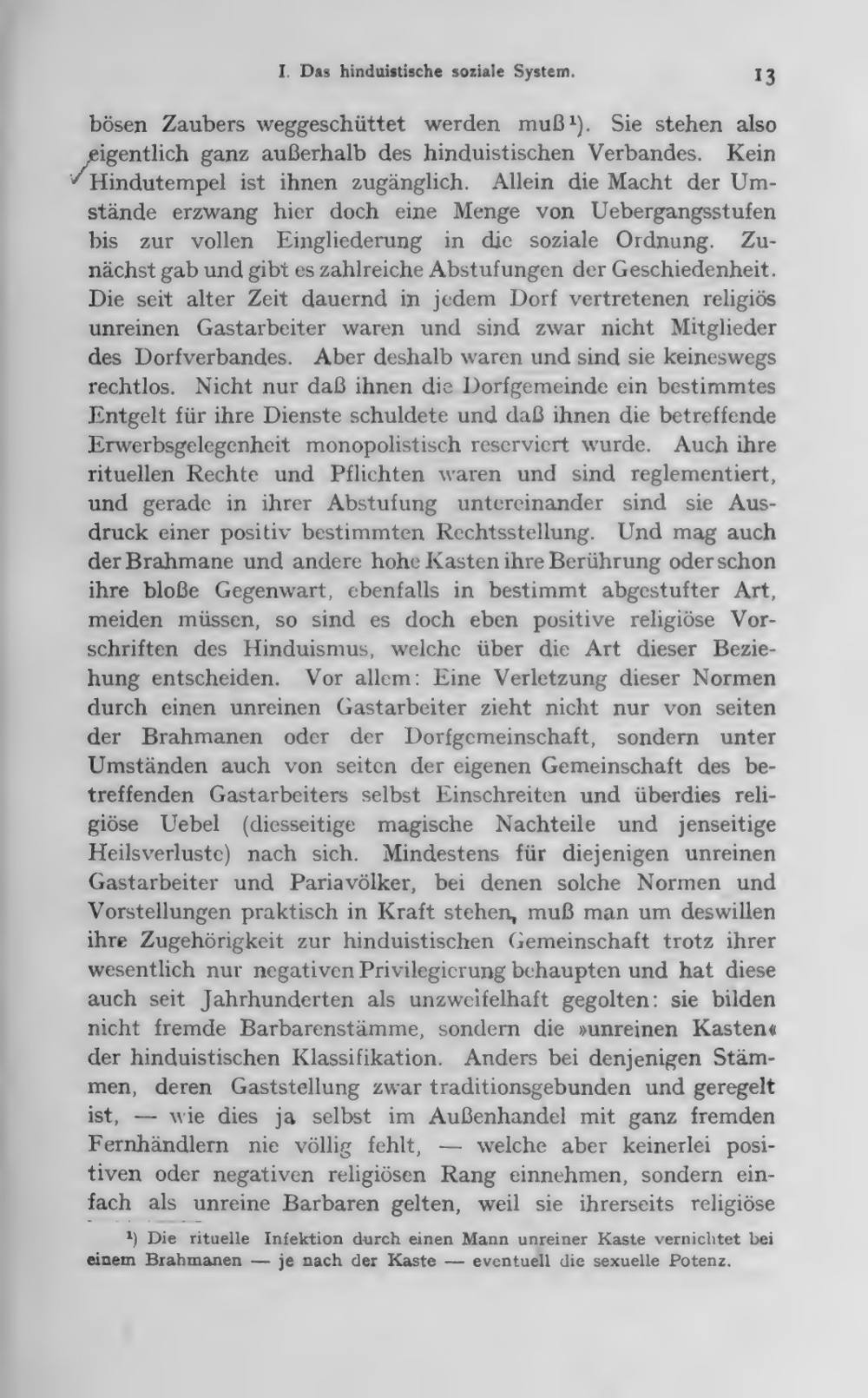
Weber is not describing a migrant worker of the modern era. His ‘Gastarbeiter’ occupies a marginal position in the village, indispensable for his labor, without membership in the village association yet nonetheless possessing rights. Elsewhere, Weber also addresses mobility: the skilled workers of trading tribes settle “as guest workers temporarily or eventually permanently in foreign communities” (Weber 1921). In Weber’s usage, one remains a guest even after taking up permanent residence (Rass 2026).
The underlying conception may have been drawn by Weber from a legal conceptual figure. Nineteenth-century German legal scholarship occasionally used Fremdenrecht [law of aliens] and Gastrecht [law of guests] as synonyms. The ‘guest’ therein held rights and obligations, but no prospect of ever belonging (Amenda/Rass 2012). Following this thread, Weber combined the ‘guest’ of this tradition—a figure of limited belonging—with the ‘worker,’ a functional category and class designation.
The compound encapsulates a figure whose presence is justified by their labor, but to whom social belonging remains inaccessible, regardless of how long their presence endures (Rass 2026).
1933–1945 | ‘Guests’ of the ‘Volksgemeinschaft’
Although the Weberian term had been invoked only sporadically during the Weimar period, it made its first appearance in the media during the National Socialist era. The newspaper portal of the Deutsche Nationalbibliothek and the North Rhine-Westphalian portal zeit.punktNRW contain more than two hundred articles referring to ‘Gastarbeiter’ for the years 1933 to 1945, most of them from 1943 and 1944, when the National Socialist state substantially expanded its forced labor system, operated it at peak capacity, and framed it intensively through propaganda (in detail Rass 2025; Rass 2026).
As early as 1940, however, the labor law expert Clemens Nörpel of the Deutsche Arbeitsfront had spoken of temporarily present “guests” of the ‘Volksgemeinschaft’, whose presence the regime tolerated as long as they remained aware of their underprivileged position and kept their distance from German society (Amenda/Rass 2012). In 1944, the journal “Die Wirtschaftskurve” wrote that the war had “also brought new concepts and word formations. Among them is the word ‘Gastarbeiter’, which we encounter so frequently today.” (documented in Amenda/Rass 2012) The press thus presented the term as a novelty already in the midst of the war; in 1961, it would appear as a novelty for a second time.
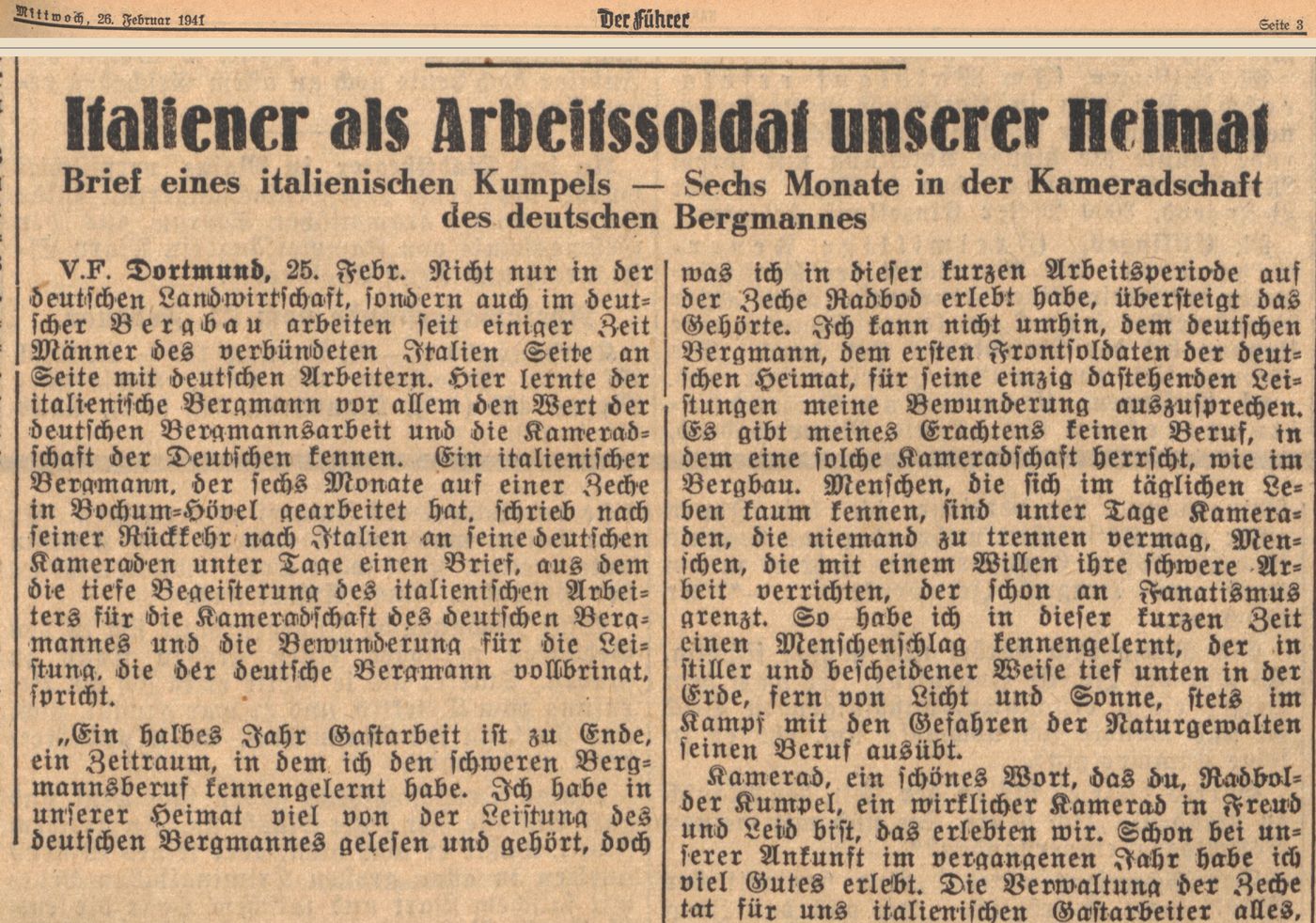
In the propaganda, the term served three functions (Rass 2026). It concealed coercion by invoking the notion of a legitimate exchange and state-regulated migration. It marked out a privileged class among the foreign laborers, into which the regime also sought to promote selected ‘Ostarbeiter’ towards the end of the war. And it legitimized the deployment of foreign laborers in conjunction with vocational training, welfare provision, and pan-European propaganda.
How acutely the regime perceived the tension between assigned status and permanent settlement is demonstrated by a 1944 military training manual in which Karl Christoffel wrote of “Fremdvolkpolitik, die das Verhältnis der bei uns lebenden ausländischen Gastarbeiter zum deutschen Volk regelt” [“the policy toward foreign peoples, which regulates the relationship of the foreign guest workers living among us to the German people”], adding: “Die Fremdvölkischen völlig wieder aus dem Reiche auszusiedeln, wird aus wirtschaftlichen Gründen vielleicht noch lange nach dem Kriege nicht durchführbar sein.” [“To resettle the foreign peoples entirely out of the Reich will perhaps, for economic reasons, not be feasible for a long time after the war.”] (Amenda/Rass 2012) In 1944, the regime was reckoning with the continued presence, beyond the end of the war, of labor forces that German authorities had recruited in occupied and allied Europe or deported to the Reich, while simultaneously continuing to categorically exclude their belonging.
The National Socialist state did not invent the term. It radicalized a meaning inherent in the language of the guest and disseminated the word for the first time through the press and propaganda: presence without belonging became presence without rights (Rass 2026). After 1945, ‘Fremdarbeiter’ — the term ubiquitous in the forced labor system of the ‘Third Reich’ — was considered tainted. When the Federal Republic began recruiting labor abroad again in the mid-1950s, the search began for an alternative.
Who, in 1961, chose to revive ‘Gastarbeiter’ of all words?
1961 | “a new designation for foreigners”
In June 1961, six years after recruitment had begun, the personnel consultant Ludwig Kroeber-Keneth — who had published on personnel management before 1945 and had been involved with the wartime economy’s labor market (Rass 2023) — introduced the word as a novelty in the Frankfurter Allgemeine Zeitung. Under the subheading “Gastarbeiter — eine neue Bezeichnung für die Fremden” [“Gastarbeiter — a new designation for foreigners”], his article “Die ausländischen Arbeitskräfte und Wir” [“Foreign Labor and Us”] of 3 June reads: “Auch der Begriff Gastarbeiter klingt noch fremd und ist auch nicht ohne inneren Widerspruch: Gemeinhin erwartet man vom Gast nicht, daß er beim Gastgeber arbeitet, bei ihm Geld verdient und es zum Teil auch wieder ausgibt.” [“The term Gastarbeiter also still sounds unfamiliar and is not without internal contradiction: one does not generally expect a guest to work for his host, to earn money from him, and to spend some of it there as well.”] (documented in Schönbach 1970) Kroeber-Keneth set the term against the ‘Wanderarbeiter’ [migrant worker] of the Wilhelmine era and the ‘Fremdarbeiter’ of the National Socialist period, and promised that the stay of those so designated would be temporary and that they would be treated well (Rass 2023).
In the same month, Werner Höfer wrote in the Neue Illustrierte under the headline “Wer möchte leben wie ein Hund?” [“Who would want to live like a dog?”] about the recruited workers: “Nun leben fremde Menschen unter uns: Gastarbeiter. Wir haben sie ins Land gerufen.” [“Now strangers live among us: Gastarbeiter. We called them into the country.”] (Rass 2023) Höfer, who since 1952 had been one of the Federal Republic’s best-known television journalists with his program “Internationaler Frühschoppen”, had joined the NSDAP in 1933, had worked from 1941 as a war correspondent for the Organisation Todt and later as press officer in Albert Speer’s armaments ministry, and in these capacities had authored at least fifty propaganda texts (Rass 2023). In 1943, he praised the deployment of “fremdvölkische Arbeitskräfte” [“foreign ethnic labor forces”] in the construction of the Atlantic Wall, who had there come to know “Energie und Tempo, Tüchtigkeit und Gründlichkeit des deutschen Menschen” [“the energy and pace, competence and thoroughness of the German people”] (Höfer 1943: 92). It seems plausible that he was familiar with the term from propaganda. Like Kroeber-Keneth, he had been active in the orbit of the wartime labor deployment. In 1961, both were among those who reintroduced the term ‘Gastarbeiter’ into West German public discourse and rendered it socially acceptable.
Nevertheless, ‘Gastarbeiter’ never became a legal category. How remote the term remained from law is illustrated by a letter to the editor from the employers’ association of the iron and metal industry, which asked the Rheinische Post in May 1962 to henceforth refer only to ‘ausländische Arbeitnehmer’ [foreign employees], the formula found in statutes, regulations, and treaties (Rass 2023; documented in Jung/Niehr/Böke 2000). The request went unheeded. Two years later, the employers’ associations themselves emblazoned ‘Gastarbeiter’ on the banner at Cologne-Deutz.
1971 | “as guest workers and not as immigrants”
It was the employers who first normalized the designation without legal force: in their enterprises, they organized the lives of the recruited workers in accordance with what the word prescribed — as a temporary sojourn. Hans Stirn described in 1964 in a volume on “Ausländische Arbeiter im Betrieb” [“Foreign Workers in the Workplace”] what recruitment meant in everyday practice: a firm employing foreign labor applied to the employment office for a work permit and to the aliens police for a residence permit, collected the new arrivals at the railway station, and provided them with bedding in the dormitory. The Bundesanstalt für Arbeitsvermittlung und Arbeitslosenversicherung [Federal Institute for Labor Placement and Unemployment Insurance] supported the construction of substantial dormitory buildings with low-interest loans; the dormitory, Stirn wrote, served the foreign workers as a “für längere Zeit Ersatz des häuslichen Kreises” [“substitute for the domestic sphere over an extended period”] (Stirn 1964). The permits derived from the law governing ‘ausländische Arbeitnehmer’ [foreign employees]; the dormitory was built for ‘Gastarbeiter’ who were expected to return to their countries of origin.
The government followed suit. Labor Minister Blank had used the term in 1964 in the Bulletin; how self-evident the term had become seven years later is illustrated by the response that the Federal Minister for Education and Science gave on 30 March 1971 to a parliamentary question concerning the schooling and vocational training of children of foreign employees. The subject line of the parliamentary paper uses the legal formula “Kinder ausländischer Arbeitnehmer” [“children of foreign employees”]; in the body of the text, however, the government defines its own position. It refers to the “vorübergehende[n], zeitlich nicht fixierbare[n] Anwesenheit” [“temporary, temporally indeterminate presence”] of approximately two million foreign employees and declares:
„The Federal Republic, however, regards foreign workers as guest workers [*Gastarbeiter*] and not as immigrants. The idea of reintegrating foreign workers into their home economies and of their children returning to their home school systems has therefore shaped social and educational measures in the Federal Republic from the very beginning.” (Deutscher Bundestag 1971)
With this, the word gained currency in governmental action. The same response attached “great importance to the possibility of reintegrating foreigners into their home economies” [“der Möglichkeit der Rückgliederung der Ausländer in ihre heimische Volkswirtschaft große Bedeutung”] and held “at the same time” that integration “into German economic life and the school system” was important (Deutscher Bundestag 1971). A year later, the federal government, the states, and associations, represented in the coordinating committee and the state committee for “Foreign Workers” at the Federal Ministry of Labor, agreed on the “Principles for the Integration of Foreign Workers and their Families” [“Grundsätze zur Eingliederung ausländischer Arbeitnehmer und ihrer Familien”]. They made integration “for the duration of their stay” the stated objective — a form of ‘integration on a temporary basis’ (Rass/Hoops, forthcoming) — and recommended vocational training that might also “be of benefit after return” [“nach Rückkehr von Nutzen sein”] (Grundsätze 1972). In the journal “Die Neue Polizei,” Kube recognized in this the “principles of official guest worker policy” [“Prinzipien der offiziellen Gastarbeiter-Politik”] (documented in Fietkau 1972).
1973 | The Recruitment Freeze and ‘Guest Worker Children’
With the recruitment freeze imposed by the Federal Government on 23 November 1973, recruitment ended — but not the presence. The Federal Employment Agency no longer placed workers from recruitment countries outside the European Community (Bundesanstalt für Arbeit 1974). Yet the recruited workers did not return to their countries of origin in the numbers that government and administration had hoped; temporary labor migration also became permanent settlement (Rass 2022).
The Federal Government’s 1971 response had anticipated this: family reunification was increasing “the tendency to extend the length of stay in the host country, up to and including permanent settlement” [“die Tendenz zur Verlängerung der Verweildauer im Gastland bis hin zum Seßhaftwerden”] (Deutscher Bundestag 1971). At the same time, the government had declared that the expectation of children returning to their home school systems had shaped educational measures from the very beginning. Education policy was still counting on the return of the children even as many families were already settling permanently.
A label had also been ready for them for a decade: the term ‘Gastarbeiterkind’ [‘guest worker child’] can be documented for the first time in 1963 in the text corpus of sub-project A3. The designation combines the temporary guest and the worker in his functional role with a child, upon whom it confers the status of the child’s parents — the temporary presence within the framework of labor migration. The Standing Conference of the Ministers of Education and Cultural Affairs still wrote in 1971 and 1976 of “children of foreign workers” [“Kindern ausländischer Arbeitnehmer”]; specialist literature, the press, and schools were already calling them ‘Gastarbeiterkinder’ by then (Çelikten et al., forthcoming). In doing so, they transferred onto the children — many of whom had already been born in the Federal Republic — the expectation that had applied to their parents: that their stay was temporary.
“We will have to decide,” wrote Jens Godber Hansen in 1974 in the preface to a Kiel publication on the education of ‘Gastarbeiterkinder,’ “whether we wish to regard guest workers as foreign auxiliary workers serving us, or as our fellow citizens. It is on the basis of this decision that we will also assess the right of their children to education.” (Hansen 1974)
The school authorities had long since decided: from the early 1970s onward, most states taught foreign children separately from German children, either in nationality classes or in preparatory classes lasting one to several years. The nationality classes were justified by the educational authorities on the grounds of preparing pupils for “the possible return to their home countries” [“die evtl. Rückkehr in die Heimatländer”], as stated, for example, in a decree from Baden-Württemberg dated December 1975 (documented in Röber 1980).
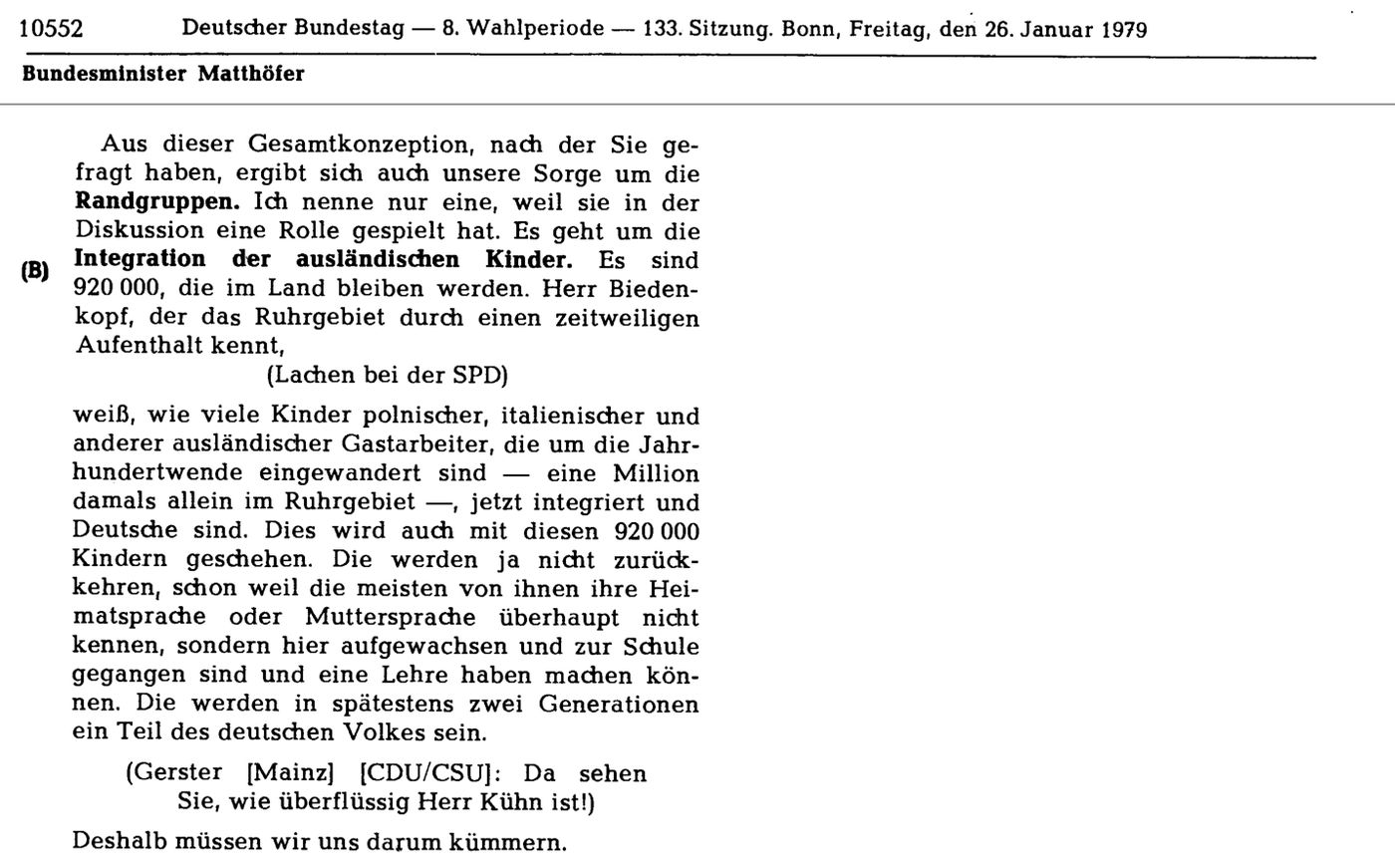
In January 1979, Finance Minister Hans Matthöfer said in the Bundestag of the children of recruited workers: “They are not going to return, not least because most of them do not know their home language or mother tongue at all, having grown up and gone to school here” [“Die werden ja nicht zurückkehren, schon weil die meisten von ihnen ihre Heimatsprache oder Muttersprache überhaupt nicht kennen, sondern hier aufgewachsen und zur Schule gegangen sind”]. In doing so, he placed them alongside the children of “Polish, Italian, and other foreign guest workers who immigrated around the turn of the century” [“polnischer, italienischer und anderer ausländischer Gastarbeiter, die um die Jahrhundertwende eingewandert sind”] (Deutscher Bundestag 1979). The minister acknowledged permanent settlement, while simultaneously applying the designation retroactively to immigrants of the turn of the century who had never been called by that name (Rass 2025).
Contestation | “So-called Guest Workers”
Neither the figure of the ‘Gastarbeiter’ nor that of the ‘Gastarbeiterkind’ went unchallenged. Objections were raised by the recruited workers themselves and by those within the majority society — in churches and in academia — who thought critically about German migration policy and its vocabulary. As early as 1969, the church working group “action 365” placed ‘Gastarbeiterkinder’ in quotation marks — the earliest instance of distancing that sub-project A3 has so far been able to document in its corpus (action 365 1969; Çelikten et al., forthcoming). Two years later, a Greek man named Kelides wrote in a report published by Michael Höhn and Uwe Seidel in the journal “Praktische Theologie”: “We are called ‘Gastarbeiter’ by the population. But in most cases we are not treated as guests.” [“Wir werden von der Bevölkerung ‚Gastarbeiter’ genannt. Aber man behandelt uns in den meisten Fällen nicht als Gäste.”] (Höhn/Seidel 1971) Kelides took the word at its word and held it up to the Germans.
Wolfgang Fietkau distanced himself from the designation already in the title of his 1972 book “Sogenannte Gastarbeiter” [“So-called Guest Workers”], writing about how German majority society demanded that the so-called guests play their assigned role: “reticent, modest, grateful, and one not too distant day, taking their leave” [“zurückhaltend, bescheiden, dankbar und eines nicht allzu fernen Tages Abschied nehmend”] (Fietkau 1972).
The sociologist Czarina Wilpert identified in 1977 the fundamental dilemma of West German education policy as a choice between “education for integration or education for rotation,” and in 1983 headed an essay on the recruited workers and their families with “From Guestworkers to Immigrants” (Wilpert 1977; Wilpert 1983; Ramírez/Rass, forthcoming). For the early 1990s, the historian Cord Pagenstecher captures the self-assertion of Turkish youth in the phrase “Wir bleiben hier!” [“We’re staying here!”] (Pagenstecher 1996).
Since the 1990s, ‘Gastarbeiterkind’ has also appeared increasingly in quotation marks in the specialist literature, or qualified with the prefix ‘so-called’ (Çelikten et al., forthcoming). Over time, what was once an unquestioned label has become a cited term. Critics have not thereby displaced the figure; they have, however, exposed it as an ascription that is not suited to serve as an analytical concept.
1981 | The Translation to America
Even before opposition began to stir in the Federal Republic, the figure of the ‘Gastarbeiter’ had already embarked on its global career, as American journalists, experts, and legislators translated and adopted the designation into English. Recruitment programs had existed in the United States long before this translation (Weise/Rass 2024): the Bracero Program had been bringing Mexican agricultural laborers into the country since 1942, yet in Congressional and press debates about this program, the term ‘guest worker’ did not appear prior to its termination in 1964 — the same year in which the Federal Republic welcomed its millionth ‘Gastarbeiter.’
How, then, did a German word become an American term of art?
Initially, Americans used the translated term to describe migration conditions in Europe. In August 1962, journalist Geoffrey Atkins of the Associated Press reported in the Washington “Sunday Star” on recruited migrants he had met in Frankfurt: “They are West Germany’s gastarbeiter (guest workers)” (documented in Rass 2023). In the following years, American newspapers repeatedly reported on state-regulated labor migration to Western Europe, and since the recession in the mid-1970s primarily on recruited workers who had lost their jobs and were being pressured to return; in this process, the German loanword gave way to the English translation (Rass 2023).
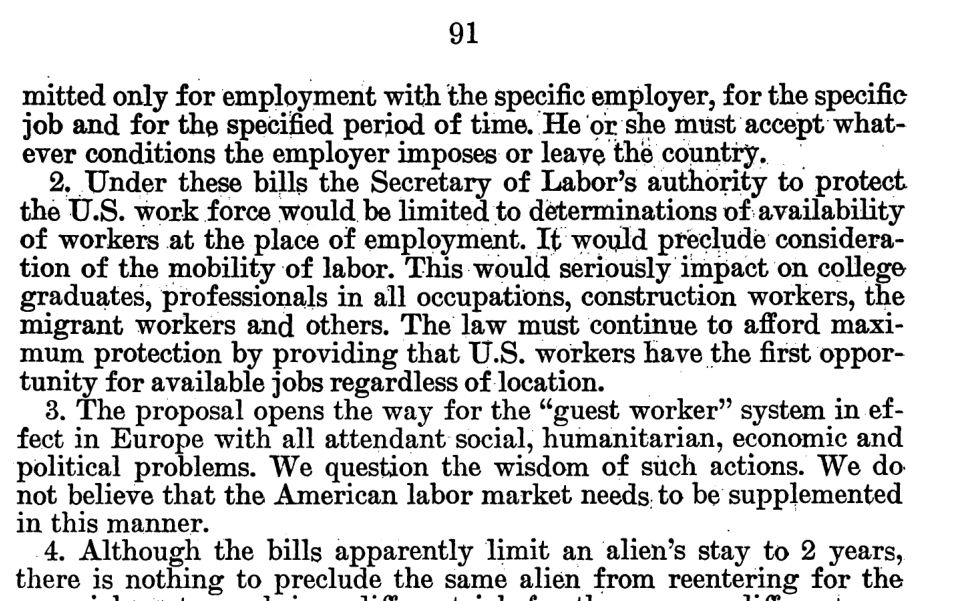
From around the mid-1970s, experts and politicians increasingly applied the term to their own immigration policy as well, specifically as a warning. In the House of Representatives hearings on immigration from the Western Hemisphere, experts from the Department of Labor rejected a proposal in the fall of 1975 to admit workers from Mexico on a temporary basis, citing European “guest workers systems” as a cautionary example (Fig. 4; Rass 2023). What had begun as a description of foreign conditions had become a model whose adoption American policymakers were debating.
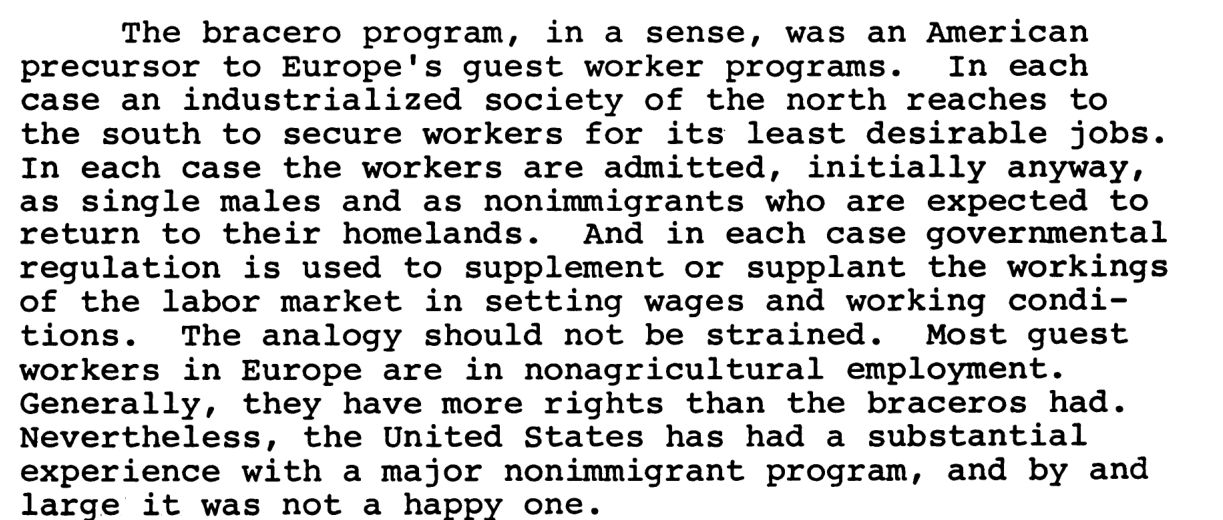
This model also made it possible to reorder the nation’s own past. In 1978, the National Commission for Manpower Policy retroactively declared the Bracero Program to be the American precursor to the European programs (Fig. 5). Yet the Bracero Program had itself been modeled on European migration agreements of the interwar period and had never been considered a “guest worker program” (Weise/Rass 2024). By the time the Reagan administration was preparing an immigration reform in 1981, “guest worker” had already become a fixture in the vocabulary of its advisors, who drew the administration’s attention to the European dilemma: without their families, recruited workers suffered from separation and loneliness; with them, they settled permanently at their destinations (Rass 2023). With this, the translation was complete; the term has since become firmly established in American political and academic discourse.
In the United States, too, the term “guest worker” remained outside the law as it stood. During the debate over the Immigration Reform and Control Act of 1986, the concept served as a foil against which its proponents defined themselves: at the final vote, Representative Peter Rodino assured his colleagues that the proposed provision for agricultural workers “can in no way be classified as a guestworker program” (documented in Briggs 1986). “Guest worker” now referred less to the migrants themselves than to a policy model that Congress and the administration could adopt or reject. In the United States, such programs were intended to frame temporary immigration while simultaneously preventing permanent settlement. Labeling people accordingly stripped them of the status of a potential immigrant who could choose to settle permanently (Rass 2023).
As early as 1981, while the Reagan administration was preparing its immigration reform, the Schmidt cabinet in Bonn had once again decided to deny a social reality that was by then clearly identifiable. When Interior Minister Gerhart Baum presented his report on November 11, 1981, stating that the Federal Republic was “de facto ein Einwanderungsland” [“de facto a country of immigration”], the cabinet resolved in that very same session that the Federal Republic was “kein Einwanderungsland” [“not a country of immigration”] and “auch nicht werden” [“should not become one”] (Kabinettsprotokolle 1981).
In Washington, “guest worker” became a synonym for labor migration without “immigration”; in Bonn, the cabinet used the figures of the “Gastarbeiter” and “Gastarbeiterkinder” [“guest worker children”] to deny an immigration that had long since taken place.
Global Present
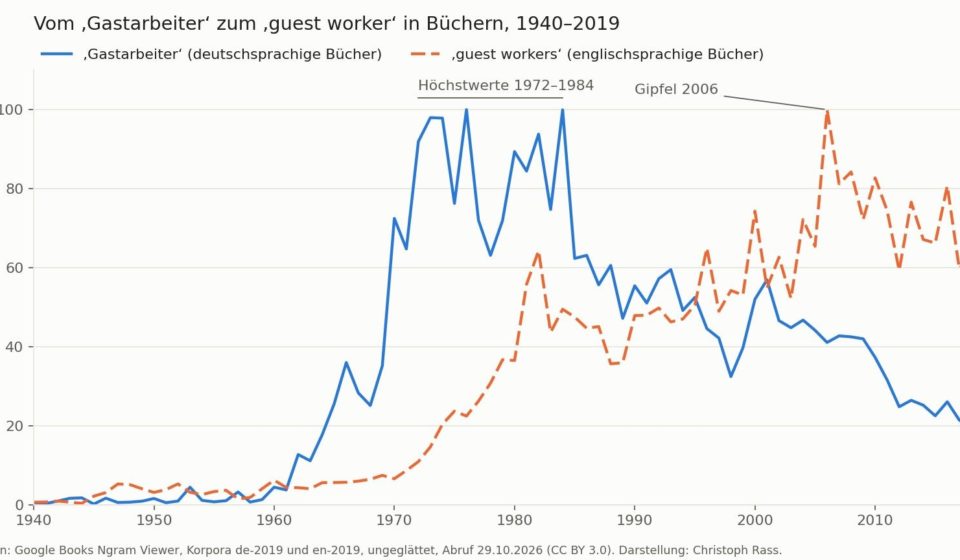
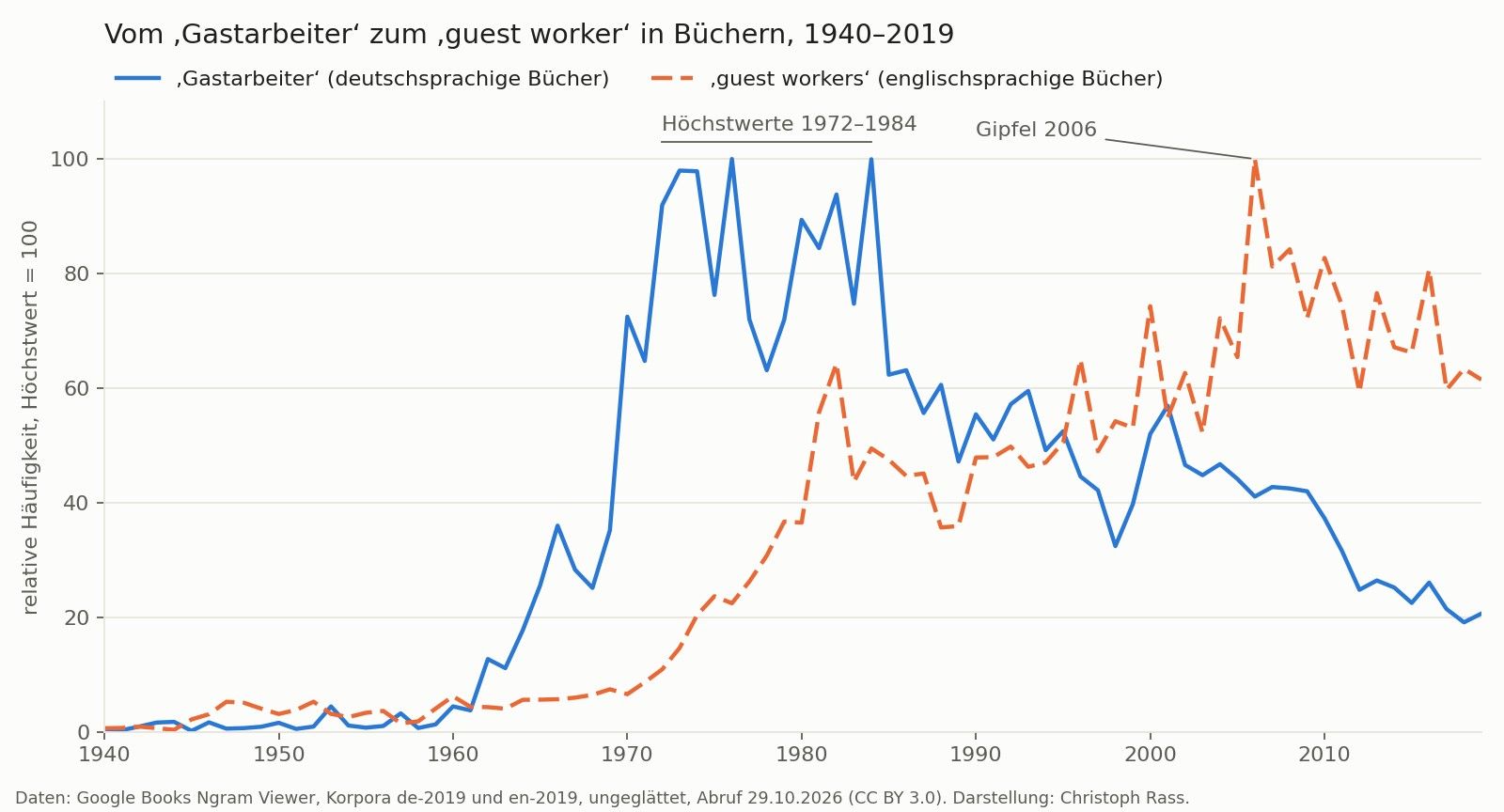
In German-language books as recorded by the Google Books Ngram Viewer, “Gastarbeiter” reached its highest frequency of use in 1976. In that year, the word appeared approximately five times as often as the legal formula “ausländische Arbeitnehmer” [“foreign employees”] at the latter’s own peak in 1982. In terms of the consent of which Gramsci speaks, this is a rough but telling finding.
The English “guest workers” did not reach its highest frequency of use until 2006, when the George W. Bush administration was pursuing yet another reform of temporary labor migration from Mexico (Rass 2023; Fig. 6). By that point, the German word had long since become a historical quotation; the English term continues to designate a program over which Washington can always renegotiate.
But what do “Gastarbeiter” and “guest worker” denote today?
ZEIT ONLINE wrote in 2015 about Qatar: „Doch in Deutschland wurden aus den Gastarbeitern irgendwann Immigranten. Das soll das Kafala-System in den arabischen Ländern verhindern.” [“But in Germany, the guest workers eventually became immigrants. The kafala system in the Arab countries is designed to prevent this.”] (ZEIT ONLINE 2015) When skilled workers from Turkey were called in to assist at German airports in June 2022, the federal government spoke of temporary labor migration, while the Bild-Zeitung, in a historical reflex, ran the headline “Bundesregierung holt Gastarbeiter” [“Federal government brings in guest workers”] (documented in Rass 2022). The press reaches for the term even where the government avoids it.
Contemporary programs perpetuate rules that the Federal Republic’s ‘guest labor’ system normalized. The American H-2B program admits seasonal workers outside agriculture whose families cannot, in practice, follow them and who have no pathway to permanent residence (Costa 2022). The kafala system of the Gulf states binds workers to their employers as sponsors in such a way that most cannot change jobs or leave the country without the employer’s permission (Sharma 2020). Japan and South Korea admitted workers for years not as workers but as ‘trainees’ on initially one-year visas, in programs that political scientist Erin Aeran Chung calls “de facto guest-worker programs” (Chung 2010). In 2019, a bill introduced in the United States House of Representatives for the recruitment of agricultural workers was titled the “Agricultural Guest Worker Reform Initiative Act” (H.R. 3740 2019). The ‘guest worker’ exists wherever authorities and newspapers, researchers, policymakers, and ultimately legislative drafters name people accordingly and create programs that treat them according to the rules thus invoked. Whenever this occurs, the figure becomes a social fact with real consequences for those affected (Rass/Holst, forthcoming).
Back to the Platform
Alongside the word, an image has remained in the Federal Republic’s visual memory from the platform at Cologne-Deutz station — an image that exhibitions and films continue to show to this day. The Deutsche Presse-Agentur dispatch of 10 September 1964 opens with a man who stood there “with an embarrassed, slightly mistrustful expression” and concludes by showing him as someone “sitting proudly on the moped” (documented in Spaich 1981). In the description of the iconic photograph in the agency’s picture archive, by 2009 he sits there without any embarrassment whatsoever, “with a proud expression” (dpa/picture alliance 2009).
The photograph taken by dpa photographer Horst Ossinger actually shows a man after more than two days of travel who is not looking into the camera but out of the frame, while microphones and cameras are thrust toward him. A film by Westdeutscher Rundfunk shows the minutes before the image was made: a translator and an official single out Armando Rodrigues de Sá from the crowd of arrivals and lead him across the tracks. “He is selected, paraded, presented.” (Rass/Ulz 2018) The pride was attributed to him by the agency and the viewing public.
As a key image, the photograph “has taken the place of historical knowledge” and fixes the notion that the ideal-typical ‘guest worker’ was “a man who had immigrated without his family, of working age” (Rass/Ulz 2018). Rodrigues de Sá had a wife and two children in Portugal and had intended to bring them over soon, a plan that came to nothing because of his mother-in-law’s need for care (Süddeutsche Zeitung 1964; Didczuneit 2004). Just as it conceals the family, the image also obscures the women who made up around one third of foreign employees in the Federal Republic by the late 1970s (Mattes 2005). Ossinger presents the ‘guest worker’ as an object of German interests, just as employers and the press wished to see him (Rass/Ulz 2018).
The figure was given legitimacy by employers, government, press, and academia, while the press agency supplied the iconic image. Following Gramsci, coercion and consent can be distinguished here. The coercion resided in the law governing ‘foreign employees,’ in the work and residence permits that companies applied for on behalf of those they recruited. The consent resided in the word ‘guest worker,’ which a minister used in the Bulletin of the Federal Government, a government in its reply to the Bundestag, and employers’ associations on a banner, until it became part of common sense. The figure was hegemonic to the extent that this consent reached; its limits were drawn by the recruits who settled in Germany and contradicted their own categorization.
Yet that consent extended into scholarship as well. The migration sociologist Stephen Castles wrote an obituary for the ‘guest worker’ in 1986 and referred to the recruits in that very text as ‘guest-workers’ (Castles 1986). The historian Rita Chin examined the ‘guest worker question’ in 2007 as an ideological construction. In her drafts, as the preface to her book explains, she had still placed the term in quotation marks; in the published version she removed the marking and asked her readers to continue reading it as “under interrogation” (Chin 2007). Chin’s note identifies the dilemma: even scholarship that examines the word as a construction thereby describes the recruits by means of it. As long as we do so, we risk perpetuating the very categories that employers, government, and press have imposed (Rass/Holst, forthcoming).
Sources and Bibliography
Sources
- action 365 (1969): Denkschrift Schule für „Gastarbeiterkinder” in der Bundesrepublik Deutschland.
- Blank, Theodor (1964): Eine Million Gastarbeiter. Eine nicht unerhebliche Voraussetzung für das Gedeihen der deutschen Wirtschaft, in: Bulletin des Presse- und Informationsamtes der Bundesregierung Nr. 160 vom 30.10.1964.
- Bundesanstalt für Arbeit (1974): Ausländische Arbeitnehmer 1972/73.
- Bundesvereinigung der Deutschen Arbeitgeberverbände (1964): Mitteilungen der Bundesvereinigung der Deutschen Arbeitgeberverbände Nr. 10.
- Deutscher Bundestag (1971): Antwort des Bundesministers für Bildung und Wissenschaft auf die Kleine Anfrage betr. Schul- und Berufsausbildung der Kinder ausländischer Arbeitnehmer in der Bundesrepublik Deutschland, Drucksache VI/2071 vom 30.03.1971, https://dserver.bundestag.de/btd/06/020/0602071.pdf.
- Deutscher Bundestag (1979): Stenographischer Bericht, 8. Wahlperiode, 133. Sitzung, 26.01.1979, https://dserver.bundestag.de/btp/08/08133.pdf.
- dpa/picture alliance (2009): Bild 883624 (Horst Ossinger, Köln-Deutz, 10.09.1964), Bildbeschreibung im Bildarchiv.
- Fietkau, Wolfgang (1972): Sogenannte Gastarbeiter. Report und Kritik.
- Grundsätze (1972): Grundsätze zur Eingliederung ausländischer Arbeitnehmer und ihrer Familien vom 20. April 1972.
- H.R. 3740 (2019): Agricultural Guest Worker Reform Initiative Act of 2019, 116th Congress, https://www.govinfo.gov/app/details/BILLS-116hr3740ih.
- Hansen, Jens Godber (1974): Der Unterricht für Gastarbeiterkinder in Schleswig-Holstein.
- Höfer, Werner (1943): Frontsoldaten und Frontarbeiter – Kameraden der Atlantikschlacht, in: Kalender der Deutschen Arbeit, S. 90–93.
- Höhn, Michael/Seidel, Uwe (1971): Konfliktmodell „Gastarbeiter”. Berichte und Analysen, in: Praktische Theologie 6, https://doi.org/10.14315/prth-1971-0105.
- Kabinettsprotokolle (1981): 52. Kabinettssitzung am 11. November 1981, in: Die Kabinettsprotokolle der Bundesregierung, hg. vom Bundesarchiv, https://kabinettsprotokolle.bundesarchiv.de/protokoll/f9ede19e-9ff6-4bed-83cb-4dfcbefbceda.
- Sonderforschungsbereich 1604 „Produktion von Migration” (2026): Forschungsprogramm, https://www.uni-osnabrueck.de/sfb1604/forschung/forschungsprogramm; Teilprojekt A3, https://www.uni-osnabrueck.de/sfb1604/projekte/a3.
- Stirn, Hans (Hg.) (1964): Ausländische Arbeiter im Betrieb.
- Süddeutsche Zeitung (1964): Wolfgang Kuballa, Großer Bahnhof für Armando Sá Rodrigues, Nr. 219 vom 11.09.1964.
- Universität Siegen (2026): Migrationsregime und „Gastarbeit” in der Bundesrepublik. Regulierungen, Akteure und Eigensinn. Ringvorlesung Wintersemester 2026/27, https://www.uni-siegen.de/en/2026/migration-policies-and-guest-worker-programs-in-the-federal-republic-of-germany.
- WDR (1964): Interview mit Manfred Dunkel, Köln-Deutz, 10.09.1964, Transkript, angekommen.com 2004.
- Weber, Max (1921): Gesammelte Aufsätze zur Religionssoziologie, Bd. 2: Hinduismus und Buddhismus (Erstdruck in: Archiv für Sozialwissenschaft und Sozialpolitik 41, 1916), https://archive.org/details/gesammelteaufs02webe.
- Weber, Max (1922): Wirtschaft und Gesellschaft (Grundriss der Sozialökonomik, III. Abteilung).
- ZEIT ONLINE (2015): Höher, schneller, Katar, 11.06.2015, https://www.zeit.de/feature/katar-fussball-wm-sport-vision-multimedia.
Research Literature
- Amenda, Lars/Rass, Christoph (2012): Fremdarbeiter, Ostarbeiter, Gastarbeiter. Semantiken der Ungleichheit und ihre Praxis im ‚Ausländereinsatz’, in: Beiträge zur Geschichte des Nationalsozialismus 28.
- Briggs, Vernon M. (1986): The „Albatross” of Immigration Reform: Temporary Worker Policy in the United States, in: International Migration Review 20.
- Castles, Stephen (1986): The Guest-Worker in Western Europe: An Obituary, in: International Migration Review 20, https://doi.org/10.1177/019791838602000402.
- Çelikten, Ahmet/Hoops, Maik/Rass, Christoph/Yıldırım, Lale (forthcoming): Situating „Gastarbeiterkinder”. Science, School, and the Production of Figures of Migration, in: Löhr, Isabella/Schwenken, Helen/Stierl, Maurice (eds.): Production of Migration: Empirical Analyses (Production of Migration, vol. 2), Cham: Springer.
- Chin, Rita (2007): The Guest Worker Question in Postwar Germany.
- Chung, Erin Aeran (2010): Workers or Residents? Diverging Patterns of Immigrant Incorporation in Korea and Japan, in: Pacific Affairs 83, https://doi.org/10.5509/2010834675.
- Costa, Daniel (2022): As the H-2B Visa Program Grows, the Need for Reforms That Protect Workers Is Greater Than Ever, Economic Policy Institute.
- Didczuneit, Veit (2004): Geschichtsbilder: Armando Rodrigues de Sá. Der millionste Gastarbeiter, das Moped und die bundesdeutsche Einwanderungsgesellschaft, lecture, conference of the Landeszentrum für Zuwanderung NRW, Cologne, 8/9 September 2004, angekommen.com.
- Gramsci, Antonio (1992): Gefängnishefte, vol. 4: Hefte 6 und 7, ed. by Klaus Bochmann and Wolfgang Fritz Haug.
- Jung, Matthias/Niehr, Thomas/Böke, Karin (2000): Ausländer und Migranten im Spiegel der Presse. Ein diskurshistorisches Wörterbuch zur Einwanderung seit 1945.
- Levy, Carl (1988): Max Weber und Antonio Gramsci, in: Mommsen, Wolfgang J./Schwentker, Wolfgang (eds.): Max Weber und seine Zeitgenossen.
- Mattes, Monika (2005): „Gastarbeiterinnen” in der Bundesrepublik. Anwerbepolitik, Migration und Geschlecht in den 50er bis 70er Jahren.
- Pagenstecher, Cord (1996): Die „Illusion” der Rückkehr. Zur Mentalitätsgeschichte von „Gastarbeit” und Einwanderung, in: Soziale Welt 47.
- Ramírez, Catherine S./Rass, Christoph (forthcoming): „Nobody Could Understand ‚Czarina Huerta'”. Migration Knowledge, an Outsider’s Critique, and the Epistemic Boundaries of a Field, in: Oxford Intersections.
- Rass, Christoph (2022): Der „Gastarbeiter”-Reflex, NGHM@UOS, 29 June 2022, https://nghm.hypotheses.org/5576.
- Rass, Christoph (2023): „Gastarbeiter” – „Guest Worker”. Translating a Keyword in Migration Politics, IMIS Working Paper 17, https://doi.org/10.48693/399.
- Rass, Christoph (2025): Long Essay | „Gastarbeiter” in der NS-Presse. Formative Jahre eines migrationspolitischen Schlüsselbegriffs, NGHM@UOS, 24 March 2025, https://nghm.hypotheses.org/33486.
- Rass, Christoph (2026): „Gastarbeiter” in the Nazi Press (1933–1945). Formative Years of a Key Term in Migration Politics, IMIS Working Paper 22.
- Rass, Christoph/Holst, Hajo (forthcoming): When Categories Come Alive: ‚Figures’ and the Production of Migration, in: Pott, Andreas/Scheffer, Thomas (eds.): Approaching the Production of Migration. Spaces – Figures – Infrastructures (Production of Migration, vol. 1), Cham: Springer.
- Rass, Christoph/Hoops, Maik (forthcoming): „Die Bundesrepublik soll und will kein Einwanderungsland werden”. Die Verweigerung der Migrationsgesellschaft unter Brandt und Schmidt.
- Rass, Christoph/Ulz, Melanie (2018): Armando Rodrigues de Sá revisited. Bildwissenschaftliche und historische Analysen im Dialog, in: Rass, Christoph/Ulz, Melanie (eds.): Migration ein Bild geben. Visuelle Aushandlungen von Diversität.
- Röber, Christa (1980): Ausländerkinder verändern die Grundschule, in: Haarmann, Dieter (ed.): Die Grundschule der achtziger Jahre, https://doi.org/10.25656/01:17520.
- Schönbach, Peter (1970): Sprache und Attitüden. Über den Einfluß der Bezeichnungen „Fremdarbeiter” und „Gastarbeiter” auf Einstellungen gegenüber ausländischen Arbeitern.
- Sharma, Nandita (2020): Home Rule. National Sovereignty and the Separation of Natives and Migrants, https://doi.org/10.1215/9781478002451.
- Spaich, Herbert (1981): Fremde in Deutschland. Unbequeme Kapitel unserer Geschichte.
- Weise, Julie M./Rass, Christoph (2024): Migrating Concepts. The Transatlantic Origins of the Bracero Program, 1919–1942, in: American Historical Review 129, https://doi.org/10.1093/ahr/rhad500.
- Wilpert, Czarina (1977): Children of Foreign Workers in the Federal Republic of Germany, in: International Migration Review 11.
- Wilpert, Czarina (1983): From Guestworkers to Immigrants: Migrant Workers and their Families in the FRG, in: New Community 11.
Find the original post at Nachlese | Siegen 2026 | Vom ‚Gastarbeiter‘ zum ‚guest worker‘. Herkunft, Karrieren und globale Gegenwart einer Figur der Migration on nghm.hypotheses.org.
This post was automatically translated from the German original.