
By Christoph Rass · Originally published on nghm.hypotheses.org
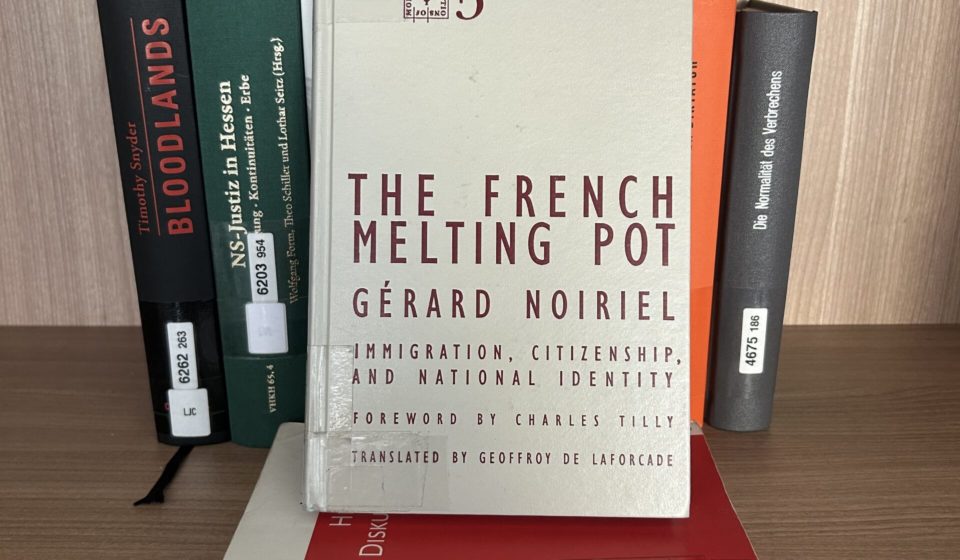
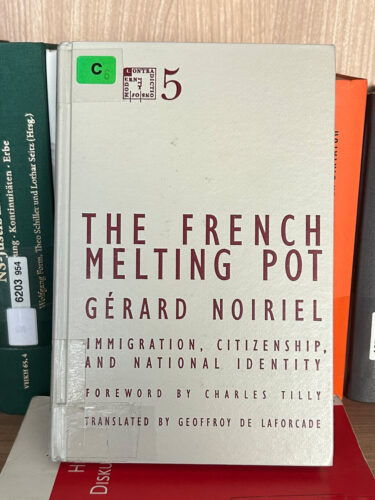
Is France a nation of immigration? Gérard Noiriel’s The French Melting Pot, featured on the NGHM Reading List, answers this question in the field of migration history and theory with a paradox: the French ›creuset‹ absorbed generations of immigrants in the nineteenth and twentieth centuries, while national historiography excluded this immigration from its narrative. The book was translated into English in 1996 by Geoffroy de Laforcade, with a preface by Charles Tilly. It appeared as the fifth volume in the series “Contradictions of Modernity,” edited by Craig Calhoun.
When Gérard Noiriel published Le creuset français in 1988, he came from the history of labor: his 1982 dissertation had examined the workers of the Lorraine steel district around Longwy; in 1986 he outlined a program for a history of immigration to France in the Annales. The starting point was asymmetric. In the United States, the myth of the “melting pot”—the land of refuge for immigrants—belonged to collective memory; in France, the history of immigration lay fallow, in Noiriel’s words, as an “histoire en friches.” Yet the French economy had relied extensively on foreign labor from the late nineteenth century through the 1970s.
Methodologically, Noiriel combines the social history of labor with a socio-histoire of relations of domination, which he developed in the circle of the journal Genèses together with sociologists and political scientists drawing on Max Weber and Norbert Elias. The focus is not on ‘migrants’ as a pre-given group, but on the procedures by which authorities register, name, and administer people as ‘foreigners’—that is, on process-generated categories. This conceptual move, from substance to category and from object to the procedures of its production, shapes the entire book.
The book’s argument has two parts: first, France is in fact a country of immigration, whose ›creuset‹—the melting pot—absorbed waves of immigration from Belgium, Italy, Poland, and North Africa in the nineteenth and twentieth centuries, as well as Armenian refugees and Jewish immigrants from Eastern Europe; second, this immigration constitutes a “non-lieu de mémoire,” a non-site of memory. The formula polemically inverts Pierre Nora’s “lieux de mémoire”; the first chapter of the English edition is accordingly titled “The Denial of Memory.”
Between thesis and elaboration, Noiriel unfolds a cyclical model: a phase of large-scale mobility is followed by a phase of stabilization and integration, enforced by an authoritarian halt to immigration in the midst of an economic and xenophobic crisis; the hardships of this integration are forgotten once assimilation across the generations is complete. Noiriel dated such crises to the economic downturns of the 1880s, the 1930s, and the 1980s. The comparison with the American “melting pot” sharpens the focus on French amnesia, whose administrative dimension Noiriel identifies: whereas the United States census asks about origins, the Third Republic had already prohibited the recording of religion or ethnic origin in population censuses.
This is where Noiriel’s most consequential move begins. The distinction between nationals and foreigners is, in his reading, a creation of the modern state. Immigration in the contemporary sense can, according to Noiriel, only be spoken of since the nation-state drew this boundary with clarity: the word “immigration” established itself in French in the 1880s; the first proper French nationality law followed in 1889. Papers, registers, and residence permits appear as preconditions of migration, not as responses to it. This inversion—migration as a product of the state’s ordering activities—also reached Anglophone scholarship through the 1996 translation.
At the University of Osnabrück, the Collaborative Research Centre (SFB) 1604 “Production of Migration,” established in 2024, proceeds from a related assumption. It examines how individual, collective, and institutional actors practice, process, and invest migration with meaning; this production is understood as a contested process of negotiation grounded in the categorization of people, groups, and practices. Sub-project A03, “Ihr seid Gastarbeiterkinder!” [“You are guest-worker children!”], traces genealogically, from the late 1960s onward, what role migration research played in generating figures such as ›Ausländerkinder‹ [foreign children], ›Gastarbeiterkinder‹ [guest-worker children], or ›Schüler mit Migrationshintergrund‹ [pupils with a migration background], and how these figures entered the German school system as practical knowledge. Where Noiriel begins with the papers and registers of the state, A03 foregrounds scholarship as a co-producer of such categories.
An Osnabrück project engages even more directly with the registers of which Noiriel speaks. In 2019, the NGHM research group, funded by the Lower Saxony Ministry of Science and Culture and in cooperation with the Lower Saxony State Archives and the City of Osnabrück, began researching the city’s “Ausländermeldekartei” [foreigners’ registration card index]. The card index recorded, between approximately 1930 and 1980, around 70,000 persons who lived in Osnabrück without holding German citizenship; its complete, machine-readable replica makes it possible to trace the path dependencies of administrative knowledge production about migration in person-related mass data across five decades. The project team presented initial findings in 2021 in the Osnabrücker Mitteilungen. The card index illustrates how a municipal administration drew, card by card, the boundary between nationals and ‘foreigners’ that Noiriel describes as a creation of the state.
A later contribution to this series will take up the question of who produces the categories with which movement is described, from the perspective of refugee history, when Peter Gatrell’s The Making of the Modern Refugee (2013) is introduced.
Noiriel’s book has attracted criticism on two points. In a historiographical survey published in The Historical Journal in September 2026, Emile Chabal, Angéline Escafré-Dublet, and Daniel A. Gordon argued that Noiriel’s invocation of a non-site of memory encouraged the notion that his book marked “ground zero” of French migration historiography. Yet before Noiriel, Jean-Charles Bonnet had already submitted the first dissertation on the history of immigration to France in 1976, and Nancy L. Green had published her study of immigrant Jewish workers in the Parisian Pletzl in 1986. The three scholars are also critical of the neo-Marxist framework with which Noiriel, in the 1980s, countered the rhetoric of the political right on immigrants. Social problems within immigrant communities of his time were interpreted by Noiriel, in their assessment, as expressions of a general social malaise, with the alienation of young members of ‘ethnic minorities’ read as a “crisis of hope.” In their judgment, this perspective was unable to account for the sharp rise in political mobilization around identity exemplified by the March for Equality and Against Racism of 1983.
What remains is the core analytical figure that Noiriel identifies in the concluding chapter under the heading “Toward a Sociohistory of National Assimilation” as a programmatic statement: a history of migration that begins with the procedures by which states produce ‘migration’ as an object. Noiriel has made this insight the foundation of a history of France in which immigration is integral to nation-building.
Students at the University of Osnabrück will find Noiriel’s The French Melting Pot at the B-IMIS location under the shelf mark D5-3a13 4696-072 2 (OPAC); the French original Le creuset français is held in the 1989 edition in the B-Magazin under 4541-736 0, and the 1992 paperback edition (Points Histoire 161) at the B-IMIS location under D5-3a13 4634-161 3.
Gérard Noiriel, The French Melting Pot: Immigration, Citizenship, and National Identity, trans. by Geoffroy de Laforcade, with a preface by Charles Tilly, Minneapolis: University of Minnesota Press 1996 (French original: Le creuset français. Histoire de l’immigration XIXe-XXe siècles, Paris: Seuil 1988).
This post is part of the series NGHM Reads, in which the 65 titles on the NGHM Reading List are introduced. The list can be explored as a knowledge graph.
Find the original post at NGHM liest | 18 | Noiriel: The French Melting Pot (1996) on nghm.hypotheses.org.
This post was automatically translated from the German original.