Digital Humanities at the University of Osnabrück. University Library Workshop with Cultural and Social Sciences in May 2025

This post was automatically translated from the German original at
Digital Humanities an der Universität Osnabrück. Workshop der UB mit den Kultur- und Sozialwissenschaften im Mai 2025.
The social and cultural sciences have already been undergoing a profound transformation for several years, driven by the omnipresent and constantly accelerating digitisation of knowledge, culture and communication. This transformation has entered a new phase with the general availability of “artificial intelligence”, whose course and effects we can barely comprehend so far.
The social, cultural and humanities respond to this situation by developing their own methodological field, the Digital Humanities (DH), which have become a dynamic and expanding branch of science that uses computer-assisted methods and digital technologies to address both new and conventional research questions in new ways and with an innovative methodological approach. At the same time, it involves the development and testing of new methodological procedures and possibilities that digital technologies open up for us.
This process fundamentally changes all aspects of our scholarly work and thus the way in which knowledge in the social, cultural and humanities is produced, transmitted and received. The emerging epistemological turn is more than an adaptation to new technical possibilities. It touches our scholarly self-understanding.
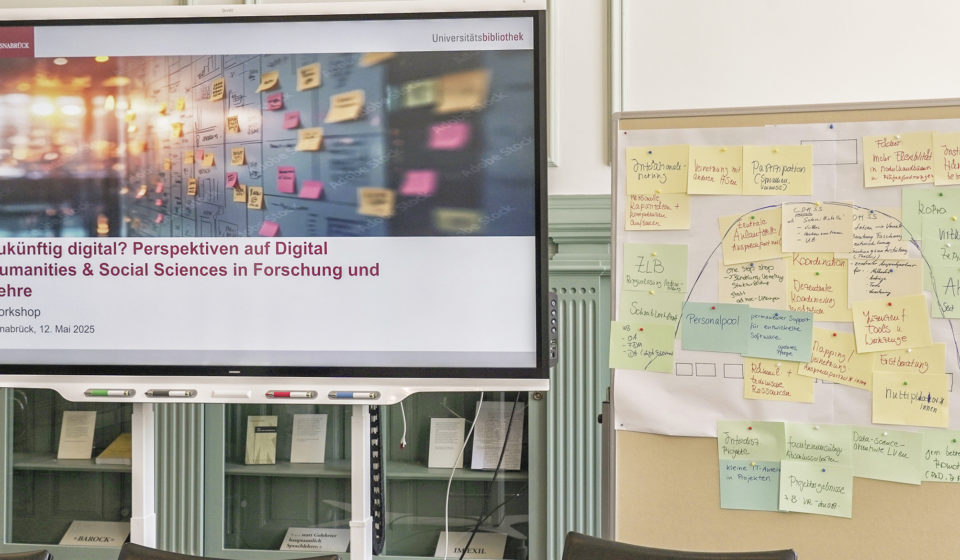
At Osnabrück University, Digital Humanities methods are not only applied in teaching and research in many areas, but are also developed, tested and made applicable. In order to further develop the bundling and networking of these approaches and to discuss the question of what infrastructures the social and cultural sciences in particular need in the field of Digital Humanities for their work, the University Library invited scholars active in this field, representatives of university infrastructure institutions and representatives of the university administration to a workshop on 12 May.
Also participating was the team from the Chair of Contemporary History and Historical Migration Research (Prof. Dr. Christoph Rass), from which a whole series of scholars have been participating for some time in an initiative group that would like to encourage the founding of its own DH centre at UOS.
In the poster exhibition that accompanied the workshop programme, the NGHM working group was represented with contributions that presented the use of DH methods in research projects and at the same time presented ideas for expanding corresponding competencies in research and teaching.
In this context, we at the Chair of Contemporary History and Historical Migration Research have been offering a regular seminar since the summer semester 2025 to introduce students early and openly to the innovative potential of DH methods and tools.
In doing so, we follow the finding that the Digital Humanities cannot be clearly and definitively defined. Rather, we understand DH as a versatile research and practice field at the interface between computer or digital technologies and disciplines of the humanities and cultural sciences, in our case history or historical migration research.
The core of DH therefore lies in our perception less in the “digital tools” themselves, but in the way they are used to pose questions in our research and teaching fields anew, to challenge old paradigms and to generate new knowledge not least also collaboratively and interdisciplinarily.
The integration of Digital Humanities into university teaching then possibly requires a rethinking of didactic concepts. In the NGHM team, we increasingly rely on project-based learning, where students develop their own small DH projects and thereby acquire digital competencies. The teaching of “Digital Literacy” – that is, digital competence – is central to this. Interdisciplinary seminars that complement the traditional course offerings are also important. But critical reflection on the role and effects of digitality in science and society is also important.
The Digital Humanities open up completely new horizons for us in the field of historical research. Through the use of text mining and distant reading, we can analyse large text corpora and recognise previously invisible patterns. We can not only use large machine-readable corpora and datasets from historical sources ever faster and more efficiently, but also create them ourselves. The 3D modelling of historical sites and artefacts enables innovative approaches to the materiality of past epochs. The combination of “mixed methods” approaches, which connect qualitative humanities traditions with quantitative digital procedures, proves particularly fruitful. We must naturally always consider the critical examination of algorithmic bias.
The training of young scholars in the field of Digital Humanities is one of the central challenges. We orient ourselves on the example of a T-model: deep historical knowledge combined with broad knowledge of digital methods. An interdisciplinary “bridge-building competence” repeatedly proves to be crucial, that is, pronounced communication skills and openness to other disciplinary cultures and methods.