Making History Production ‘Playable’ | The “Osnabrück Peace Chess”. Negotiating Memory in Game Format.

This post was automatically translated from the German original at
Geschichtsproduktion ‘spielbar’ machen | Das “Osnabrücker Friedensschach“. Die Aushandlung von Erinnerung im Spielformat..
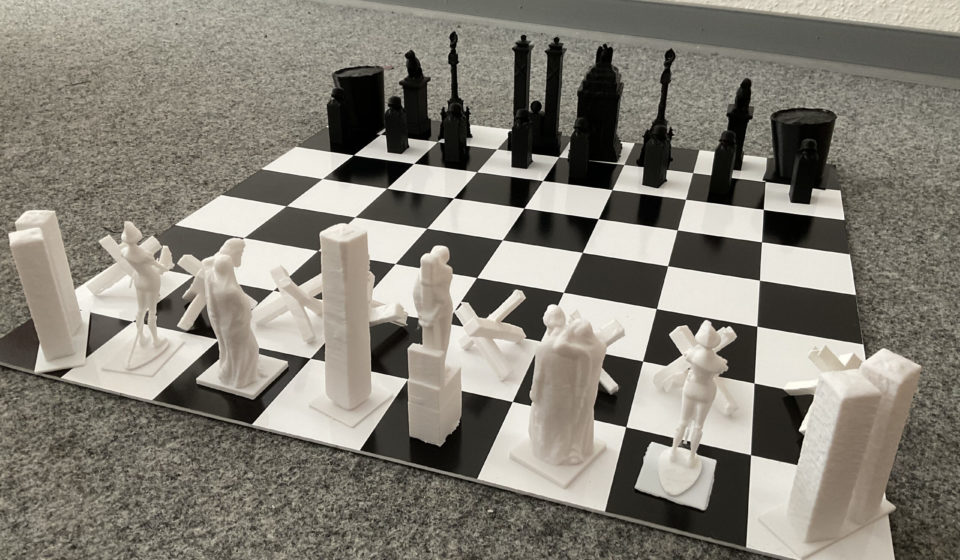
In the context of the interdisciplinary LehrZeit project “Researching, Mediating, Exhibiting. Virtual Learning Spaces in Historical Studies” at the University of Osnabrück, students together with Imke Selle, Prof. Dr. Christoph Rass, Prof. Dr. Lale Yildirim & Prof. Dr. Michael Brinkmeier developed the “Osnabrück Peace Chess”: the chessboard functions as an interactive memory game in which “peace monuments” and “war memorials” compete against each other and create a new landscape of memory through their arrangement on the board in each game. The course of play symbolises processes of negotiating history and memory culture and aims to stimulate reflective discussion about the production of history and its representation through material culture in public space.
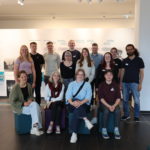
Within the framework of LehrZeit 2023, students from history and computer science were brought together. The aim was to test practice-oriented approaches for conveying historical content in the context of digital education. Students from both disciplines collaboratively developed a mixed-reality exhibition on Osnabrück monuments and presented it at the Osnabrück University Library.
The Peace Chess served as an interface between academic research, historical cultural practice and digital competence development.
At the centre was the reflexive engagement with forms of public remembrance – particularly with war and peace monuments – in a playful setting.
The conception of LehrZeit within the framework of Osnabrück’s Peace Year 2023 connected to Osnabrück’s self-positioning as a “City of Peace”. Starting from the 375th anniversary of the Peace of Westphalia, LehrZeit focused on the negotiation of history, public memory and urban identity. In doing so, a fundamental contradiction in memory culture became visible: despite the city’s peace-political self-understanding, numerous traditional war memorials continue to shape Osnabrück’s cityscape to this day.
Against this background, the Osnabrück Peace Chess emerged as a reflexive game format that symbolically sets these tension-filled sites of memory against each other: war and peace monuments become game pieces that embody competing forms of historical narrative.
Digitally reconstructed miniatures of real monuments in Osnabrück’s urban space take the place of classic chess pieces. Monuments historically associated with war, violence or peace face each other as opposing pieces. The chessboard thus becomes a symbolic stage for confrontation and dialogical engagement in history and memory culture.
This setting not only enables a playful approach to historical content; the selection, reproduction and staging of the monuments in the game simultaneously points to the question of which narratives gain visibility in public space – and which remain marginalised.
The monument replicas were created using photogrammetry and LiDAR scanning and made accessible as 3D prints within the framework of the game – in doing so, the students also utilised the technical infrastructure of Osnabrück’s Digilab. In the mixed-reality exhibition “The Monument in Motion. Remembering War and Peace in Osnabrück Anew” that emerged from the project, the Peace Chess was physically experienceable as an analogue exhibition element and served there as a concrete space for reflection on tensions in memory culture within Osnabrück’s urban space.
Within the framework of the Connective Holocaust Commemoration Expo of the Alfred Landecker Foundation at the University of Sussex in June 2025, the team from the Chair of Modern History and Historical Migration Research once again presented the Osnabrück Peace Chess as an exhibition piece and put it up for discussion in an international and interdisciplinary context. On this occasion too, the chess game with its underlying concept attracted great interest. Detailed reports on the Expo including a digital tour can be found here.
*** English Version ***
Making History Playable | The “Osnabrück Peace Chess”. Negotiating Memory in a Game Format (by Imke Selle)
As part of the interdisciplinary LehrZeit project “Researching, Mediating, Exhibiting. Virtual Learning Spaces in Historical Studies” at Osnabrück University, students – under the guidance of Imke Selle, Prof. Dr. Christoph Rass, Prof. Dr. Lale Yildirim, and Prof. Dr. Michael Brinkmeier – developed the “Osnabrück Peace Chess”: a chessboard functioning as an interactive memory game, in which “peace monuments” and “war memorials” face off. In every match, their arrangement on the board generates a new landscape of memory. The course of play symbolizes processes of negotiating history and memory culture, aiming to stimulate a reflective discussion about the production of history and its representation through material culture in public space.
The project brought together students from history and computer science to explore practice-oriented approaches for conveying historical content in digital education. Students from both fields collaboratively created a mixed-reality exhibition on monuments in Osnabrück, presented at the Osnabrück University Library.
At the centre was a reflective engagement with forms of public remembrance—especially with war and peace monuments—within a playful setting.
The LehrZeit project was designed in the context of the Peace Year 2023 in the City of Osnabrück, drawing on the city’s self-conception as a “City of Peace”. Inspired by the 375th anniversary of the Peace of Westphalia, the project focused on the negotiation of history, public memory, and urban identity. A fundamental contradiction in local memory culture became evident: Despite the city’s peace-oriented self-image, numerous traditional war memorials still shape Osnabrück’s urban landscape.
Against this backdrop, the “Osnabrück Peace Chess” emerged as a reflexive game format that symbolically sets these conflicting memory sites in opposition: war and peace monuments become game pieces representing competing narratives of history.
Instead of classic chess pieces, the game uses digitally reconstructed miniatures of real monuments from the city of Osnabrück. Monuments historically associated with war, violence, or peace face off as opposing figures. The chessboard thus becomes a symbolic stage for confrontation and dialogical engagement in the realms of history and memory culture.
This setting not only facilitates a playful approach to historical content; the selection, reproduction, and staging of the monuments in the game simultaneously raises the question of which narratives gain visibility in public space—and which are marginalized.
The monument replicas were created using photogrammetry and LiDAR scanning and made available as 3D prints in the game. Students made use of the technical infrastructure at Osnabrück University’s DigiLab. In the resulting Mixed-Reality Exhibition “The Monument in Motion. Rethinking War and Peace in Osnabrück,” the Peace Chess was a physical exhibition element and served as a tangible space for reflecting on tensions in memory culture within Osnabrück’s urban environment.
At the Connective Holocaust Commemoration Expo, hosted by the Alfred Landecker Foundation at the University of Sussex in June 2025, the team from the Chair of Modern History and Historical Migration Studies once again presented the Osnabrück Peace Chess as part of the exhibition, placing it in an international and interdisciplinary context for discussion. The chess game and its underlying concept once again attracted considerable attention. A detailed report on the expo, including a digital tour, is available here.