There and Back Again | Excursion to the ZeitZentrum Zivilcourage Hannover

This post was automatically translated from the German original at
Hin und wieder zurück | Exkursion ins ZeitZentrum Zivilcourage Hannover.
Between Puzzle Room and Memorial Culture: Right-wing Radicalism Then and Now. An Approach at the ZeitZentrum Zivilcourage
An excursion report by Manuel Büchner and Leonie Güneri
Right-wing radical tendencies and anti-democratic positions are no longer a marginal phenomenon; they manifest themselves in social debates, online, and in many everyday situations. For this reason, it is particularly important to actively engage with the causes, mechanisms, and effects of right-wing radicalism, as well as with possibilities for civil society participation.
With this motivation, a preliminary meeting for the planned excursion to Hannover took place on 18 July. Under the guidance of Imke Selle and Jessica Wehner, we collectively addressed central questions surrounding the topic of right-wing radicalism: What do we understand by it, how do we encounter right-wing attitudes in everyday life, and what responsibility do we ourselves bear? The role of personal agency and civil society engagement was particularly central to our considerations – a theme that would accompany us throughout the rest of the excursion.
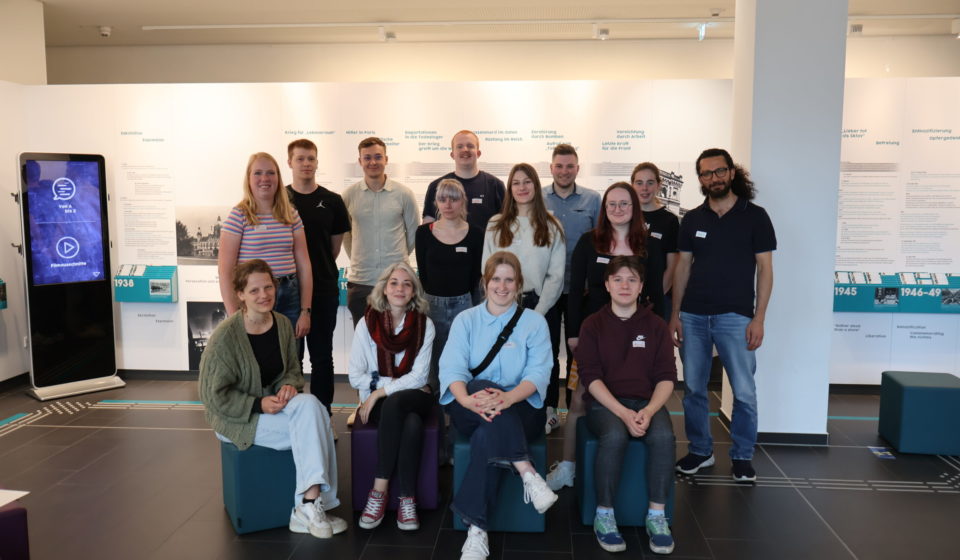
On the morning of 31 July, we met at Osnabrück Central Station and travelled together by train to Hannover to visit the ZeitZentrum Zivilcourage. Already during the journey, a lively exchange developed about our expectations, our prior knowledge, and personal points of contact with the topic. On site, we were met with an interactive and varied workshop that illuminated the history, symbols, and contemporary manifestations of right-wing radicalism through practical examples and group tasks.
After arriving at the ZeitZentrum, we were welcomed by two educational staff members of the ZeitZentrum who guided us through the day. To begin, we positioned ourselves on various theses, such as “I frequently encounter right-wing radicalism in everyday life”. Already here it became apparent how different our personal experiences with it are and how relevant the topic is even in our immediate environment.
The central element of our visit was participation in the workshop “My World?”: The Story of Bex. This workshop includes a so-called “interactive youth room”, which is also referred to as a “puzzle room”. It is set up like an escape room. The participants must solve puzzles in order to reconstruct the story of the young person Bex, who lives in this room and drifts into the right-wing scene. The term ‘escape room’ is deliberately avoided in order to do justice to the seriousness of the topic and to prevent possible trivialisation.
Together as a group, we attempted to reconstruct the radicalisation and deradicalisation story of Bex. In the course of the story, Bex engaged with Johann Wilhelm “Rukeli” Trollmann, a successful boxer and Sinto who lost his German middleweight championship title during the Nazi era due to his heritage. This encounter becomes a turning point for the young person: it not only confronts him with the consequences of exclusion and racist discrimination, but also leads him to critically reflect on his own actions and develop the desire to exit the right-wing milieu.
Through solving puzzles and collecting clues, we finally succeeded in collectively reconstructing the radicalisation and exit of the young person from the right-wing scene. We deliberately leave the exact details and solutions open here so as not to spoil the experience for other groups.
Following the “interactive youth room”, we reflected together on which right-wing symbols and codes we had noticed during the game and how they serve for identification and communication within right-wing groups. We also discussed the emotional impact of these scenarios and talked about mechanisms such as group pressure, role models, and the role of loneliness and exclusion in the radicalisation process.
A second focus of the visit was the historical work at the ZeitZentrum. We engaged with the biographies of three selected individuals: Wanda Pranden, Johann Wilhelm “Rukeli” Trollmann, who was already known from the puzzle room, and Egon Kuhn. Based on exhibition information, we were to develop short biographies and select three objects that symbolise central aspects of each life path. The subsequent presentations illustrated the different victim and perpetrator biographies and showed how multifaceted the history of exclusion, adaptation, courage, and resistance is. After each group phase, there was the opportunity to ask questions and make comments or describe particularities from one’s own small group work. Various observations, open questions, and individual impressions were shared.
Around 3:30 PM, the official part of the excursion ended with a brief debriefing of the workshop between the participants and the accompanying lecturers. In this context, both strengths and challenges of the didactic concept at the ZeitZentrum were reflected upon. It became apparent that the majority of participants found the interactive approach at the ZeitZentrum particularly successful.
The excursion to the ZeitZentrum Zivilcourage successfully combined interactive methods, historical contextualisation, and personal reflection. Particularly the interplay of the puzzle room, biographical work, and critical exchange enabled us not only to recognise methods and signals of right-wing radicalism, but also to concretely question our own attitudes and possibilities for showing civil courage.
Those interested can find an insight into the last excursion by Team NGHM to the ZeitZentrum Zivilcourage here: