
This post was automatically translated from the German original at
Online Now | Zwei neue NGHM-Ausstellungen.
What can we learn about local history when we read administrative files, index cards and survey forms not only as carriers of information, but as sources that were themselves involved in the production of knowledge about population, belonging and exclusion?
Two new digital exhibition projects by students from the Research Group Modern History and Historical Migration Research explore this question. Both emerged from courses taught by Prof. Dr. Christoph Rass and combine source-based analysis with digital presentation formats.
Following completed scholarly editing by Valentin Loos, M.A., the two exhibitions, implemented using the Omeka S system, now make results from research and teaching publicly accessible – and invite visitors not only to read about Osnabrück university and city history, but to explore it analytically.
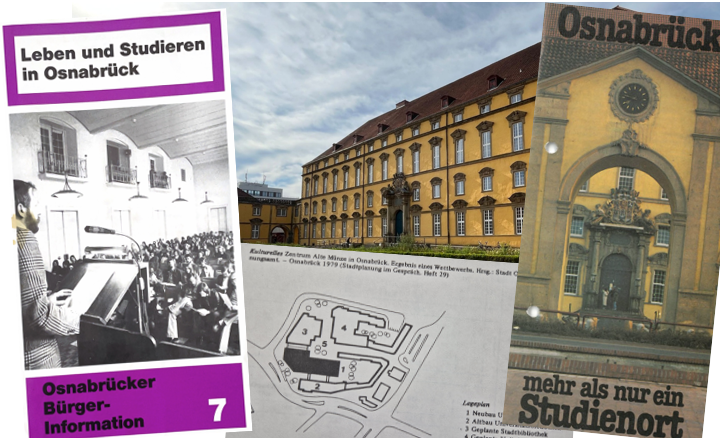
The University of Osnabrück – Foundation and Early Years
On 17 April 1974, the first official courses took place at the newly founded University of Osnabrück. But the history of our university reaches further back. A multitude of developments had to be set in motion and interwoven more than fifty years ago to create the place where we study, teach and conduct research today.
The exhibition is structured around six thematic focal points and examines selected social, spatial, didactic and organisational aspects of the university’s foundation. Central themes include the political conflicts that accompanied the founding process – such as the disputes surrounding the creation of the campus at Westerberg. Furthermore, the life and self-organisation of students is addressed, the development of central institutions such as the university library is traced, and the relationship between scholarship and emancipation in the university’s early phase is examined.
The chosen thematic areas reflect the interests of the participating students: decisions and course-setting made fifty years ago continue to shape university life today. Making the founding and early years visible can help to contextualise and better understand current structures.
The exhibition was developed in close collaboration with the University Archive Osnabrück and its director Dr. Thorsten Unger. The archive, located within the Lower Saxony State Archive, Osnabrück Division, preserves the central sources on the history of the university and its predecessor institutions and has provided students with both access to the collections and professional archival consultation.
Lohstraße – Urban History Reflected in a Street
The second project focuses on a single Osnabrück street: Lohstraße. From a microhistorical perspective, it asks what can be learned about a seemingly randomly chosen location and the people who lived there when different source collections are systematically interconnected. The sources consulted include the Osnabrück casualty index, the Gestapo index, the foreign residents’ registration index, and the survey forms from the first census in West Germany after the Second World War.
Each of these sources depicts Lohstraße and its residents in specific ways – thereby creating particular visibilities and invisibilities. The Gestapo index recorded different people and characteristics than the foreign residents’ registration index; the census forms, in turn, followed an entirely different administrative logic. It is precisely in the comparative analysis of these different records that the mechanisms become visible through which administrative practice not only documented categories such as ‘foreigner’, ‘casualty’ or ‘suspect’, but actively produced them.
The exhibition thus makes urban history accessible in a way that goes beyond depicting changes in the cityscape: it places people’s lived experiences at the centre and shows that migration, mobility and population administration were not exceptional phenomena, but long-term components of Osnabrück urban society.
The exhibition was developed in close cooperation with the Lower Saxony State Archive. The source collections consulted are preserved in the Osnabrück and Hannover divisions, whose staff provided students with both access to the archival materials and professional consultation in source work.
Digital Exhibitions as a Format for Knowledge Transfer
Both projects demonstrate what can emerge when students work with source collections and present their results in digital formats. The connection between teaching context and public presentation creates a space in which analysis is not only developed but also communicated. At the same time, both exhibitions make visible that the sources on which our knowledge of the past is based are themselves products of those very practices that we examine in our studies.