Announcement: Tiny Desk Colloquium on 2 July 2026: Current Research in the History of Migration

This post was automatically translated from the German original at
Ankündigung: Tiny Desk Kolloquium am 2. Juli 2026: Aktuelle migrationsgeschichtliche Forschung.
On 2 July 2026, the sixth edition of the NGHM Tiny Desk Colloquium will take place. Once again, young historians from the University of Osnabrück will have the opportunity to present outstanding theses, and our guests will have the chance to present and discuss their research on the topic of migration history.
With the TDK, the Professorship for Contemporary History and Historical Migration Research has chosen a format of short presentations and brief discussion rounds, through which six topics are introduced and brought into dialogue with one another and with the audience once per semester within a manageable timeframe.
On 2 July, the TDK, under the direction of Dr. Sebastian Musch, will offer insights into current research on Displaced Persons in post-war Germany and institutions of migration policy in the 1980s and 1990s. The programme will be complemented by two student contributions. The first contribution — based on a thesis — addresses National Socialist trials against judicial personnel. In the second contribution, students from the project seminar “Forced Migration, Refugee Policy and Society in Lower Saxony after the Second World War” will report on their work and the recently published exhibition on the care home for DPs in Varel.
All interested parties — and especially students in Osnabrück — are warmly invited! Registration is not required.
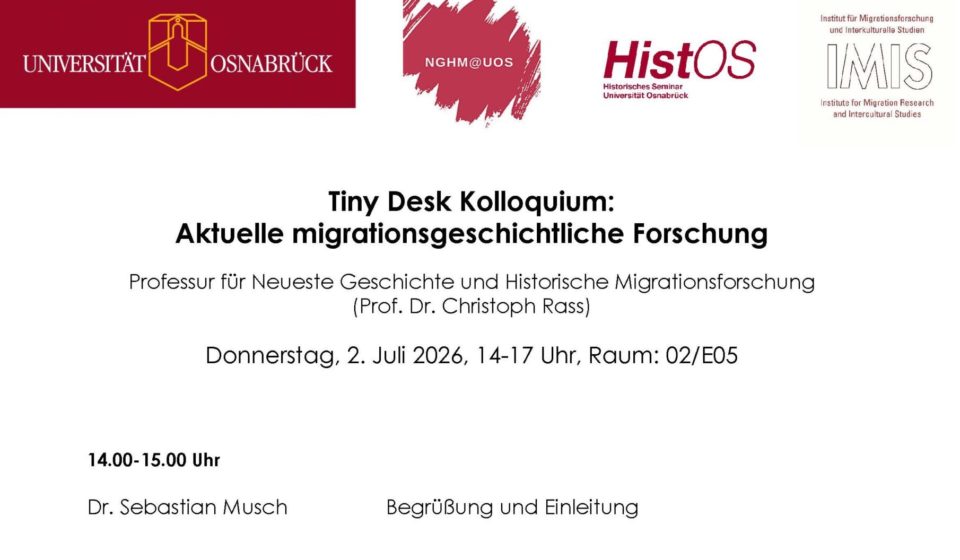
6th Tiny Desk Colloquium: Current Research in Migration History
Thursday, 2 July 2026
2:00 p.m. to 5:00 p.m.
Room 02/E05
The first edition of the TDK in 2023 was dedicated to cooperation with the Museum and Park Kalkriese. On that occasion, news from conflict landscape research and the collaboration between the university and the site of the Battle of the Teutoburg Forest were presented.
The second TDK event facilitated an exchange on perspectives in the context of the use of Virtual Reality and 3D models in research and teaching.
The third TDK provided a forum for young historians who presented their theses on the regional history of Osnabrück, and offered insights into third-party funded projects in which doctoral candidates at the Professorship for Contemporary History and Historical Migration Research at the University of Osnabrück are pursuing their qualifications.
The fourth edition offered insights into the field of Digital Humanities: alongside presentations of work on the system of National Socialist “euthanasia” and “Internally Displaced Persons” produced as part of theses at the Historical Seminar, contributions on AI in research and teaching as well as the technical possibilities in the field of Digital Humanities were delivered by speakers from VirtUOS and the University Library.
In the fifth edition of the TDK, entitled “The Holocaust and Its Consequences — Regional and International Perspectives”, young historians from the Historical Seminar presented outstanding theses and WebApp projects before guests and NGHM staff members shared insights into their research.
*** Programme ***
6th Tiny Desk Colloquium of the Professorship for Contemporary History and Historical Migration Research, 2 July 2026, 2–5 p.m., Room 02/E05
Welcome and Introduction: Dr. Sebastian Musch
Lennart Blömer
The Construction of Credibility in Early National Socialist Trials against Judicial Personnel
Students of the Project Seminar
Closed Case? The Care Home for Displaced Persons in Varel, 1950 to 1959 — A Student Report
Dr. Maria Rhode
Studying under Special Circumstances. DPs at the University of Göttingen, 1946–1950
Dr. David Templin
Multiculturalism and the City. The Frankfurt “Amt für multikulturelle Angelegenheiten” [“Office for Multicultural Affairs”] and Its Municipal Networks in the Late 1980s and Early 1990s
Dr. Sebastian Huhn
“The archives must be considered dangerous”. On the Contested Founding Narrative of the Modern International Refugee Regime