Announcement: Tiny Desk Colloquium on 29 January 2026: The Holocaust and its Consequences – Regional and International Perspectives

This post was automatically translated from the German original at
Ankündigung: Tiny Desk Kolloquium am 29. Januar 2026: Der Holocaust und seine Folgen – regionale und internationale Perspektiven.
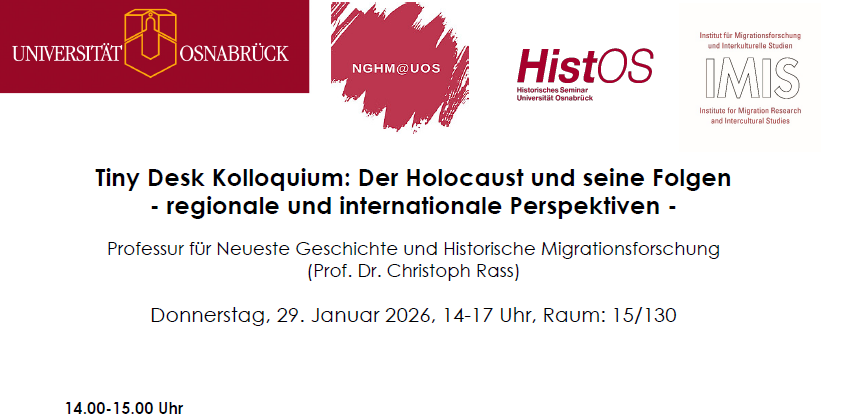
On January 29, 2026, the fifth edition of the NGHM Tiny Desk Colloquium will take place. Once again, young historians from the University of Osnabrück will have the opportunity to present outstanding thesis projects, and our guests will have the chance to present and discuss their research on the topic “The Holocaust and its Consequences – Regional and International Perspectives”.
With the TDK, the Chair of Modern History and Historical Migration Research has chosen a format of short presentations and brief discussion rounds, with which six topics are presented once each semester in a manageable timeframe and brought into dialogue with each other and with the audience.
On January 29, the TDK under the direction of Prof. Dr. Christoph Rass offers insights into a thesis on the production of the “Second Generation” in German-language migration research as well as current research on the topic “The Holocaust and its Consequences” with regional and international perspectives. The programme is complemented by a presentation from students of the Digital History Workshop on the development of web apps for historians.
All interested parties – and especially Osnabrück students – are cordially invited! Registration is not required.
5th Tiny Desk Colloquium: The Holocaust and its Consequences – Regional and International Perspectives
Thursday, January 29, 2026
2:00 to 5:00 PM
Room 15/130
* * *
The first edition of the TDK was dedicated in 2023 to cooperation with the Museum and Park Kalkriese. This presented news from conflict landscape research and the collaboration between the university and the site of the Battle of the Teutoburg Forest.
The second TDK event enabled exchange on perspectives in the context of the use of Virtual Reality and 3D models in research and teaching.
The third TDK offered a forum for young historians who presented their thesis projects on Osnabrück regional history, and provided insights into third-party funded projects in which doctoral candidates at the Chair of Modern History and Historical Migration Research at the University of Osnabrück are qualifying.
The fourth edition offered insights into the field of Digital Humanities: In addition to insights into work on the Nazi “euthanasia” system and “Internally Displaced Persons”, which emerged from thesis projects at the Historical Seminar, contributions on AI in research and teaching as well as the technical possibilities in the field of Digital Humanities were presented by speakers from VirtUOS and the University Library.
*** Programme ***
5th Tiny Desk Colloquium of the Chair of Modern History and Historical Migration Research, January 29, 2026, 2-5 PM, Room 15/130
Welcome and Introduction: Prof. Dr. Christoph Rass
Julia Lohmann
The Formative Phase of the Production of a ‘Second Generation’ in German-Language Migration Research since the Mid-1970s
Students of the Digital History Workshop
From Historical Question to Web App. Vibe Coding in the Digital History Workshop
Martina Sellmeyer
The Osnabrück Jewish Community in the 20th Century until its Destruction in the Holocaust
Dr. Michael Gander
Tracing Jewish Life in Latvia – Historical Connections and Cooperations between Actors in Memorial Work in the Osnabrück Region, in Riga and in Vishki
Dr. Sebastian Musch
The Osnabrück Synagogue Reconstruction of 1969 between Reparations Discourse and Municipal Memory Politics