There and back again | Film Screening “Black Sugar – Red Blood” and Meeting with Anna Strishkowa

This post was automatically translated from the German original at
Exkursion Ibbenbüren (I) | Filmvorführung „Schwarzer Zucker – rotes Blut” und Begegnung mit Anna Strishkowa.
On 19 January 2026, students from the Chair of Contemporary History and Historical Migration Research participated in a film screening at the Bürgerhaus Ibbenbüren. The documentary film “Black Sugar – Red Blood” by Luigi Toscano about the life of Auschwitz survivor Anna Strishkowa was shown. The excursion formed the first part of a two-part event series, which will continue on 27 January with a witness conversation.
Context: Memory Culture and Historical Education
The excursion, led by Prof. Dr. Christoph Rass, took place as part of the event series “Against Forgetting”, which is supported by school chaplain Christoph Moormann and a local organising team. Over 1,500 pupils from the Tecklenburger Land saw the film that day in two screenings. The event demonstrates how extra-university formats of transmission convey historical knowledge about the Shoah to different target groups – and what role direct encounters with survivors play in this process.
Mayor Dr. Marc Schrameyer welcomed those present and emphasised the importance of conveying history through personal life stories. He appealed to the young people to resist the “idiotic chatter from the right-wing fringe”. Sylvia Löhrmann, North Rhine-Westphalia’s Commissioner for Antisemitism, referred to the increase in antisemitic incidents in all areas of society and stressed that behind the numbers stood human beings.
The Film: “Black Sugar – Red Blood”
The 90-minute documentary film by Luigi Toscano, a photographer and filmmaker from Mannheim, tells the story of Anna Strishkowa. On 4 December 1943, she stood as a small child on the ramp at Auschwitz – without her family, without knowing her parents’ names, without knowing where she was born. She survived the children’s camp Potulice and Auschwitz. In the post-war turmoil, a family took her in, but her identity remained unclear for decades.
It was only in the course of Toscano’s photo project with Holocaust survivors that he met the now 86-year-old Ukrainian and asked her permission to search for her family. With success: the film documents this process of identity reconstruction, which simultaneously raises the question of how knowledge about one’s own origins was systematically destroyed by the violence of National Socialism.
The film has already received multiple awards and was shown in Ibbenbüren for the first time in 2025. That Anna Strishkowa was once again personally present is thanks to the commitment of the local organising team.
The Encounter: Between Documentation and Transmission
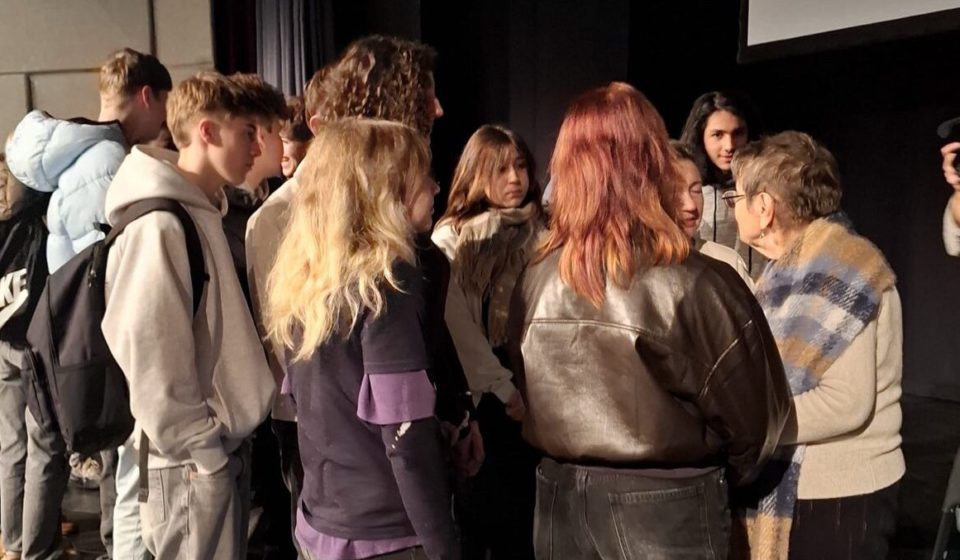
After the film screening, those present had the opportunity to ask Anna Strishkowa questions or speak with her personally. Many pupils took the opportunity to shake her hand, thank her, or embrace her. Sixteen-year-old Julia Hafner, who embraced Strishkowa on stage, described the encounter as having a “massive impact”: “I embraced her because I was so moved by seeing her.”
Anna Strishkowa addressed the young people with the words: “You will become second witnesses.” The term ‘second witnesses’ refers in memorial pedagogy to that generation which has no direct experience of the Shoah but carries forward the stories of survivors through encounters with them. This concept is gaining increasing significance in view of the advancing age of the last survivors for the question of how memory of the Shoah can be maintained even after the end of witness testimony.
The witness, who had to leave Kiev due to the war in Ukraine and now lives in northern Germany, described her motivation for continuing appearances despite her age: “When I retired, I asked myself what I could do now, for the future, for people.” Her concern is to pass on her story and tell the children “how terrible it was” so that they could understand that such things must never happen again.
Reflection: Topics for Engagement
The event in Ibbenbüren stands as an example of a transmission format that relies on the emotional impact of personal encounters. The film functions as a medium that transports biographical knowledge, while the subsequent encounter with the witness enables a different quality of engagement. The reactions of the pupils – embraces, tears, applause – point to an affective dimension of historical learning that differs from purely cognitive forms of transmission.
In their reflection texts, the Osnabrück students can engage with a series of questions that arise from the excursion:
On the transmission of history: What role does emotionalisation play in the transmission of historical knowledge? How do individual life stories relate to structural analysis of persecution and extermination? What opportunities and what limits does biographical focus have in the transmission of history?
On witness testimony: What does it mean to become a ‘second witness’ when the possibility of direct encounters with survivors will end in the foreseeable future? How does memory culture change when no witnesses are still alive? Which media forms – film, recording, virtual reality – can replace direct encounter, and which dimensions are lost in the process?
On the event format: How do school and university approaches to the history of the Shoah differ? What function does the presence of political representatives fulfil at such events? How can the tension between commemoration and historical analysis be productively addressed?
On one’s own position: What expectations do students of history bring to such an event? How does direct encounter with a survivor change one’s own understanding of history as a science? And what responsibility arises from this for one’s own work as a historian?
Outlook: Witness Conversation on 27 January 2026
The excursion will continue on 27 January 2026 – International Holocaust Remembrance Day – with a witness conversation at the Kulturhaus Ibbenbüren. Originally, a conversation with Dr. Boris Zabarko, historian and Holocaust survivor from Ukraine, was planned. Since he unfortunately could not travel from Kiev for health reasons, Anna Strishkowa will once again be the focus. Prof. Dr. Christoph Rass will speak the opening words.
The format of the witness conversation on the memorial day offers a different framework than the film screening: instead of media transmission through the documentary film, direct conversation takes centre stage. The students thus receive the opportunity to experience both transmission formats and compare them with each other.
The excursion is part of the teaching programme of the Chair of Contemporary History and Historical Migration Research at the University of Osnabrück in the winter semester 2025/26.